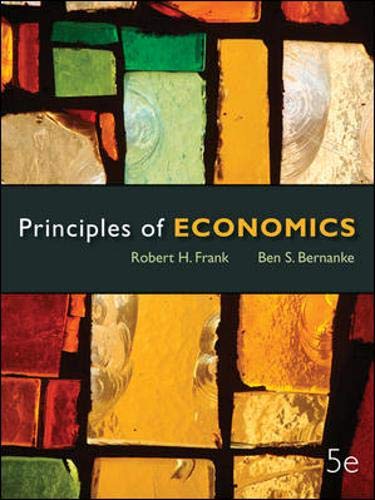

Principles of economics Robert H. Frank, Ben S. Bernanke, with the assistance of Roger T. Kaufman.
Detalles de publicación: Boston McGraw-Hill/Irwin c2012.Edición: 3rd edDescripción: 1 v. (various pagings) ill. 29 cmTipo de contenido:- 9780073511405 (alk. paper)
- 0073125679 (alk. paper)
- 330 F8281p3 23
- HB171.5 .F734 2012
| Imagen de cubierta | Tipo de ítem | Biblioteca actual | Biblioteca de origen | Colección | Ubicación en estantería | Signatura topográfica | Materiales especificados | Info Vol | URL | Copia número | Estado | Notas | Fecha de vencimiento | Código de barras | Reserva de ítems | Prioridad de la cola de reserva de ejemplar | Reservas para cursos | |
|---|---|---|---|---|---|---|---|---|---|---|---|---|---|---|---|---|---|---|
| Libro | Biblioteca Encarnación Valdés Colección General bev | 330 F8281p3 (Navegar estantería(Abre debajo)) | c. 2 | Disponible | 80000002631151 | |||||||||||||
| Libro | Biblioteca Encarnación Valdés Colección General bev | 330 F8281p3 (Navegar estantería(Abre debajo)) | Disponible | 80000002389602 |
Descripciones mejoradas de Syndetics:
In recent years, innovative texts in mathematics, science, foreign languages, and other fields have achieved dramatic pedagogical gains by abandoning the traditional encyclopedic approach in favor of teaching a shorter list of core principles in depth. Two well-respected writers and researchers, Bob Frank and Ben Bernanke, have shown that the less-is-more approach affords similar gains in introductory economics. The authors introduce a coherent short list of core principles and reinforce them by illustrating and applying each in numerous contexts. With engaging questions, explanations and exercises, the authors help students relate economic principles to a host of everyday experiences such as going to the ATM or purchasing airline tickets. Throughout this process, the authors encourage students to become "economic naturalists:" people who employ basic economic principles to understand and explain what they observe in the world around them.
Principles of Economics, fifth edition, is thoroughly updated with examples that connect to current events such as the financial crisis of 2008 and Great Recession of 2007-2009 as well as other topics commonly discussed in the media. In addition, the text is paired with McGraw-Hill's market-leading online assignment and assessment solution Connect Economics, providing tools to enhance course management and student learning.Connect is the only integrated learning system that empowers students by continuously adapting to deliver precisely what they need, when they need it, and how they need it, so that your class time is more engaging and effective.
Various multi-media instructional aids, including web sites, are available to supplement the text.
Includes index.
Tabla de contenidos provista por Syndetics
- Part 1 Introduction
- 1 Thinking Like an Economist
- 2 Comparative Advantage
- 3 Supply and Demand
- Part 2 Competition and the Invisible Hand
- 4 Elasticity
- 5 Demand
- 6 Perfectly Competitive Supply
- 7 Efficiency, Exchange, and the Invisible Hand in Action
- Part 3 Market Imperfections
- 8 Monopoly, Oligopoly, and Monopolistic Competition
- 9 Games and Strategic Behavior
- 10 Externalities and Property Rights
- 11 The Economics of Information
- Part 4 Economics of Public Policy
- 12 Labor Markets, Poverty, and Income Distribution
- 13 The Environment, Health, and Safety
- 14 Public Goods and Tax Policy
- Part 5 Macroeconomics: Data and Issues
- 15 Spending, Income, and GDP
- 16 Inflation and the Price Level
- 17 Wages and Unemployment
- Part 6 The Economy in the Long Run
- 18 Economic Growth
- 19 Saving, Capital Formation, and Financial Markets
- 20 Money, Prices, and the Financial System
- Part 7 The Economy in the Short Run
- 21 Short-Term Economic Fluctuations
- 22 Spending, Output, and Fiscal Policy
- 23 Monetary Policy and the Federal Reserve
- 24 Aggregate Demand, Aggregate Supply, and Business Cycles
- 25 Macroeconomic Policy
- Part 8 The International Economy
- 26 Exchange Rates, International Trade, and Capital Flows