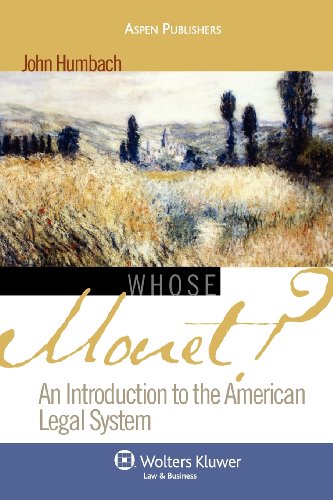

Whose Monet? an introduction to the American legal system John A. Humbach.
Detalles de publicación: Austin Wolters Kluwer Law & Business/Aspen Publishers c2007.Edición: 1st edDescripción: xvi, 232 p. ill., map 23 cm. teacher's manualISBN:- 9780735565579 (pbk.)
- 0735565570 (pbk.)
- 9780735571914 (teacher's manual)
- 0735571910 (teacher's manual)
- 347.73/5 22
- KF 8863 .H86 2007
| Imagen de cubierta | Tipo de ítem | Biblioteca actual | Biblioteca de origen | Colección | Ubicación en estantería | Signatura topográfica | Materiales especificados | Info Vol | URL | Copia número | Estado | Notas | Fecha de vencimiento | Código de barras | Reserva de ítems | Prioridad de la cola de reserva de ejemplar | Reservas para cursos | |
|---|---|---|---|---|---|---|---|---|---|---|---|---|---|---|---|---|---|---|
| Libro | Biblioteca de Derecho Mons. Fremiot Torres Oliver Colección General biblioteca derecho | KF 8863 .H86 2007 (Navegar estantería(Abre debajo)) | Disponible | 70000000881553 |
Descripciones mejoradas de Syndetics:
This extraordinary paperback provides a highly accessible and appealing orientation to the American legal system and presents basic concepts of civil litigation to first-year law students. Whose Monet? An Introduction to the American Legal System focuses on a lengthy dispute over the ownership of a painting as a vehicle for introducing students to the basic law school tasks of reading analytically, understanding legal materials, and working with the common law. The author and his colleagues have used these materials successfully in their classrooms for many years, ensuring their teachability and effectiveness: Whose Monet? can be used as primary course material in orientation courses or seminars, as well as collateral reading for in-semester Legal Process or Civil Procedure courses The organization is logical and straightforward and the accessible writing style--lucid, descriptive, and conversational--is ideal for incoming students The major events in a lawsuit are considered, and the text sheds light on how the law is applied in a civil dispute, introducing common law and statutory law and the various courts and their interrelationship (trial/appellate, state/federal) The author draws on judicial opinions, litigation papers, transcripts, and selections from commentators and various jurisprudential sources, thereby exposing the first-year student to as broad a spectrum of materials as possible Telling the story of a real lawsuit (DeWeerth v. Baldinger)--from client intake through trial and various appeals--draws students into the legal process by means of an engaging narrative and makes for a truly enjoying teaching experience for professors The lawyer's role is examined in both its functional and moral dimensions: What do lawyers do? What does society legitimately expect lawyers to do? This book is suitable for both classroom and stand-alone assigned reading Professor Humbach, with over 30 years of experience teaching and writing articles and instruction programs for first-year property students, includes a separate Teacher's Manual. Drawing upon his own classroom experience with these materials, he: suggests "learning objectives" for each chapter offers different teaching approaches provides answers to questions in the book suggests sample syllabi
Introduction -- The lawyer's task : facts and law -- Deciding whether to sue -- Deciding where to sue : the court system -- Commencing a civil action -- The complaint -- The common law -- The answer -- "Discovery" -- A motion for summary judgment -- Statutory law and administrative regulations -- The trial -- The judgment -- The appeal -- The aftermath.
Tabla de contenidos provista por Syndetics
- Chapter I Introduction(p. 1)
- Chapter II The Lawyer's Task: Facts and Law(p. 9)
- The Facts(p. 10)
- Facts of DeWeerth v. Baldinger as Summarized by the Trial Court(p. 17)
- The Law(p. 21)
- Chapter III Deciding Whether to Sue(p. 27)
- Chapter IV Deciding Where to Sue: The Court System(p. 31)
- Federal Court System(p. 33)
- A Note on "Civil" and "Criminal" Cases(p. 37)
- 1 District Courts(p. 39)
- 2 United States Courts of Appeals(p. 42)
- 3 Supreme Court of the United States(p. 44)
- 4 Other Federal Courts(p. 45)
- State Court Systems(p. 45)
- 1 Trial Courts(p. 47)
- 2 State Courts of Appeals(p. 48)
- 3 State Supreme Courts(p. 49)
- 4 Other State Courts(p. 50)
- The Best Court for Mrs. DeWeerth?(p. 51)
- Chapter V Commencing a Civil Action(p. 55)
- Chapter VI The Complaint(p. 63)
- The Content of Pleadings(p. 65)
- The Complaint's Legal Sufficiency-A Motion to Dismiss(p. 67)
- Decision on Motion to Dismiss(p. 74)
- DeWeerth v. Baldinger I(p. 74)
- A Note on "Briefing" Cases(p. 79)
- Chapter VII The Common Law(p. 83)
- The Emergence of American Common Law(p. 90)
- Kerwhacker v. Cleveland, Columbus & Cincinnati RR(p. 96)
- The Fluidity of the Common Law(p. 98)
- The Stability of the Common Law-Stare Decisis(p. 105)
- Hart v. Massanari(p. 116)
- Chapter VIII The Answer(p. 121)
- Chapter IX "Discovery"(p. 125)
- Chapter X A Motion for Summary Judgment(p. 131)
- O'Keeffe v. Snyder(p. 134)
- DeWeerth v. Baldinger II(p. 144)
- Chapter XI Statutory Law and Administrative Regulations(p. 153)
- What Statutes Are Supposed to Do(p. 155)
- How Statutes Get Enacted(p. 159)
- Administrative Regulations(p. 161)
- Interpreting Statutes(p. 164)
- Interpreting the Statute in DeWeerth(p. 168)
- Chapter XII The Trial(p. 171)
- Selecting the Jury (Voir Dire)(p. 174)
- Opening Statements(p. 176)
- Presenting the Testimony and Other Evidence(p. 177)
- Motions for Judgment as a Matter of Law or Judgment of Acquittal(p. 180)
- Closing Arguments(p. 181)
- Charge to the Jury(p. 182)
- Chapter XIII The Judgment (and a Motion for a "Judgment N.O.V.")(p. 185)
- Chapter XIV The Appeal(p. 189)
- DeWeerth v. Baldinger III(p. 193)
- Chapter XV The Aftermath(p. 207)
- Solomon R. Guggenheim Foundation v. Lubell(p. 208)
- DeWeerth v. Baldinger IV(p. 212)
- DeWeerth v. Baldinger V(p. 214)
- Postscript(p. 219)
- Appendix A Extracts from Testimony of Gerda Dorothea DeWeerth(p. 223)