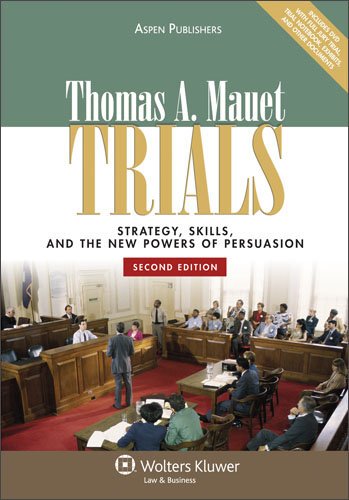

Trials strategy, skills, and the new power of persuasion Thomas A. Mauet.
Detalles de publicación: Austin Wolters Kluwer Law & Business New York, NY Aspen Publishers c2009.Edición: 2nd edDescripción: xxvii, 620 p. ill. 26 cm. 1 DVD-ROM (4 3/4 in.)ISBN:- 9780735577213 (pbk.)
- 0735577218 (pbk.)
- 9780735577220 (pbk. ; teacher's manual)
- 0735577226 (pbk. ; teacher's manual)
- 347.73/75 22
- KF 8915 .M384 2009
| Imagen de cubierta | Tipo de ítem | Biblioteca actual | Biblioteca de origen | Colección | Ubicación en estantería | Signatura topográfica | Materiales especificados | Info Vol | URL | Copia número | Estado | Notas | Fecha de vencimiento | Código de barras | Reserva de ítems | Prioridad de la cola de reserva de ejemplar | Reservas para cursos | |
|---|---|---|---|---|---|---|---|---|---|---|---|---|---|---|---|---|---|---|
| Libro | Biblioteca de Derecho Mons. Fremiot Torres Oliver Colección General biblioteca derecho | KF 8915 .M384 2009 (Navegar estantería(Abre debajo)) | Disponible | 70000000881543 |
Descripciones mejoradas de Syndetics:
Companion Website: www.aspenlawschool.com/books/mauettrials In Trials, Second Edition, national trial authority Thomas Mauet has organized and clarified contemporary trial theory and practice, emphasizing the jurors' perspective, the increased necessity of an effective opening statement, and the importance now given to visual presentation at trial. With new material on the formalities of the courtroom setting--how lawyers conduct themselves before the judge and jury--the Second Edition of Trials features: the latest research about jurors--how they process and evaluate people, information, and arguments, and how they reach collective decisions crafting and presenting an effective opening statement, with a consistent emphasis on the opening statement's strategic importance annotated examples of highly effective opening statements from both the plaintiff's and defendant's attorneys creating a visual strategy and using electronic media in opening statements, closing arguments, and expert testimony a step-by-step methodology for effective trial strategy and preparation analyze the case develop a theory, story line, and theme create an emotionally compelling presentation use a trial preparation checklist and notebook to get organized instruction and examples for jury selection, closing arguments, and bench trials (as well as other hearings) logical sequence of topics that traces the stages of a jury trial consistent internal chapter structure and pedagogy The Law lays out the legal framework for each chapter The Jury's Perspective provides sociological or psychological context substantive exposition/instruction Common Problems describe pitfalls to avoid at each stage of the trial complimentary new DVD with a jury trial of Gable v. Cannon that demonstrates trial courtroom procedures, a trial notebook, exhibits, witness examinations, opening statements and closing arguments for civil commercial cases the Teacher's Manual offers Thomas Mauet's advice for organizing and teaching a jury trial advocacy program, including a two-week session and a three-day program Timely and practical, Thomas Mauet explains and illustrates the strategy, analysis, and planning of trial litigation with the voice of both courtroom and classroom experience.
Accompanied by: Teacher's manual (v, 100 p. ; 28 cm.), c2009.
Includes bibliographical references (p. 12-13) and index.
Persuasion -- Strategy, preparation, and organization -- Jury selection -- Opening statements -- Direct examinations -- Cross-examinations -- Exhibits and visual aids -- Experts -- Closing arguments -- Evidentiary objections -- Bench trials and other contested hearings.
Tabla de contenidos provista por Syndetics
- Chapter 1 Persuasion
- Chapter 2 Strategy, Preparation, and Organization
- Chapter 3 Jury Selection
- Chapter 4 Opening Statements
- Chapter 5 Direct Examinations
- Chapter 6 Cross-Examinations
- Chapter 7 Exhibits and Visual Aids
- Chapter 8 Experts
- Chapter 9 Closing Arguments
- Chapter 10 Evidentiary Objections
- Chapter 11 Bench Trials and Other Contested Hearings
- Appendix: Federal Rules of Evidence