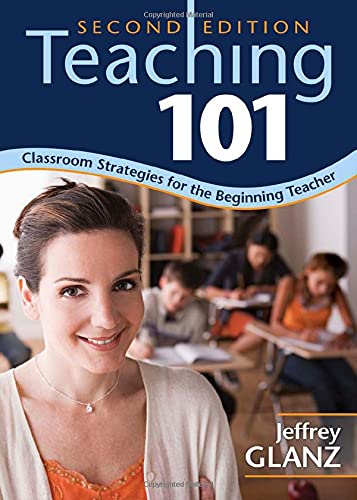

Teaching 101 classroom strategies for the beginning teacher Jeffrey Glanz.
Detalles de publicación: Thousand Oaks, Calif. Corwin Press c2009.Edición: 2nd edDescripción: xix, 301 p. ill. 26 cmISBN:- 9781412967143 (cloth)
- 9781412967150 (pbk.)
- 371.1 G546t2 22
- LB2844.1.N4 G53 2009
| Imagen de cubierta | Tipo de ítem | Biblioteca actual | Biblioteca de origen | Colección | Ubicación en estantería | Signatura topográfica | Materiales especificados | Info Vol | URL | Copia número | Estado | Notas | Fecha de vencimiento | Código de barras | Reserva de ítems | Prioridad de la cola de reserva de ejemplar | Reservas para cursos | |
|---|---|---|---|---|---|---|---|---|---|---|---|---|---|---|---|---|---|---|
| Libro | Biblioteca Encarnación Valdés Colección General bev | 371.1 G546t2 (Navegar estantería(Abre debajo)) | Disponible | 80000002387895 |
Descripciones mejoradas de Syndetics:
"One of the richest books I have ever read for beginning teachers. Even veteran teachers will get a lot out of it. I really wish I had a book like this when I was a student teacher." --Julie Wakefield, Social Studies TeacherRobert McQueen High School, Sparks, NV
Reflect on the art of teaching to develop your skills and expand your horizons!
The noble profession of teaching plays a vital role in inspiring students to achieve excellence. This new edition of one of the most comprehensive introductions to teaching available provides essential knowledge and actively engages new teachers in practice to become an exceptional teacher.
Easy to understand and practical, this wide-ranging guide provides tools such as questions and activities at the end of each chapter, Web sites and vital readings for further study, and a self-assessment instrument to help readers succeed in their first year. The second edition includes more information on curriculum development and technology, more sample lesson plans, a new section on bullying, new activity sheets, and many checklists with immediate application procedures. The book is packed with helpful suggestions on topics such as:
Lesson planning Classroom management Differentiating instruction Standards Assessment and grading Literacy Cooperative learning Inclusion National Board certificationTeaching 101 is an invaluable resource that teachers can reference throughout their careers to expand their skills and perspectives.
Includes bibliographical references and index.
Tabla de contenidos provista por Syndetics
- Preface to the Second Edition
- Acknowledgments
- About the Author
- Activity 1
- 1 Why Does Teaching Matter?
- Focus Questions
- Follow-Up Questions/Activities
- Activity 2
- 2 What Makes a Good Teacher?
- Focus Questions
- Teaching Idea #1 Are You a Good Teacher?
- Teaching Idea #2 Seven Research-Based Findings About the Qualities of an Effective Teacher
- Teaching Idea #3 What Makes an Effective Teacher?
- Teaching Idea #4 Three Approaches to Teaching
- Teaching Idea #5 Four of the Most Essential Concepts That Affect Student Achievement
- Teaching Idea #6 An Important Quality of a Good Teacher
- Teaching Idea #7 Another Important Quality of a Good Teacher
- Teaching Idea #8 A Final Quality of a Good Teacher
- Teaching Idea #9 A Good Teacher Must Use Wait Time Effectively
- Teaching Idea #10 Questioning Strategies
- Teaching Idea #11 Good Teachers Incorporate Literacy Strategies Whenever Feasible, Five Literacy Strategies That Work
- Teaching Idea #12 Good Teachers Encourage "Hands-On" and "Minds-On" Learning
- Teaching Idea #13 Good Teachers Employ K-W-L
- Teaching Idea #14 Good Teachers Get Parents on Their Side: 10 Ways
- Conclusion
- Follow-Up Questions/Activities
- Activity 3
- 3 Who Are the Students in My Class?
- Focus Questions
- Student Idea #1 What Do I Need to Know About My Students?
- Student Idea #2 All Students Have Five Basic Needs
- Student Idea #3 Children Need Attention and Much More . . .
- Student Idea #4 Role of Race, Gender, Sexual Orientation, and Social Class
- Student Idea #5 Hatred, Bigotry, and Prejudice
- Student Idea #6 Bullying
- Student Idea #7 Students With Learning Disabilities
- Student Idea #8 Are You a Culturally Relevant Teacher?
- Student Idea #9 Different Ways of Learning
- Student Idea #10 Differentiating Instruction, But How Can I Meet the Needs of All My Students?
- Student Idea #11 The Challenge of Inclusion
- Conclusion
- Follow-Up Questions/Activities
- Activity 4
- 4 How Should I Write Lesson Plans?
- Focus Questions
- Lesson Plan Idea #1 Understanding the Lesson Plan
- Lesson Plan Idea #2 Essential Components and Criteria of a Successful Lesson
- Lesson Plan Idea #3 Sample Lesson Plans
- Conclusion
- Follow-Up Questions/Activities
- Activity 5
- 5 Can I Effectively Manage My Classroom?
- Focus Questions
- Classroom Management Idea #1 Basic Terms and Elements
- Classroom Management Idea #2 Developing Your Personal System of Discipline
- Classroom Management Idea #3 A Sample Discipline Plan
- Follow-Up Questions/Activities
- Activity 6
- 6 How Can I Help My Students Learn?
- Focus Questions
- Helping My Students Idea #1 Simple Strategies for the Early Grades
- Helping My Students Idea #2 Simple Strategies on How to Improve Learning
- Helping My Students Idea #3 Simple Strategies on How to Improve Study Skills
- Helping My Students Idea #4 Simple Strategies on How to Read Material From a Chapter or Book
- Helping My Students Idea #5 Cooperative Learning
- Conclusion
- Follow-Up Questions/Activities
- Activity 7
- 7 How Should I Assess and Grade My Students?
- Focus Questions
- Assessment Idea #1 Assessment Basics
- Assessment Idea #2 Some Fundamental Principles of Assessment
- Assessment Idea #3 Constructing Classroom Tests
- Assessment Idea #4 Using Portfolio Assessment?
- Conclusion
- Follow-Up Questions/Activities
- Activity 8
- 8 How Can I Best Incorporate State and District Curriculum Standards?
- Focus Questions
- Standards Idea #1 What Is Curriculum Development?
- Standards Idea #2 Testing and Standards Movement
- Standards Idea #3 Suggestions for Implementing Standards
- Conclusion
- Follow-Up Questions/Activities
- Activity 9
- 9 How Can I Begin to Incorporate Technology Into My Teaching?
- Focus Questions
- Teachnology Idea #1 K-12 Technology Standards
- Teachnology Idea #2 Profiles for Technology-Literate Students
- Teachnology Idea #3 The Internet as a Teaching Tool
- Teachnology Idea #4 Criteria for Evaluating World Wide Web Sites
- Teachnology Idea #5 Criteria for Evaluating Software Programs
- Teachnology Idea #6 Use of PowerPoint in the Classroom
- Abstract and Rationale
- My Year of the Rooster
- Conclusion
- Follow-Up Questions/Activities
- Closing Comments
- Appendix A Annotated Bibliography
- Appendix B Some of the Best Web Sites for Teachers
- Appendix C Self-Assessment Instrument
- Appendix D Teacher's Suggestions Exchange Forum
- References
- Index
Notas de autor provistas por Syndetics
Jeffrey Glanzcurrently serves as a Senior Fellow at the Institute for University-School Partnership, Director of the Masters Program and the Raine and Stanley Silverstein Chair in Professional Ethics and Values at the Azrieli Graduate School of Jewish Education and Administration at Yeshiva University. Prior to coming to YU, Dr. Glanz served as Dean of Graduate Programs and Chair of the Department of Education at Wagner College in Staten Island, New York. He also coordinated the educational leadership program that led to New York State certification as a principal and assistant principal. Prior to arriving at Wagner, he served as executive assistant to the president of Kean University in Union, New Jersey. Dr. Glanz held faculty status as a tenured professor in the Department of Instruction and Educational Leadership at Kean University's College of Education. He was named Graduate Teacher of the Year in 1999 by the Student Graduate Association and was also that year's recipient of the Presidential Award for Outstanding Scholarship. He served as a teacher and assistant principal in the New York City public schools. He has conducted numerous workshops and seminars internationally. Dr. Glanz has authored, coauthored, and co-edited 20 books and has many peer-reviewed article publications.