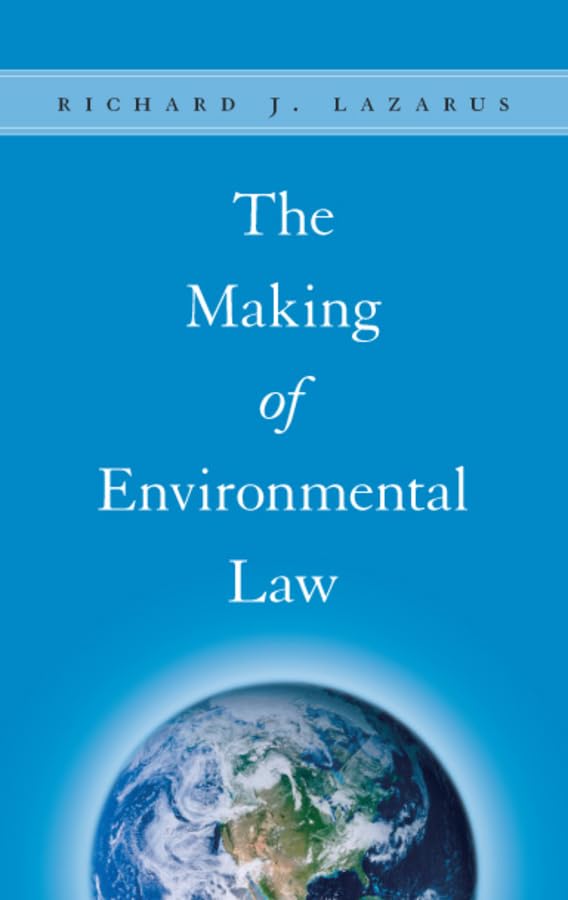

The making of environmental law Richard J. Lazarus.
Detalles de publicación: Chicago University of Chicago Press 2004.Descripción: xvi, 318 p. 24 cmISBN:- 0226470377 (cloth : alk. paper)
- 9780226470375 (cloth : alk. paper)
- 344.7304/6 22
- KF 3775 .L398 2004
| Imagen de cubierta | Tipo de ítem | Biblioteca actual | Biblioteca de origen | Colección | Ubicación en estantería | Signatura topográfica | Materiales especificados | Info Vol | URL | Copia número | Estado | Notas | Fecha de vencimiento | Código de barras | Reserva de ítems | Prioridad de la cola de reserva de ejemplar | Reservas para cursos | |
|---|---|---|---|---|---|---|---|---|---|---|---|---|---|---|---|---|---|---|
| Libro | Biblioteca de Derecho Mons. Fremiot Torres Oliver Colección General biblioteca derecho | KF 3775 .L398 2004 (Navegar estantería(Abre debajo)) | Disponible | 70000000882332 |
Descripciones mejoradas de Syndetics:
The unprecedented expansion in environmental regulation over the past thirty years--at all levels of government--signifies a transformation of our nation's laws that is both palpable and encouraging. Environmental laws now affect almost everything we do, from the cars we drive and the places we live to the air we breathe and the water we drink. But while enormous strides have been made since the 1970s, gaps in the coverage, implementation, and enforcement of the existing laws still leave much work to be done.
In The Making of Environmental Law , Richard J. Lazarus offers a new interpretation of the past three decades of this area of the law, examining the legal, political, cultural, and scientific factors that have shaped--and sometimes hindered--the creation of pollution controls and natural resource management laws. He argues that in the future, environmental law must forge a more nuanced understanding of the uncertainties and trade-offs, as well as the better-organized political opposition that currently dominates the federal government. Lazarus is especially well equipped to tell this story, given his active involvement in many of the most significant moments in the history of environmental law as a litigator for the Justice Department's Environment and Natural Resources Division, an assistant to the Solicitor General, and a member of advisory boards of the U.S. Environmental Protection Agency, the World Wildlife Fund, and the Environmental Defense Fund.
Ranging widely in his analysis, Lazarus not only explains why modern environmental law emerged when it did and how it has evolved, but also points to the ambiguities in our current situation. As the field of environmental law "grays" with middle age, Lazarus's discussions of its history, the lessons learned from past legal reforms, and the challenges facing future lawmakers are both timely and invigorating.
Includes bibliographical references (p. 255-294) and index.
Time, space, and ecological injury -- The implications of ecological injury for environmental protection law -- The challenges for U.S. lawmaking institutions and processes of environmental protection law -- Becoming environmental law -- Building a road : the 1970s -- Expanding the road : the 1980s -- Maintaining the road : the 1990s -- The emerging architecture of U.S. environmental law -- Changing conceptions of time and space redux : environmental law's future challenges -- Environmental law's second (and quite different) "republican moment" -- Conclusion : the graying of the green.
Tabla de contenidos provista por Syndetics
- Introduction
- Part I Making Environmental Law
- 1 Time, Space, and Ecological Injury
- 2 The Implications of Ecological Injury for Environmental Protection Law
- 3 The Challenges for U.S. Lawmaking Institutions and Processes of Environmental Protection Law
- Part II The Road Taken
- 4 Becoming Environmental Law
- 5 Building a Road: The 1970s
- 6 Expanding the Road: The 1980s
- 7 Maintaining the Road: The 1990s
- Part III Environmental Law in the New Millennium
- 8 The Emerging Architecture of U.S. Environmental Law
- 9 Changing Conceptions of Time and Space Redux: Environmental Law's Future Challenges
- 10 Environmental Law's Second (and Quite Different) "Republican Moment"
- Conclusion: The Graying of the Green
- Notes
- Index