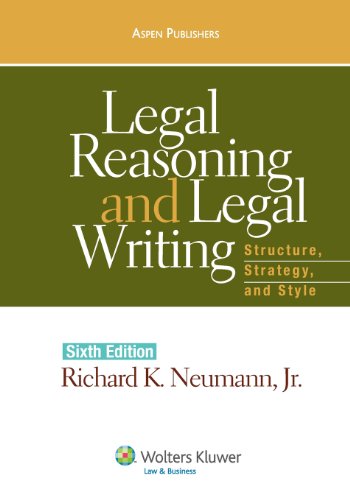

Legal reasoning and legal writing : structure, strategy, and style / Richard K. Neumann, Jr.
Detalles de publicación: Austin : Wolters Kluwer Law & Business, New York, NY : Aspen Publishers, 2009.Edición: 6th edDescripción: xxx, 520 p. : forms ; 26 cmTipo de contenido:- 9780735576667 (pbk.)
- 0735576661 (pbk.)
- 808/.06634 22
- KF 250 .N48 2009
| Imagen de cubierta | Tipo de ítem | Biblioteca actual | Biblioteca de origen | Colección | Ubicación en estantería | Signatura topográfica | Materiales especificados | Info Vol | URL | Copia número | Estado | Notas | Fecha de vencimiento | Código de barras | Reserva de ítems | Prioridad de la cola de reserva de ejemplar | Reservas para cursos | |
|---|---|---|---|---|---|---|---|---|---|---|---|---|---|---|---|---|---|---|
| Libro | Biblioteca de Derecho Mons. Fremiot Torres Oliver Colección General biblioteca derecho | KF 250 .N48 2009 (Navegar estantería(Abre debajo)) | c. 3 | Disponible | 70000000903092 | |||||||||||||
| Reserva | Biblioteca de Derecho Mons. Fremiot Torres Oliver Colección General biblioteca derecho | KF 250 .N48 2009 (Navegar estantería(Abre debajo)) | c. 2 | Disponible | 70000000882352 | |||||||||||||
| Reserva | Biblioteca de Derecho Mons. Fremiot Torres Oliver Colección General biblioteca derecho | KF 250 .N48 2009 (Navegar estantería(Abre debajo)) | c. 1 | Disponible | 70000000882351 |
Descripciones mejoradas de Syndetics:
The Sixth Edition of this respected and popular text remains grounded in the premise that legal reasoning and legal writing are best learned when they are taught together. Building on that foundation, Neumann continues to offer complete, clear, and timely coverage of how to form a legal argument and how to write an effective legal memorandum. Streamlined in its Sixth Edition, Legal Reasoning and Legal Writing features : comprehensive coverage of legal writing: the office memo the motion memo the appellate brief eminently readable text, including an exceptionally lucid explanation of the reasoning behind the proof of a conclusion of law a thoughtful treatment of all aspects of legal reasoning student-friendly instruction on the process of writing, The mechanics of style, and grammar up-to-date examples and exercises sample documents in the Appendices, including an office memo, motion memo, and two appellate briefs Highly regarded author Richard K. Neumann, Jr. presents, In tandem, smart, in-depth coverage of legal writing and legal reasoning, supported by examples, writing samples, and extraordinarily clear and lucid exposition.
Includes bibliographical references and index.
An introduction to American law -- Rule-based reasoning -- An introduction to judicial decisions and statutes -- Briefing cases -- The art of legal writing -- The process of writing -- Office memoranda -- Initially obtaining the facts: client interviewing -- Predictive writing -- A paradigm for organizing proof of a conclusion of law -- Varying the depth of rule proof and rule application -- Combining proofs of separate conclusions of law -- Working with the paradigm -- Selecting authority -- Working with precedent -- Working with statutes -- Working with facts -- Paragraphing -- Effective style -- Citations and quotations -- Client advice letters -- Demand letters -- How to write exam answers -- Developing a persuasive theory -- Developing persuasive arguments -- Handling the procedural posture -- Motion memoranda -- Point headings and sub-headings -- Statements of the case -- Questions presented -- Appellate practice -- Appellate briefs -- Writing the appellate brief -- Oral argument.
Tabla de contenidos provista por Syndetics
- Part I Introduction To Law and Its Study
- Chapter 1 An Introduction to American Law
- Chapter 2 Rule-Based Reasoning
- Chapter 3 An Introduction to Judicial Decisions and Statutes
- Chapter 4 Briefing Cases
- Part II Introduction to Legal Writing
- Chapter 5 The Art of Legal Writing
- Chapter 6 The Process of Writing
- Part III Office Memoranda
- Chapter 7 Office Memoranda
- Chapter 8 Initially Obtaining the Facts: Client Interviewing
- Chapter 9 Predictive Writing
- Part IV Organizing Proof of a Conclusion of Law
- Chapter 10 A Paradigm for Organizing Proof of a Conclusion of Law
- Chapter 11 Varying the Depth of Rule Proof and Rule Application
- Chapter 12 Combining Proofs of Separate Conclusions of Law
- Chapter 13 Working with the Paradigm
- Part V General Analytical Skills
- Chapter 14 Selecting Authority
- Chapter 15 Working with Precedent
- Chapter 16 Working with Statutes
- Chapter 17 Working with Facts
- Part VI General Writing Skills
- Chapter 18 Paragraphing
- Chapter 19 Effective Style
- Chapter 20 Citations and Quotations
- Part VII Letters and Exam Answers
- Chapter 21 Client Advice Letters
- Chapter 22 Demand Letters
- Chapter 23 How to Write Exam Answers
- Part VIII The Shift to Persuasion
- Chapter 24 Developing a Persuasive Theory
- Chapter 25 Developing Persuasive Arguments
- Chapter 26 Handling the Procedural Posture
- Chapter 27 Motion Memoranda
- Chapter 28 Point Headings and Sub-Headings
- Chapter 29 Statements of the Case
- Chapter 30 Questions Presented
- Part IX Appellate Briefs
- Chapter 31 Appellate Practice
- Chapter 32 Appellate Briefs
- Chapter 33 Writing the Appellate Brief
- Part X Into the Courtroom
- Chapter 34 Oral Argument
- Appendices
- Appendix A Basic Legal Usage
- Appendix B Nine Punctuation Issues
- Appendix C Sample Office Memorandum
- Appendix D Sample Client Advice Letter
- Appendix E Sample Demand Letter
- Appendix F Sample Motion Memorandum
- Appendix G Sample Appellant's Brief
- Appendix H Sample Appellee's Brief
- Index