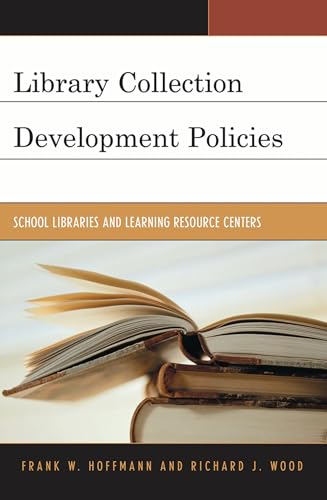

Library collection development policies school libraries and learning resource centers Frank W. Hoffmann, Richard J. Wood.
Series Good policy, good practice ; no. 2Detalles de publicación: Lanham, Md. Scarecrow Press 2007.Descripción: xvii, 205 p. 23 cmISBN:- 9780810851818 (pbk. : alk. paper)
- 0810851814 (pbk. : alk. paper)
- 025.21 H7113L 22
- Z687.2.U6 H65 2007
| Imagen de cubierta | Tipo de ítem | Biblioteca actual | Biblioteca de origen | Colección | Ubicación en estantería | Signatura topográfica | Materiales especificados | Info Vol | URL | Copia número | Estado | Notas | Fecha de vencimiento | Código de barras | Reserva de ítems | Prioridad de la cola de reserva de ejemplar | Reservas para cursos | |
|---|---|---|---|---|---|---|---|---|---|---|---|---|---|---|---|---|---|---|
| Libro | Biblioteca Encarnación Valdés Colección General bev | 025.21 H7113L (Navegar estantería(Abre debajo)) | Disponible | 80000002383910 |
Descripciones mejoradas de Syndetics:
Library Collection Development Policies: School Libraries and Learning Resource Centers represents an ongoing effort to fill the void in the library literature relating to collection development policies. The authors' experience spans four decades as library educators and practitioners. They created this book, as well as the earlier volume devoted to academic, public, and special libraries, to assist both library school students and professionals in the field regarding the compilation, revision, and implementation of policies.
Many libraries carry out the vital function of collection development without any form of documented plan. This work provides such a plan and is divided into three major sections. Part one focuses on standardized elements most likely to be found in selection policies, thereby serving as a blueprint for building library holdings; part two explores the ethical and legal issues ensuing from the use of digital resources; and part three addresses digital information within the context of traditional library operations. Concluding the book are two appendixes, one identifies the school libraries that provided material serving either as examples or illustrating the function of various policy statements, and the other provides a selection of materials from the American Library Association dealing with intellectual freedom.
Includes bibliographical references and index.
Collection development policy introduction -- Mission, goals, and objectives statements -- Responsibility for collection development -- Evaluative criteria -- Format/types of materials statement -- Treatment of specific resource groups -- Special collections -- Resource sharing -- Selection aids -- Acquisitions -- Gifts -- Budgeting/funding -- Intellectual freedom -- Copyright -- Collection maintenance -- Weeding -- Collection evaluation -- Services/special features -- Appendixes in policies -- Bibliography -- Acceptable use policies -- Virtual collection development -- Policy components for virtual resources -- Appendix A: Institutions contributing policy excerpts -- Appendix B: Intellectual freedom statements and forms -- Index -- About the authors.
Reseñas proporcionadas por Syndetics
School Library Journal Review
This book takes library media specialists step-by-step through revising or writing their own collection-development policies. This second edition includes updates in services, such as technology and the Internet, and provides helpful ideas and philosophies. The focus is on Library 2.0 technology while still incorporating the more traditional means of collection development. Beginning with a mission statement, the book proceeds to digital information, copyright issues, weeding, and acceptable-use policies. Examples of best policies for public, private, and academic school libraries are included in each section, as are references to Information Power, G. Edward Evans and Margaret Zarnosky Saponaro's Developing Library and Information Center Collections (Libraries Unlimited, 2005), and Elizabeth Futas's Collection Development Policies and Procedures (Onyx, 1994). What this book adds to those resources are practical examples from school library systems and policy examples of the newer Library 2.0 technology-such as adding a collection development policy for each school's virtual collection. The appendixes provide links to valuable resources on intellectual freedom, acceptable-use policies, and a sample form for confronting a challenge.-Lori E. Donovan, Thomas Dale High School, Chester, VA (c) Copyright 2010. Library Journals LLC, a wholly owned subsidiary of Media Source, Inc. No redistribution permitted.Booklist Review
Updating parts of Library Collection Development Policies: A Reference and Writers' Handbook (1996), this volume focuses on collection development for school libraries and districts. The brief introduction explains the book's purpose and arrangement and gives examples of policies (large city, county district, specific elementary school, small district) and how these may differ by size, orientation, clientele, and whether the institution is public or private. Succeeding chapters deal with policies, selection criteria and responsibility, formats, acceptable use, resource sharing, selection aids, the acquisition process, gifts, budgets, intellectual freedom, copyright, collection maintenance, weeding, and virtual resources. Specific examples are provided, and the authors include ways to handle modern formats that older guides overlook. Two appendixes include links to institutional policies and texts of many ALA statements on access and challenges. A school or district would find many useful models here to avoid reinventing policy statements.--Gooden, Susan Copyright 2007 BooklistNotas de autor provistas por Syndetics
Frank W. Hoffmann is professor of library science at Sam Houston State University. He has worked in libraries in Indiana, Tennessee, and Pennsylvania and has written over thirty books relating to librarianship and popular music, including more than a dozen titles for Scarecrow Press.
Richard J. Wood is dean of university libraries at the University of South Alabama and was formerly the director of university libraries at the Citadel and Sam Houston State University.