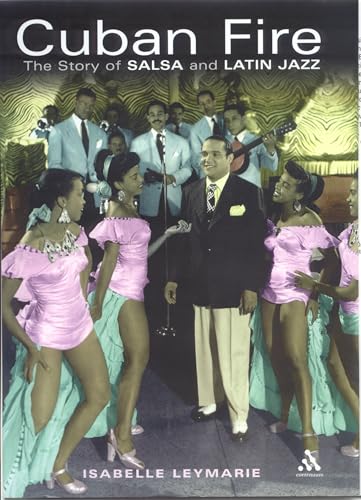

Cuban fire the story of salsa and Latin jazz Isabelle Leymarie.
Idioma: Inglés Lenguaje original: Francés Detalles de publicación: London New York Continuum 2002.Descripción: vi, 394 p. ill. 26 cmISBN:- 0826455867
- 781.64/097291 21
- ML3486.C8 L313 2002
| Imagen de cubierta | Tipo de ítem | Biblioteca actual | Biblioteca de origen | Colección | Ubicación en estantería | Signatura topográfica | Materiales especificados | Info Vol | URL | Copia número | Estado | Notas | Fecha de vencimiento | Código de barras | Reserva de ítems | Prioridad de la cola de reserva de ejemplar | Reservas para cursos | |
|---|---|---|---|---|---|---|---|---|---|---|---|---|---|---|---|---|---|---|
| Libro | Biblioteca Encarnación Valdés Sala de Música | 781.64 L684c (Navegar estantería(Abre debajo)) | Disponible | 80000002383605 |
Descripciones mejoradas de Syndetics:
This title tells the saga of popular music of Cuban origin, and its major artists from the 1920s to today. Afro-Cuban music derives its richness from the fusion of various cultures. On the island of tobacco, rum and coffee, the marriage of sacred and secular African musical genres with Spanish and French melodies has given rise to numerous genres which have gained international fame: son, rhumba, guaracha, conga, mambo, cha-cha-cha, pachanga, nueva timba. In the US, Cubans have settled alongside other Hispanic communities. In New York, the boogaloo, salsa and Latin jazz, created by musicians such as Machito, Dizzy Gillespie and Chano Pozo emerged from contact with Puerto Ricans and African-Americans, and the rhythms of Puerto Rico and Santo Domingo were integrated into salsa and Latin jazz.
Translation of: Cuban fire : musiques populaires d'expression cubaine.
Includes discography (p. 360-364), bibliographical references (p. 365-369), and index.
Tabla de contenidos provista por Syndetics
- Introduction(p. 1)
- Acknowledgments(p. 6)
- I The roots
- 1 From African liturgies to Creole rhythms(p. 9)
- Sacred music(p. 9)
- Traditional secular music(p. 18)
- The clave(p. 37)
- Rhythm instruments(p. 39)
- II The 1920s and 1930s: son, rumba, and conga
- 2 Havana and Cuba(p. 44)
- Emergence of the Havana son(p. 50)
- The rise of charangas, the bolero, and the guajira(p. 68)
- The beginnings of jazz(p. 78)
- 3 The United States and Puerto Rico(p. 83)
- The awakening of the Barrio(p. 85)
- Music in Puerto Rico(p. 98)
- III The 1940s and 1950s: the golden age of Cuban music
- 4 Havana and Cuba(p. 108)
- From nuevo ritmo to cha-cha: the great charangas(p. 111)
- Updating the son(p. 121)
- Big bands, combos, and descargas(p. 130)
- Singers in Cuba(p. 142)
- 5 The United States and Puerto Rico(p. 157)
- Que rico el mambo!(p. 158)
- The Afro-Cubans(p. 165)
- Tito Puente, Tito Rodriguez, and other Latin bands(p. 174)
- Singers in the U.S. and Puerto Rico(p. 186)
- Chano Pozo and his disciples(p. 189)
- Expansion of Latin jazz(p. 199)
- IV The 1960s: the pachanga, the boogaloo, and Latin soul
- 6 Havana and Cuba(p. 208)
- The explosion of rhythms(p. 210)
- 7 The United States and Puerto Rico(p. 216)
- The pachanga and the boogaloo era(p. 216)
- Emergence of charangas(p. 228)
- Revival of the bomba and the plena(p. 232)
- Latin jazz and Latin soul(p. 238)
- V From the 1970s until today: advent of the songo
- 8 Havana and Cuba(p. 244)
- Traditional music(p. 245)
- The songo and charangas(p. 247)
- The son(p. 250)
- The nueva timba(p. 253)
- The Buena Vista Social Club phenomenon(p. 256)
- Latin jazz(p. 258)
- Other bands(p. 265)
- Vocalists(p. 265)
- 9 The United States and Puerto Rico(p. 267)
- Instrumental salsa(p. 267)
- The salsa vocalists(p. 289)
- Salsa in Puerto Rico, California, and Florida(p. 297)
- The merengue(p. 306)
- New horizons for Latin jazz(p. 315)
- Latin rock and Latin disco(p. 326)
- 10 The rest of the world(p. 329)
- Influence of Cuban and Puerto Rican music abroad(p. 329)
- VI Conclusion(p. 341)
- Glossary(p. 343)
- Interviews(p. 348)
- Discography(p. 360)
- Bibliography(p. 365)
- Index(p. 370)