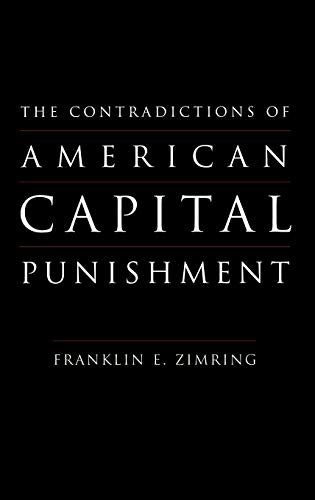

The contradictions of American capital punishment Franklin E. Zimring.
Series Studies in crime and public policyDetalles de publicación: New York Oxford University Press 2003.Descripción: ix, 258 p. ill. 24 cmISBN:- 0195152360 (cloth)
- 364.33/0973 21
- HV8699.U5 Z563 2003
| Imagen de cubierta | Tipo de ítem | Biblioteca actual | Biblioteca de origen | Colección | Ubicación en estantería | Signatura topográfica | Materiales especificados | Info Vol | URL | Copia número | Estado | Notas | Fecha de vencimiento | Código de barras | Reserva de ítems | Prioridad de la cola de reserva de ejemplar | Reservas para cursos | |
|---|---|---|---|---|---|---|---|---|---|---|---|---|---|---|---|---|---|---|
| Libro | Biblioteca Encarnación Valdés Colección General bev | 364.33 Z76c (Navegar estantería(Abre debajo)) | Disponible | 80000002377011 |
Descripciones mejoradas de Syndetics:
Why does the United States continue to employ the death penalty when fifty other developed democracies have abolished it? Why does capital punishment become more problematic each year? How can the death penalty conflict be resolved? In The Contradictions of American Capital Punishment, Frank Zimring reveals that the seemingly insoluble turmoil surrounding the death penalty reflects a deep and long-standing division in American values, a division that he predicts will soon bring about the end of capital punishment in our country. On the one hand, execution would seem to violate our nation's highest legal principles of fairness and due process. It sets us increasingly apart from our allies and indeed is regarded by European nations as a barbaric and particularly egregious form of American exceptionalism. On the other hand, the death penalty represents a deeply held American belief in violent social justice that sees the hangman as an agent of local control and safeguard of community values. Zimring uncovers the most troubling symptom of this attraction to vigilante justice in the lynch mob. He shows that the great majority of executions in recent decades have occurred in precisely those Southern states where lynchings were most common a hundred years ago. It is this legacy, Zimring suggests, that constitutes both the distinctive appeal of the death penalty in the United States and one of the most compelling reasons for abolishing it. Impeccably researched and engagingly written, Contradictions in American Capital Punishment casts a clear new light on America's long and troubled embrace of the death penalty.
Includes bibliographical references (p. [243]-249) and index.
Tabla de contenidos provista por Syndetics
- Preface(p. ix)
- Acknowledgments(p. xi)
- I. Divergent Trends(p. 1)
- 1. The Peculiar Present of American Capital Punishment(p. 3)
- 2. More Than a Trend: Abolition in the Developed Nations(p. 16)
- 3. The Symbolic Transformation of American Capital Punishment(p. 42)
- II. Explaining the American Difference(p. 65)
- 4. Federalism and Its Discontents(p. 67)
- 5. The Vigilante Tradition and Modern Executions(p. 89)
- 6. The Consequences of Contradictory Values(p. 119)
- III. Capital Punishment in the American Future(p. 141)
- 7. The No-Win 1990s(p. 143)
- 8. The Beginning of the End(p. 179)
- Appendix A Statistical Materials on Lynchings and Executions(p. 207)
- Appendix B Reported Frequencies of National Death Penalty Policy, 1980 to 2001(p. 213)
- Appendix C Death Row and Execution Statistics(p. 227)
- Appendix D New Survey Analysis Materials(p. 229)
- Appendix E Justified Killings by Citizens and Police, by State(p. 237)
- Appendix F Review of Death Penalty Exoneration Data from the Death Penalty Information Center(p. 241)
- References(p. 243)
- Index(p. 251)