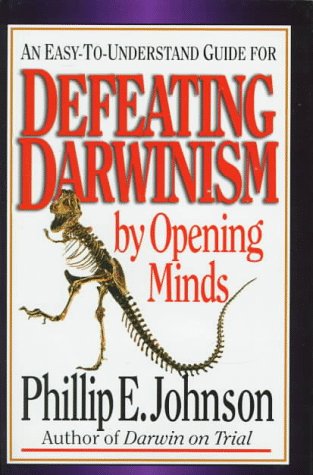
Imagen de portada de Amazon
Imagen de Amazon.com
Imagen de cubierta Syndetics
Portada de Syndetics
Imagen de OpenLibrary

Defeating Darwinism by opening minds Phillip E. Johnson.

Por: Detalles de publicación: Downers Grove, Ill. InterVarsity Press c1997.Descripción: 131 p. 22 cmISBN:
  • 0830813624 (alk. paper)
  • 0830813608 (pbk. : alk. paper)
Tema(s): Clasificación CDD:
  • 576.82 J661d 21
Clasificación LoC:
  • QH367.3 .J655 1997
Premios: Haga clic para abrir en una nueva ventana
Valoración
    Valoración media: 0.0 (0 votos)
Existencias
Imagen de cubierta Tipo de ítem Biblioteca actual Biblioteca de origen Colección Ubicación en estantería Signatura topográfica Materiales especificados Info Vol URL Copia número Estado Notas Fecha de vencimiento Código de barras Reserva de ítems Prioridad de la cola de reserva de ejemplar Reservas para cursos
Libro Biblioteca Encarnación Valdés Colección General bev 576.82 J661d (Navegar estantería(Abre debajo)) Disponible 80000002376559
Total de reservas: 0

Descripciones mejoradas de Syndetics:

-- A more accessible treatment of many issues covered in Darwin on Trial and Reason in the Balance.
-- Teaches good thinking habits to help readers sort out arguments in the creation-evolution debate.
-- Introduces basic issues in the evolution debate.
-- Nontechnical and easy to understand without oversimplifying the issues.
-- Advice for avoiding common mistakes and identifying deceptive arguments.

With All of the Complicated Scientific Debate swirling around the topic of evolution, is there an easy way to understand the basic issues without oversimplifying? Phillip Johnson says there is: the key to defeating the false claims of Darwinism is to open our minds to good thinking habits. Here is first-rate advice on avoiding common mistakes in discussions about evolution, understanding the legacy of the Scopes trial, spotting deceptive arguments, and grasping the basic scientific issues without getting bogged down in unnecessary details.

In the bestselling and critically acclaimed Darwin on Trial and Reason in the Balance, Phillip Johnson exposed the misleading claims of evolutionary naturalism. Defeating Darwinism provides a new and powerful treatment of these issues for high-school students, parents, teachers, pastors, youth advisors and ordinary readers. Johnson aims not just to defeat a bad theory, but to defeat it in the right way -- by opening minds to the truth.

Includes bibliographical references (p. [120]-131).

Tabla de contenidos provista por Syndetics

  • Introduction
  • 1 Emilio's Letter: Three Common Mistakes
  • 2 Inherit the Wind: The Play's the Thing
  • 3 Tuning Up Your Baloney Detector
  • 4 A Real Education in Evolution
  • 5 Intelligent Design
  • 6 The Wedge: A Strategy for Truth
  • 7 Modernism: The Established Religion of the West
  • 8 Stepping Off the Reservation
  • Notes

Reseñas proporcionadas por Syndetics

Publishers Weekly Review

By profaning the scientific establishment's most sacred cows, U.C.-Berkeley law professor Johnson has earned critical acclaim and brisk sales. Now, the witty iconoclast who questioned the scientific evidence for Darwinian evolution in his Darwin on Trial (1991) provides a short, simple manual to help students, parents, teachers and pastors debate evolution, "a subject," Johnson says, "that has for too long been protected from critical thinking by law and academic custom." Included in the book are tips for using what Carl Sagan once called a "baloney detector kit" to verify the evidence used by opponents in an argument, as well as tips for detecting ad hominem and straw man arguments. Johnson's greatest contribution, however, is that he helps non-scientists distinguish between scientific fact, like microevolution within species, and unproved scientific theories, like macroevolution, which claims that molecules became men. He is also adept at exposing philosophical bias behind ostensibly "objective" scientific arguments. With measured prose and systematic thinking, Johnson uses his legal expertise to demonstrate the ways in which arguments about evolutionary theory may be conducted. (Aug.) (c) Copyright PWxyz, LLC. All rights reserved

Booklist Review

Johnson feels his successful antievolution books, Darwin on Trial (1991) and Reason in the Balance (1995), are more complicated than parents and teachers need to prepare students to take on the evolutionists. Hence, this shorter version of his overall thesis that also advises how to debate evolution. Johnson first makes clear what he perceives the real adversary to be: a dogma that insists life arose solely by chance and that denies contrary evidence a hearing. He then counsels believers to avoid such common mistakes as retreating from theism to deism (and so transforming a continuously creative God into an uninvolved First Cause), to learn to spot faulty analogies and other forms of poor logic, to know the soundest scientific data casting doubt on classical evolution, and to persist--for, he says, the days of Darwinian hegemony are numbered. He firmly believes and seeks to persuade readers that his ultimate causes, aside from religious faith, are freedom of inquiry and the opening of now closed minds. --Ray Olson
Compartir
logopucpr-y-vive

Contáctanos

¡Queremos saber de ti!

Tel. 787.841.2000 Ext. 1801

bibliotecavaldes@pucpr.edu

⁣Búscanos en las redes

© 2026 Desarrollado por Ignite Online • All Rights Reserved • Powered by Koha.