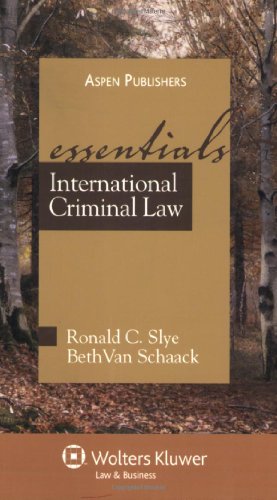

International criminal law essentials Ronald C. Slye, Beth Van Schaack .
Series Essentials (Aspen Publishers)Detalles de publicación: Austin Wolters Kluwer Law & Business New York, NY Aspen Publishers c2009.Descripción: xxi, 354 p. 22 cmISBN:- 9780735565531 (pbk. : alk. paper)
- 0735565538 (pbk. : alk. paper)
- 345 22
- KZ 6326 .S598 2009
| Imagen de cubierta | Tipo de ítem | Biblioteca actual | Biblioteca de origen | Colección | Ubicación en estantería | Signatura topográfica | Materiales especificados | Info Vol | URL | Copia número | Estado | Notas | Fecha de vencimiento | Código de barras | Reserva de ítems | Prioridad de la cola de reserva de ejemplar | Reservas para cursos | |
|---|---|---|---|---|---|---|---|---|---|---|---|---|---|---|---|---|---|---|
| Libro Reserva BD | Biblioteca de Derecho Mons. Fremiot Torres Oliver Colección General biblioteca derecho | KZ 6326 .S598 2009 (Navegar estantería(Abre debajo)) | Disponible | 70000000848346 |
Descripciones mejoradas de Syndetics:
Highly respected educator-scholars Elizabeth Van Schaack and Ronald C. Slye highlight and summarize the major concepts and themes of International Criminal Law with clear, informal language in this concise paperback text. Van Schaack and Slye provide a general overview of International Criminal Law that includes: a straightforward introductory chapter explanation and descriptions of the major international crimes, including: war crimes crimes against humanity genocide aggression terrorism coverage of individual rights and protections and the major defenses available to International Criminal Law defendants references to decisions from outside of the usual Western canon such as those from African, Asian, and Central and South American source discussion of the growing body of international jurisprudence being generated through international tribunals, hybrid tribunals, and other sources If you're thinking about teaching a course on International Criminal Law, you'll want to examine this timely, brief, and conceptually organized introductory text, written by two of the leading authorities in the field.
Includes bibliographical references (p. 323-336) and index.
A concise history of international criminal law -- Sovereignty, jurisdiction, and power -- The making of international criminal law -- The internationalization of crimes -- The principle of legality in international criminal law -- The legal regulation of armed conflict -- The crimes of terrorism -- Genocide and crimes against humanity -- Immunities, amnesties, and excuses -- Forms of individual responsibility -- International criminal law and its alternatives : truth, justice, reconciliation, and memory.
Tabla de contenidos provista por Syndetics
- Acknowledgments(p. xv)
- Preface(p. xvii)
- Part I The Discipline of International Criminal Law(p. 1)
- What Is International Criminal Law?(p. 2)
- Chapter 1 A Concise History of International Criminal Law(p. 7)
- Introduction: The Genesis Story(p. 7)
- Substantive Law Antecedents to Modern ICL(p. 8)
- Just War: Jus Ad Bellum(p. 8)
- Penal Antecedents: Piracy and Slavery(p. 9)
- International Humanitarian Law(p. 13)
- Efforts to Enforce International Criminal Law(p. 18)
- Pre-World War I: Antecedents(p. 18)
- World War I: A False Start(p. 20)
- The Interwar Period: Efforts to Avert Another World War(p. 26)
- World War II: A Return to First Principles(p. 27)
- Post-World War II: The Cold War Freeze(p. 38)
- Post-Cold War Period: A Renaissance(p. 42)
- Chapter 2 Sovereignty, Jurisdiction, and Power(p. 49)
- Creatures of Consent(p. 51)
- The International Criminal Court(p. 51)
- Preconditions for the Exercise of Jurisdiction(p. 52)
- Trigger Mechanisms(p. 56)
- Admissibility(p. 58)
- Consensual Hybrid Tribunals(p. 59)
- Creatures of Coercion(p. 64)
- Nuremberg and Tokyo(p. 65)
- The Ad Hoc International Tribunals(p. 65)
- Imposed Hybrid Tribunals(p. 69)
- Domestic Legal Systems(p. 71)
- Civilian Courts(p. 71)
- Domestic Military Courts(p. 77)
- Extradition, Transfer, Rendition, and Abduction(p. 79)
- Conclusion(p. 83)
- Chapter 3 The Making of International Criminal Law(p. 85)
- Treaties(p. 88)
- Customary International Law(p. 95)
- General Principles of Law(p. 99)
- Judicial Decisions(p. 102)
- The Works of Scholars(p. 103)
- "Soft Law"(p. 104)
- Conclusion(p. 105)
- Chapter 4 The Internationalization of Crimes(p. 107)
- The Jurisdictional Approach(p. 108)
- The Inter-National Approach(p. 109)
- The Identity Approach(p. 110)
- The Policy Approach(p. 113)
- The Nexus to Armed Conflict Approach(p. 114)
- The Global Stability Approach(p. 115)
- The Dignity Approach(p. 116)
- The Mens Rea Approach(p. 118)
- Conclusion(p. 119)
- Chapter 5 The Principle of Legality in International Criminal Law(p. 121)
- NCSL in International Criminal Law(p. 124)
- Responses to NCSL Defenses(p. 126)
- The Applicability of Nullum Crimen Sine Lege in International Criminal Law(p. 126)
- Acts as Malum in Se(p. 128)
- Illegality = Criminality(p. 130)
- Notice Anywhere Is Notice Everywhere(p. 133)
- The Object and Purpose of ICL(p. 137)
- Conclusion(p. 141)
- Part II Intersections(p. 145)
- Chapter 6 The Legal Regulation of Armed Conflict(p. 149)
- Jus Ad Bellum(p. 151)
- The Original Crime of Aggression(p. 151)
- The Modern Crime of Aggression(p. 155)
- Defining the Crime of Aggression(p. 156)
- Preconditions for the Exercise of Jurisdiction(p. 159)
- Including the Crime of Aggression in the ICC Statute(p. 163)
- Jus In Bello(p. 165)
- Triggering International Humanitarian Law(p. 166)
- Conflict Classification(p. 169)
- Choice of Law Implications of Conflict Classification(p. 173)
- Nexus to Armed Conflict(p. 175)
- Protected Persons(p. 177)
- Means and Methods of Warfare(p. 180)
- War Crimes Before the International Criminal Court(p. 182)
- Chapter 7 The Crimes of Terrorism(p. 185)
- Terrorism Under International Law(p. 186)
- Terrorism Within the ICC Statute(p. 191)
- The Interface Between Terrorism and War(p. 195)
- Violent Acts Committed Within International Armed Conflicts(p. 196)
- Violent Acts Committed Outside of Armed Conflict(p. 197)
- The Initiation of an International Armed Conflict(p. 198)
- Violent Acts Committed Within Noninternational Armed Conflicts(p. 199)
- The Initiation of a Noninternational Armed Conflict(p. 201)
- The Penal Consequences of Violent Acts Committed Within Noninternational Armed Conflicts(p. 203)
- Prosecuting Acts of Terrorism Before the ICC(p. 206)
- Chapter 8 Genocide and Crimes Against Humanity(p. 209)
- Crimes Against Humanity(p. 211)
- Genocide(p. 214)
- The Elements of the Two Crimes(p. 216)
- The Chapeau Elements(p. 216)
- Mens Rea and the Challenge of Specific Intent(p. 217)
- Protected Groups(p. 222)
- Crimes Against Humanity and Armed Conflict(p. 229)
- Policy or Plan(p. 231)
- Enumerated Acts(p. 233)
- Persecution(p. 236)
- Extermination(p. 237)
- Conclusion: Convergence or Distinction?(p. 238)
- Chapter 9 Immunities, Amnesties, and Excuses(p. 241)
- Immunities(p. 242)
- Functional and Personal Immunities(p. 243)
- Combatant Immunity(p. 246)
- Immunity Before the ICC(p. 249)
- Immunity and Customary International Law(p. 252)
- Amnesties(p. 254)
- Amnesties Before the Special Court for Sierra Leone(p. 254)
- Amnesties and the ICC Statute(p. 255)
- Interests of Justice(p. 256)
- Complementarity(p. 258)
- Security Council Deferral(p. 260)
- Ne Bis In Idem(p. 262)
- Excuses and Justifications(p. 263)
- Conclusion(p. 267)
- Chapter 10 Forms of Individual Responsibility(p. 269)
- Superior Responsibility(p. 272)
- History of the Doctrine(p. 273)
- Superior Responsibility in Treaty Law(p. 277)
- Elements of the Contemporary Doctrine(p. 280)
- Subordination(p. 281)
- Mens Rea(p. 283)
- Actus Reus (Omission)(p. 284)
- Complicity and Joint Criminal Enterprise(p. 287)
- Complicity(p. 288)
- Joint Criminal Enterprise(p. 290)
- Chapter 11 International Criminal Law and Its Alternatives: Truth, Justice, Reconciliation, and Memory(p. 295)
- The Objectives of International Criminal Law(p. 296)
- Retribution(p. 297)
- Deterrence(p. 298)
- Rehabilitation(p. 300)
- Peace and Reconciliation(p. 302)
- The Critiques of International Criminal Justice(p. 303)
- Victor's Justice(p. 304)
- Prevention in Lieu of Justice(p. 305)
- Justice and Diplomacy(p. 307)
- Alternatives to International Criminal Justice(p. 308)
- Do Nothing(p. 308)
- Amnesty(p. 309)
- Truth and Investigatory Commissions(p. 310)
- Lustration(p. 312)
- Civil Trials(p. 312)
- State Responsibility(p. 314)
- Jurisdictional Concurrence(p. 318)
- Conclusion(p. 321)
- Endnotes(p. 323)
- Glossary(p. 337)
- Index(p. 347)
Notas de autor provistas por Syndetics
Ronald C. Slye is the Director of International and Comparative Law Programs at Seattle University School of Law as well as Honorary Professor at the University of Witwatersrand School of Law in South AfricaBeth Van Schaack is an active teacher and scholar in international law, international human rights, transitional justice, international criminal law, and humanitarian law