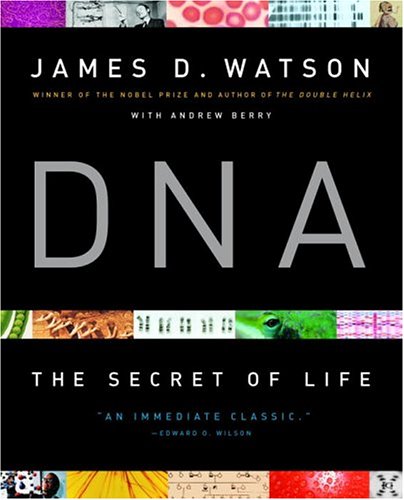

DNA The secret of life James D. Watson.
Detalles de publicación: New York Alfred A. Knopf 2006.Descripción: 446 p. 21cmISBN:- 0375710078
| Imagen de cubierta | Tipo de ítem | Biblioteca actual | Biblioteca de origen | Colección | Ubicación en estantería | Signatura topográfica | Materiales especificados | Info Vol | URL | Copia número | Estado | Notas | Fecha de vencimiento | Código de barras | Reserva de ítems | Prioridad de la cola de reserva de ejemplar | Reservas para cursos | |
|---|---|---|---|---|---|---|---|---|---|---|---|---|---|---|---|---|---|---|
| Libro | Biblioteca Mons. Iñaki Mallona (Arecibo) Colección General ab | 576.5 W339d (Navegar estantería(Abre debajo)) | Disponible | 60000010062062 |
Descripciones mejoradas de Syndetics:
Fifty years ago, James D. Watson, then just twentyfour, helped launch the greatest ongoing scientific quest of our time. Now, with unique authority and sweeping vision, he gives us the first full account of the genetic revolution--from Mendel's garden to the double helix to the sequencing of the human genome and beyond. Watson's lively, panoramic narrative begins with the fanciful speculations of the ancients as to why "like begets like" before skipping ahead to 1866, when an Austrian monk named Gregor Mendel first deduced the basic laws of inheritance. But genetics as we recognize it today--with its capacity, both thrilling and sobering, to manipulate the very essence of living things--came into being only with the rise of molecular investigations culminating in the breakthrough discovery of the structure of DNA, for which Watson shared a Nobel prize in 1962. In the DNA molecule's graceful curves was the key to a whole new science. Having shown that the secret of life is chemical, modern genetics has set mankind off on a journey unimaginable just a few decades ago. Watson provides the general reader with clear explanations of molecular processes and emerging technologies. He shows us how DNA continues to alter our understanding of human origins, and of our identities as groups and as individuals. And with the insight of one who has remained close to every advance in research since the double helix, he reveals how genetics has unleashed a wealth of possibilities to alter the human condition--from genetically modified foods to genetically modified babies--and transformed itself from a domain of pure research into one of big business as well. It is a sometimes topsy-turvy world full of great minds and great egos, driven by ambitions to improve the human condition as well as to improve investment portfolios, a world vividly captured in these pages. Facing a future of choices and social and ethical implications of which we dare not remain uninformed, we could have no better guide than James Watson, who leads us with the same bravura storytelling that made The Double Helix one of the most successful books on science ever published. Infused with a scientist's awe at nature's marvels and a humanist's profound sympathies,DNAis destined to become the classic telling of the defining scientific saga of our age. From the Hardcover edition.
Includes bibliographical references and index.
Extracto provisto por Syndetics
Reseñas proporcionadas por Syndetics
Library Journal Review
Watson celebrates the 50th anniversary of the discovery of DNA. Catch him on the five-part PBS series in April or on the eight-city author tour. (c) Copyright 2010. Library Journals LLC, a wholly owned subsidiary of Media Source, Inc. No redistribution permitted.Publishers Weekly Review
Who better than James Watson to lead a guided tour of DNA? When he and his English colleague, Francis Crick, discovered the double helix structure of the DNA molecule in 1953, little could they imagine that a mere 50 years later scientists would be putting the finishing touches on a map of the human genome. In this magisterial work, Watson, who won the Nobel Prize with Crick for their discovery, guides readers through the startling and rapid advances in genetic technology and what these advances will mean for our lives. Watson covers all aspects of the genome, from the layout of four simple bases on the DNA molecule through their complex construction into genes, then to the mechanisms whereby proteins produced by genes create our uniquely human characteristics-as well as the genetic mutations that can cause illnesses or inherited diseases like Duchenne muscular dystrophy and Huntington's disease. Watson may have mellowed a little over the years since he displayed his youthful brashness in The Double Helix, but he still isn't shy about taking on controversial subjects. He criticizes biotech corporations for patenting genes, making diagnostic medical procedures horribly expensive and damping further basic research. He notes that while China and other countries with large populations to feed have eagerly grasped the potential of genetically modified foodstuffs, America squandered $100 million on a recall of taco shells and the genetically modified corn used in them. He pleads passionately for the refinement and widespread use of prenatal genetic testing. Watson will probably provoke the most controversy with his criticism of scientists, corporations and government funding sources for their avoidance of important areas of research-notably the genetics of skin coloration-for political reasons. Every reader who wants to understand their own medical future will want to read this book. 100 color and b&w illus. 150,000 first printing; BOMC and History Book Club selection. (Apr. 7) FYI: A five-part PBS series on DNA featuring Watson will air later this year. (c) Copyright PWxyz, LLC. All rights reservedCHOICE Review
This book is what one might expect from the author of perhaps the most popular and notorious book ever written about science. For the 50th anniversary of the discovery of the structure of DNA, Watson recaps The Double Helix (CH, May'68) and brings genetic research up-to-date. (Not disparaging his coauthor's contribution, the first-person voice throughout is clearly Watson's.) Whatever hesitation Watson may have felt about Crick proclaiming the DNA structure "the secret of life" in 1953, he has embraced the belief since. He offers an excellent, attractively produced insider account of both history and the state of the art, portraying the light-hearted and human sides of science along with the serious. The book is also a soapbox for Watson's advocacy of genetic engineering and condescension toward its critics. Invoking Frankenstein--and the film Gattaca (1999)--to illuminate public anxiety over genetic tinkering, he remains sanguine about the greater good to come of it. Physicists may have "known sin" after the atomic bomb, but Watson does not admit to any fall from grace for biologists. (Nor does he do much to right the wrong done to Rosalind Franklin in his earlier account.) A Web site supplements the book. ^BSumming Up: Recommended. General readers. L. W. Moore formerly, University of KentuckyBooklist Review
Intended to enlighten those with "zero biological knowledge," this history of the genetics revolution coincides with the fiftieth anniversary of Watson and Francis Crick's coup in divining DNA's structure. A leader of the revolution as an administrator and public defender, Watson throughout the work addresses objections leveled at molecular manipulation. It's a fair-minded approach that fruitfully combines with Watson's clarity about the biochemistry underlying, for instance, the dread of genetically modified crops; if by his conclusion, a reader still adamantly opposes this or that technology, at least the stance won't be in the face of ignorance. Alongside this mission of enlightenment, Watson repeats a penchant for colorful characterization of rivals--perhaps the factor that made The Double Helix (1968) such a controversial classic. Previously caricatured, Rosalind Franklin now comes off more generously, Watson conceding that her work (vital to his and Crick's visualization of the double helix) justified a Nobel Prize had she not died tragically early. Nobel winners subsequently crowd Watson's narrative, accorded the laurels for their milestones in deducing pathways from DNA replication to protein production; in isolating individual genes; and in the invention of DNA amplification that makes fingerprinting and genome mapping possible. Whatever one's feelings about it, genetic engineering has rarely been as plainly explained as in this tremendously cogent tour d'horizon, a capstone worthy of Watson's career as a public scientist. --Gilbert TaylorNotas de autor provistas por Syndetics
James Dewey Watson James D. Watson was born on April 6, 1928. Watson was an extremely industrious student and entered the University of Chicago when he was only 15. He received his Bachelor of Science degree in Zoology four years later, and went on to earn a Ph.D. in the same subject at Indiana University. He was performing research at the University of Copenhagen in Denmark, when he first learned of the biomolecular research at the Cavendish Laboratory of Cambridge University in England. Watson joined Francis Crick in this work in 1951.At the age of 25, he and colleague Crick discovered the structure of DNA, the double helix. Watson went on to become a Senior Research Fellow in Biology at the California Institute of Technology, before returning to Cambridge in 1955. The following year he moved to Harvard University, where he became Professor of Biology, a post he held until 1976. Watson and Crick won the 1962 Nobel Laureate in Medicine for their discoveries concerning the molecular structure of nuclear acids and its significance for information transfer in living material. In 1968, Watson published his account of the DNA discovery, "The Double Helix." The book became an international best-seller.
Watson became the Director and later President of the Cold Spring Harbor Laboratory. In 1988 he served as Director of the Human Genome Project at the National Institutes of Health, a massive project to decipher the entire genetic code of the human species. Watson has received many awards and medals for his work, along with the Nobel Prize, he has also received the Presidential Medal of Freedom.
(Bowker Author Biography)