Reseñas proporcionadas por Syndetics
Library Journal Review
Since 9/11, we often hear that "civilization" is under attack, but what is civilization, and what have we in fact gained and lost through its existence? With this fine volume, British writer Osborne (The Deprat Affair: Ambition, Revenge and Deceit in French Indo-China) joins the select contemporary scholars (e.g., Theodore Zeldin and Susan Neiman) who are attempting to take into account both the costs and the gains of Western progress. Osborne's book is a model of clarity and concision: he condenses 20,000 years of Western history into fewer than 500 pages, defining civilization as "the story...we tell ourselves in order to secure our place in the world." But he asserts that the Western story--of reason and progress and of organizing the world in a manner that "bring[s] benefit to all"--is a false one that in fact has engendered catastrophe as much as progress. The ruthless marginalization of non-Western peoples and their cultures, enslavement, genocide, the destruction of native ways and values, and the burden shouldered by our own underprivileged are all part of the price of Western civilization. The West's simplistic beliefs, Osborne concludes, are "as dangerous to humanity as military conquest." An exceptional book that should be in every library.--David Keymer, Modesto, CA (c) Copyright 2010. Library Journals LLC, a wholly owned subsidiary of Media Source, Inc. No redistribution permitted. All rights reserved.
Publishers Weekly Review
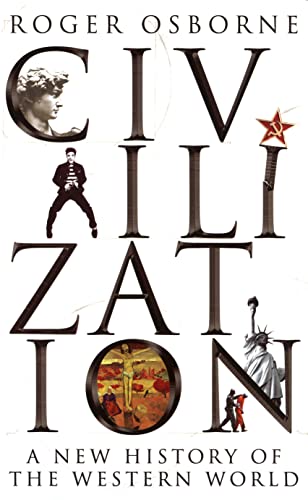
This stimulating survey steers a middle course between triumphal pageant of progress and postmodern bricolage of clashing perspectives to attempt a coherent narrative of Western history. Historian Osborne (The Floating Egg: Episodes in the Making of Geology) traces a lucid, thoughtful overview of European and American history from Stonehenge and the Greco-Roman era to the present. Tying together his account are a few broad themes, most prominently the development of rationalism the use of abstract reasoning to uncover universal laws governing nature and society from its Platonic origins to its apotheosis in Western science and its malevolent influence on Soviet communism. This often sinister rationalism works in counterpoint, and sometimes opposition, to what he sees as the redeeming organicity of Western culture, its rootedness in human adaptation to changing environments and practical needs in a multitude of contexts, from the growth of medieval towns to the rise of Hollywood and rock 'n' roll. Some pronouncements, like Osborne's insistence on the unique ferocity of Western warfare, aren't persuasive, and the paragraph he accords the Rolling Stones' 1969 Altamont concert is one too many. But one judges such a book less by its historiographical synthesis than by the wealth of provocative insights it throws up, and by that measure Osborne succeeds admirably. Photos. (Dec.) (c) Copyright PWxyz, LLC. All rights reserved
CHOICE Review
Osborne's scheme is ambitious: to write a history of the Western world to clarify what "civilization" it is that the West is defending in the wake of the 2001 attacks on New York and Washington. The headlong rush through 3,000 years of history results in dizzying oversimplification and a mind-numbing onslaught of facts, not all of which are correct. Osborne's general theme is that Western civilization has separated its inhabitants from the natural world, creating the "self-regarding," selfish, and rational individual. The worst excesses he traces to the influence of the Enlightenment, but it is clear that it has been all downhill since the Neolithic Age. One might ask with Rousseau, "Must we return again to the forest to live among bears?" Osborne (emer., geography, Uppsala Univ.) might not go that far (neither did Rousseau), but he does not have much to say in support of the modern West. Summing Up: Recommended. General collections/public libraries. E. Edson emerita, Piedmont Virginia Community College
Booklist Review
We frequently hear speculation that the West is engaged in a clash of civilizations with the Muslim world. So it is useful, perhaps even vital, that the West periodically examine the roots, history, and current condition of its civilization. Osborne is clearly an admirer of the richness and magnificent achievements of Western civilization. However, he is no cultural chauvinist, and he eloquently poses the dilemma implicit in a culture that could produce the glories of classical Greece and the Renaissance and the barbarism of Nazi Germany. Osborne follows a chronological approach that ranges from prehistory to the post-cold war period. Fortunately, he avoids the pitfalls of trying to tell too much, concentrating on vital and specific themes within particular epochs, including such topics as the development of democratic institutions in Athens, the growth of industrial capitalism, and the nature of totalitarianism under Hitler. This is a well-written, easily digestible survey illustrating that there remains much to be cherished within the common threads of our diverse civilization. --Jay Freeman Copyright 2006 Booklist