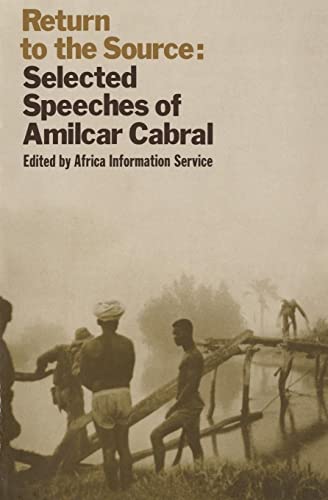

Return to the source selected speeches. Edited by Africa Information Service.
Detalles de publicación: New York Monthly Review Press [1974, c1973]Descripción: 110 p. illus. 21 cmISBN:- 0853453454
- 320.9/66/5702
- DT613.75 .C32 1974
| Imagen de cubierta | Tipo de ítem | Biblioteca actual | Biblioteca de origen | Colección | Ubicación en estantería | Signatura topográfica | Materiales especificados | Info Vol | URL | Copia número | Estado | Notas | Fecha de vencimiento | Código de barras | Reserva de ítems | Prioridad de la cola de reserva de ejemplar | Reservas para cursos | |
|---|---|---|---|---|---|---|---|---|---|---|---|---|---|---|---|---|---|---|
| Libro | Biblioteca Encarnación Valdés Colección General bev | 320.96657 C117r (Navegar estantería(Abre debajo)) | Disponible | 80000000403694 |
Descripciones mejoradas de Syndetics:
A classic collection of essays calling for self-liberation through a return to African ways of thinking, being, and acting
Amilcar Cabral, who was the Secretary-General of the African Party for the Independence of Guinea and the Cape Verde Islands (PAIGC), was assassinated by Portuguese agents on January 20, 1973. Under his leadership, the PAIGC liberated three-quarters of the countryside of Guinea in less than ten years of revolutionary struggle. Cabral distinguished himself among modern revolutionaries by the long and careful preparation, both theoretical and practical, which he undertook before launching the revolutionary struggle, and, in the course of the preparation, became one of the world's outstanding theoreticians of anti-imperialist struggle. This volume contains some of the principal speeches Cabral delivered in his last years during visits to the United States. The first is his speech to the fourth Commission of the United Nations General Assembly on October 16, 1972, on "Questions of Territories Under Portuguese Administration." His brilliant speeches on "National Liberation and Culture" (1970) and "Identity and Dignity in the Context of the National Liberation Struggle" (1972) follow.
Bibliography: p. 107-110.