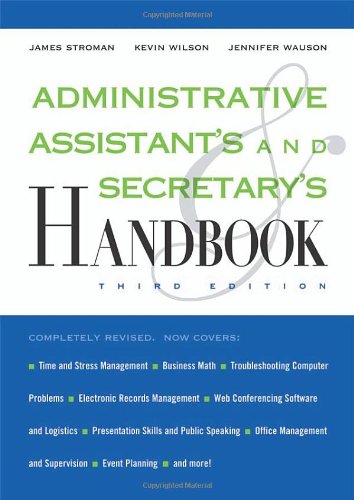
Imagen de portada de Amazon
Imagen de Amazon.com
Imagen de cubierta Syndetics
Portada de Syndetics
Imagen de OpenLibrary

Administrative assistant's & secretarys handbook by James Stroman, K. Wilson, Jennifer Wauson.

Por: Colaborador(es): Detalles de publicación: New York AMACOM c2008.Edición: 3rd edDescripción: xiii, 578 p. ill. 26 cmISBN:
  • 9780814409138
Otro título:
  • Administrative assistant's and secretarys handbook
Tema(s):
Valoración
    Valoración media: 0.0 (0 votos)
Existencias
Imagen de cubierta Tipo de ítem Biblioteca actual Biblioteca de origen Colección Ubicación en estantería Signatura topográfica Materiales especificados Info Vol URL Copia número Estado Notas Fecha de vencimiento Código de barras Reserva de ítems Prioridad de la cola de reserva de ejemplar Reservas para cursos
Libro Biblioteca de Mayagüez Colección General mb HF5547.5 .A247 2008 (Navegar estantería(Abre debajo)) Disponible 50000003191011
Libro Biblioteca Mons. Iñaki Mallona (Arecibo) Colección General ab 651.3 S919a3 (Navegar estantería(Abre debajo)) Disponible 60000010157201
Total de reservas: 0

Descripciones mejoradas de Syndetics:

Between coordinating meetings, making travel arrangements, and running the phone lines, being a professional administrative assistant requires an astonishing and varied range of skills involving interpersonal communication, written presentations, and organizational ability.Written in a down-to-earth style, Administrative Assistant's and Secretary's Handbook provides readers with information on subjects including record keeping, telephone usage, office machines, mail, business letters, and computer software skills. Now in its third edition, the book has been completely revised with expanded coverage of topics including electronic records management, interpersonal and communication skills, troubleshooting computer problems, time and stress management, customer service, event planning, web conferencing, math for office professionals, office management and supervision, transcription, and much more.Comprehensive and completely up-to-date, this is the book every administrative professional should own.

Includes bibliographical references and index.

gccnov2008

Extracto provisto por Syndetics

CHAPTER 1 WHY ARE YOU NEEDED? As an administrative assistant, you are hired to relieve your busy employer of a great deal of work, especially the details of office procedure and other matters that do not require your employer's personal involvement. You'll act as a liaison between your boss and the rest of the company. Sometimes you'll act as a buffer. Depending on the size of the com¬pany, you may also be called on to perform tasks normally outside the secretarial role in sales, banking, billing, payroll, accounting, advertising, public relations, purchasing, and more. Everything you do for your employer must duplicate as closely as possible what he or she would do if not absorbed in work that couldn't be delegated. Every businessperson dreams of having the perfect administrative assistant, and every administrative assistant dreams of having the perfect boss. Hopefully, you and your boss will become so well adjusted to each other that you'll work as a team, each trusting the other to carry part of the load in harmony. WHAT DO EMPLOYERS WANT? It's helpful to know what an employer expects of a "perfect administrative assistant" so that you can present yourself at your best during both the job interview and those criti¬cal first weeks on the job. Here are a few of the most important qualities:  Punctuality. An employer wants an administrative assistant who is consistently punc¬tual and always on hand during office hours. An administrative assistant who contin¬ually arrives even a few minutes late or who is ill frequently can cause havoc in a busy office. The employer knows from experience that such an administrative assistant may not be truly interested in the work. This person will be passed over or terminated in favor of someone with greater respect for the job--an administrative assistant who is always punctual and always there when needed.  Dependability. An employer considers the applicant's disposition and personality, try¬ing to judge whether he or she is dependable. For example, would the candidate rush home at precisely 5 p.m. despite an office crisis, or would he or she take enough responsibility to volunteer to remain after hours if an emergency arises?  Ability to learn. An employer wants to know the extent of the applicant's education-- not only formal programs and degrees but also self-instruction and single courses. This information indicates the applicant's willingness and capacity for learning. For example, an employer may hope that you know the specific computer software the company already uses, but he or she may not be too concerned if you aren't familiar with it if you show the potential to learn quickly.  Willingness to follow instructions. An employer wants a candidate who follows instructions carefully and willingly. Of course, a good administrative assistant soon takes initiative and performs certain tasks differently to save time or improve results. But the administrative assistant who always demands complete control may ultimate¬ly become unwilling to follow instructions, debating or questioning every one of the boss's directives. Though intelligent input from an administrative assistant is prized, an employer usually prefers not to argue points that he or she has already decided. The employer is concerned with more important matters than explaining all the reasons for pursuing a particular policy. Therefore, the employer looks for an administrative assis¬tant who will execute a decision no matter how many alternatives may seem obvious, or no matter what a former boss did in the same situation. In other words, the employ¬er wants someone whose personality will be an asset rather than a handicap.  Loyalty and confidentiality. Although these qualities are impossible to discover dur¬ing an interview alone, every boss wants his or her administrative assistant to possess them. In an office, there is nothing more unwelcome than the "human sieve" who con¬stantly chatters about every conversation heard, spreads idle rumors like wildfire, and must constantly be screened from confidential projects and information. No matter how efficient, how educated, and how experienced that administrative assistant is, his or her employment will be short-lived.  And something else. A keen employer wants more in a prospective administrative assistant than these general qualifications. During an extended interview, the employ¬er is looking for quick-wittedness, flexibility, commitment to work, a certain quality and level of conversation, and a sense of courtesy. This last attribute is essential in establishing cordial relations with clients and fellow employees. INTERVIEW TIPS During your interview, it is wise to be as relaxed as possible despite a natural tendency to be nervous. Appear on time, of course, and be well groomed and neatly dressed; oth¬erwise, the appointment may be canceled at the receptionist's desk. If you try too hard to sell yourself, you'll make a poor impression. Allow the employ¬er to form his or her own first impression. After all, he or she knows what kind of admin¬istrative assistant is needed and, in addition, may prefer to work with a certain type of person. If you're not what the employer wants, it's better for both of you that another applicant be chosen. During an interview, the employer may try to see where your attention is focused, asking such questions as how many sick days you used on your previous jobs and how many outside activities you engage in. Previous sick days can and will be checked, so don't lie. If you have many outside interests, mention only those that in some way con¬tribute to your job, such as night courses or professional associations. You don't want to give the impression that you're "too busy" to work. If you receive a job offer, the salary may be less than what you think you're worth. There's often a discrepancy between what we'd like to make and what we can make. Job applicants fresh from school, in particular, may feel this way until they become more familiar with what the market is actually paying. Before refusing a position on the basis of salary alone, first be sure you know what the salaries are for comparable secretarial and administrative assistant positions in your area and for someone with your education and experience. Then find out whether you'll be eligible for a raise after a short period of probation. Finally, consider whether the position has opportunities for increased responsibility and advancement. While it may not seem true to you right now as a job applicant, a big salary is rarely more important than professional satisfaction. YOUR APPRENTICESHIP Even if you are already well experienced, once you have a new position, you must be prepared to serve an apprenticeship with your new employer. Your past experience may be useful only in that it has taught you to learn quickly and to evaluate new situations. At your new office, there may be a different method for almost every daily procedure, even for distributing and opening the mail. No doubt, there will be a filing system you haven't used elsewhere. You may be asked to use letter formats, paragraphing, punctua¬tion, and abbreviations that were vetoed by a previous employer. You may also discover that your new boss has an extensive vocabulary with many words you'll need to learn, or just the reverse--a poor vocabulary that needs your assis¬tance. Will your new boss wish you to type a letter exactly as dictated, or do you have permission to "add to and take from"? Or will the boss furnish only the essentials of what he or she wishes to convey and request that you put the letter together in proper form yourself? Your need to be flexible extends to the computer system in the new office. You may find many differences between the hardware and software you used in school or at a past job and what you must use now. Even an updated version of the same software package may have a different user interface and functions. You need to familiarize yourself with the new computer and software, even if it means staying after work to read the manual and to experiment. Stimulated by your brand new environment and your past experience, you may find yourself coming up with dozens of ideas and suggestions within your first few weeks on the job. When you have a suggestion to offer, remember that it may very well have been made before and rejected for excellent reasons. When one of your ideas is refused, don't take it personally. Soon, after you're more familiar with the company and its operations, you'll be able to make a better suggestion. At the same time, don't be reluctant to give input freely when the boss asks for it. A new employee's overeagerness to offer advice, recommend changes, and carry over methods from old jobs may just disguise a need to be recognized for his or her capa¬bility. In this situation, the best way to prove yourself is to do your best, learn quickly, follow instructions accurately and intelligently, and cooperate with fellow employees. Show consideration for others beyond the call of duty. A little extra giving will cost you absolutely nothing and will bring huge dividends in trust and friendship among your co¬workers and with your employer. Excerpted from Administrative Assistant's and Secretary's Handbook by Kevin Wilson, James Stroman, Jennifer Wauson, K. Wilson All rights reserved by the original copyright owners. Excerpts are provided for display purposes only and may not be reproduced, reprinted or distributed without the written permission of the publisher.

Notas de autor provistas por Syndetics

James Stroman (Dallas, TX) has worked as an executive assistant to an army general, a governor, and the owner of an NFL football team.

Kevin Wilson (Acworth, GA) is Vice President of Videologies, Inc., a company that specializes in training administrative professionals in Fortune 500 companies.

Jennifer Wauson (Atlanta, GA) is President of Videologies, Inc.

Compartir
logopucpr-y-vive

Contáctanos

¡Queremos saber de ti!

Tel. 787.841.2000 Ext. 1801

bibliotecavaldes@pucpr.edu

⁣Búscanos en las redes

© 2026 Desarrollado por Ignite Online • All Rights Reserved • Powered by Koha.