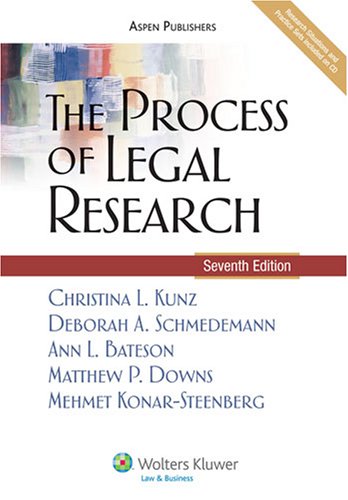

The process of legal research Christina L. Kunz ... [et al.].
Detalles de publicación: New York, NY Aspen Publishers c2008.Edición: 7th edDescripción: xxxiii, 451 p. ill. 26 cm. 1 CD-ROM (4 3/4 in.)ISBN:- 9780735569775
- 0735569770
- 340.072/073 22
- KF 240 .P76 2008
| Imagen de cubierta | Tipo de ítem | Biblioteca actual | Biblioteca de origen | Colección | Ubicación en estantería | Signatura topográfica | Materiales especificados | Info Vol | URL | Copia número | Estado | Notas | Fecha de vencimiento | Código de barras | Reserva de ítems | Prioridad de la cola de reserva de ejemplar | Reservas para cursos | |
|---|---|---|---|---|---|---|---|---|---|---|---|---|---|---|---|---|---|---|
| Libro | Biblioteca de Derecho Mons. Fremiot Torres Oliver Colección General biblioteca derecho | KF 240 .P76 2008 (Navegar estantería(Abre debajo)) | Disponible | 70000000848619 |
Descripciones mejoradas de Syndetics:
The proven-effective process approach makes this text a favorite among legal research professors. A wealth of learning aids and memory devices make The Process of Legal Research a favorite among students. Book jacket.
Includes bibliographical references and index.
The lay of the land : the importance of legal research, legal authorities, and research media -- From curiosity to closure : eight cognitive tasks -- Encyclopedias -- Treatises -- Legal periodicals -- A.L.R. annotations -- Restatements -- Additional types of commentary and strategy -- Case reporters, digests, and their alternatives -- Case citators -- Constitutions and statutes -- Legislative process materials -- Regulations -- Agency decisions -- Looseleaf services -- Rules of procedure -- Rules of professional responsibility -- Developing an integrated research strategy.
Tabla de contenidos provista por Syndetics
- Exhibits(p. xvii)
- Preface(p. xxv)
- Acknowledgments(p. xxvii)
- Unit I Overview(p. 1)
- Chapter 1 The Lay of the Land: The Importance of Legal Research, Legal Authorities, and Research Media(p. 3)
- A The Canoga Case(p. 3)
- B The Importance of Legal Research(p. 5)
- C Legal Authorities(p. 6)
- 1 The Law(p. 7)
- 2 Commentary(p. 8)
- 3 Finding Tools(p. 21)
- D Research Media(p. 21)
- E The Approach of This Book(p. 24)
- Chapter 2 From Curiosity to Closure: Eight Cognitive Tasks(p. 26)
- A Introduction(p. 27)
- B Curiosity(p. 28)
- 1 Learn and React to Your Client's Situation(p. 28)
- 2 Develop Research Terms and Research Issues(p. 30)
- a Understanding Legal Language(p. 30)
- b Generating Research Terms(p. 31)
- c Using Dictionaries and Thesauri(p. 34)
- d Formulating Legal Issues(p. 35)
- C Content and Context(p. 39)
- 3 List and Rank Potential Authorities(p. 39)
- 4 Assess Available Sources(p. 40)
- D Consultation(p. 42)
- 5 Use Your Terms and Issues to Locate Pertinent Passages(p. 43)
- 6 Study Pertinent Passages(p. 55)
- 7 Research Backward and Forward from Major Authorities(p. 59)
- E Closure(p. 62)
- 8 Stop Researching(p. 62)
- F Summary(p. 63)
- Interlude No. 1: Browsing the Internet(p. 65)
- Unit II Commentary(p. 73)
- Introduction(p. 74)
- Chapter 3 Encyclopedias(p. 75)
- A What Is an Encyclopedia, and Why Are They Useful?(p. 75)
- B How Do You Research in and Cite Encyclopedias?(p. 76)
- C What Else?(p. 83)
- Chapter 4 Treatises(p. 84)
- A What Is a Treatise, and Why Are They Useful?(p. 84)
- B How Do You Research in and Cite Treatises?(p. 88)
- 1 Researching in Treatises(p. 88)
- 2 Citing Treatises(p. 94)
- C What Else?(p. 94)
- Chapter 5 Legal Periodicals(p. 97)
- A What Is a Legal Periodical, and Why Are They Useful?(p. 97)
- B How Do You Research in and Cite Legal Periodicals?(p. 99)
- 1 Researching in Periodicals(p. 99)
- 2 Citing Periodical Articles(p. 106)
- C What Else?(p. 106)
- Chapter 6 A.L.R. Annotations(p. 110)
- A What Are American Law Reports Annotations (A.L.R.), and Why Are They Useful?(p. 110)
- B How Do You Research in and Cite A.L.R.s?(p. 114)
- 1 Researching in A.L.R.(p. 114)
- 2 Citing A.L.R.s(p. 121)
- C What Else?(p. 121)
- Chapter 7 Restatements(p. 124)
- A What Are the Restatements, and Why Are They Useful?(p. 124)
- B How Do You Research in and Cite Restatements?(p. 127)
- C What Else?(p. 139)
- Chapter 8 Additional Types of Commentary and Strategy(p. 140)
- A Additional Types of Commentary(p. 140)
- B Strategies for Commentary Research(p. 141)
- 1 Choosing Among Commentary Sources(p. 141)
- 2 Deciding Whether to Cite Commentary(p. 143)
- Interlude No. 2: Research in Commentary(p. 144)
- Unit III Case Law(p. 147)
- Introduction(p. 148)
- Chapter 9 Case Reporters, Digests, and Their Alternatives(p. 149)
- A What Is a Case?(p. 150)
- 1 How Does a Case Come to Be Decided?(p. 150)
- 2 How Are Court Systems Structured?(p. 151)
- 3 What Does a Published Case Look Like?(p. 152)
- B Why Would You Research Which cases?(p. 157)
- 1 The Common Law, Stare Decisis, and Precedent(p. 157)
- 2 Mandatory versus Persuasive Precedent: Federalism, Jurisdiction, and Level of Court(p. 158)
- 3 Good Law: History, Treatment, and Publication Status(p. 159)
- a Subsequent History(p. 159)
- b Treatment(p. 161)
- c Publication Status(p. 161)
- 4 Additional Factors(p. 162)
- C How Do You Research Cases?(p. 163)
- 1 Introduction(p. 163)
- 2 Paper Research(p. 167)
- 3 Online Resources(p. 177)
- 4 Summary(p. 188)
- D How Do You Cite Cases?(p. 190)
- E What Else?(p. 191)
- Chapter 10 Case Citators(p. 193)
- A What Are Case Citators, and Why Would You Use Them?(p. 193)
- B How Do You Use Case Citators?(p. 195)
- 1 Introduction(p. 195)
- 2 LexisNexis' Shepard's Citator(p. 195)
- 3 Westlaw's KeyCite(p. 202)
- 4 Citating Strategies(p. 209)
- C Why and How Should You Bolster Your Research in Case Citators?(p. 211)
- Interlude No. 3: Research in Case Law(p. 213)
- Unit IV Enacted Law(p. 219)
- Introduction(p. 220)
- Chapter 11 Constitutions and Statutes(p. 221)
- A What Are Constitutions and Statutes, and Why Would You Research Them?(p. 222)
- 1 What Is a Constitution, and Why Would You Research It?(p. 222)
- 2 What Is a Statute, and Why Would You Research It?(p. 223)
- 3 Whose Law Governs?(p. 227)
- 4 How Does Enacted Law Relate to Case Law?(p. 230)
- 5 When Do Sister Jurisdictions' Statutory Cases Matter?(p. 230)
- B How Do You Research Constitutions and Statutes?(p. 231)
- 1 Introduction(p. 231)
- 2 Statutory Codes(p. 235)
- 3 Statutory Cases and Updating(p. 264)
- 4 Session Laws(p. 267)
- 5 Local Ordinances(p. 269)
- 6 Summary(p. 269)
- C How Do You Cite Constitutions and Statutes?(p. 271)
- D What Else?(p. 272)
- Chapter 12 Legislative Process Materials(p. 274)
- A Introduction: The Legislative Process(p. 275)
- 1 Introduction(p. 275)
- 2 The Legislative Process(p. 275)
- B Legislative History(p. 278)
- 1 What Are Legislative History Materials?(p. 278)
- 2 Why Would You Research Legislative History Materials?(p. 279)
- 3 How Do You Research Legislative History?(p. 289)
- 4 How Do You Cite Legislative Materials?(p. 307)
- 5 What Else?(p. 308)
- C Pending Legislation(p. 309)
- D Concluding Points(p. 313)
- Interlude No. 4: Research in Enacted Law(p. 314)
- 1 New Mexico's Employee Privacy Act(p. 314)
- 2 The Federal Statute: Americans with Disabilities Act (ADA)(p. 315)
- 3 The Taos City Code(p. 317)
- Unit V Administrative Materials(p. 319)
- Introduction(p. 320)
- Chapter 13 Regulations(p. 321)
- A What Are Regulations, and Why Would You Research Them?(p. 322)
- B How Do You Research and Cite Regulations?(p. 323)
- 1 Researching Regulations(p. 323)
- 2 Citing Regulations(p. 345)
- C What Else?(p. 347)
- Chapter 14 Agency Decisions(p. 348)
- A What Is an Agency Decision, and Why Would You Research Agency Decisions?(p. 348)
- B How Do You Research and Cite Agency Decisions?(p. 355)
- 1 Researching Agency Decisions(p. 355)
- 2 Citing Agency Decisions(p. 366)
- C What Else?(p. 366)
- Chapter 15 Looseleaf Services(p. 367)
- A What Are Looseleaf Services?(p. 367)
- B How Do You Research in and Cite Looseleaf Services?(p. 368)
- 1 Researching in Looseleaf Services(p. 368)
- 2 Citing Looseleaf Services(p. 374)
- C What Else?(p. 374)
- Interlude No. 5: Research in Administrative Materials(p. 376)
- Unit VI Rules of Procedure and Legal Ethics(p. 377)
- Introduction(p. 378)
- Chapter 16 Rules of Procedure(p. 379)
- A What Are Rules of Procedure, and Why Would You Research Them?(p. 379)
- B How Do You Research and Cite Rules of Procedure?(p. 382)
- 1 Introduction(p. 382)
- 2 Commentary(p. 391)
- 3 The Rule and Comments(p. 391)
- 4 Cases Interpreting the Rule(p. 394)
- 5 Citing Rules of Procedure(p. 396)
- C What Else?(p. 396)
- D Interlude: The Canoga Case(p. 398)
- Chapter 17 Rules of Professional Responsibility(p. 400)
- A What Are Rules of Professional Responsibility, and Why Would You Research Them?(p. 400)
- B How Do You Research and Cite Rules of Professional Responsibility?(p. 403)
- 1 Introduction(p. 403)
- 2 Commentary(p. 409)
- 3 The Law of Your State(p. 409)
- 4 Persuasive Authorities(p. 412)
- 5 Citation(p. 415)
- C What Else?(p. 415)
- D Interlude: The Canoga Case(p. 417)
- Unit VII Conclusion(p. 423)
- Chapter 18 Developing an Integrated Research Strategy(p. 425)
- A Introduction: The Older Persons' Housing Dilemma(p. 425)
- B Four Research Journals(p. 426)
- 1 Adine Momoh, Representing Charles and Beca Swee(p. 426)
- 2 Marcus Ploeger, Representing Charles and Beca Swee(p. 430)
- 3 Karen Hazel, Representing Costa Brava Towers(p. 432)
- 4 Jesse J. Klick, Representing Costa Brava Towers(p. 435)
- C Our Observations(p. 437)
- Index(p. 439)
Notas de autor provistas por Syndetics
Christina L. Kunz Professor of Law William Mitchell College of LawDeborah A. Schmedemann Professor of Law William Mitchell College of Law
Ann L. Bateson Director of the Schoenecker Law Library Associate Dean and Professor of Law University of St. Thomas School of Law
Matthew P. Downs Director of the Law Library and Professor of Law Florida International University College of Law
Mehmet Konar-Steenberg Associate Professor of Law William Mitchell College of Law