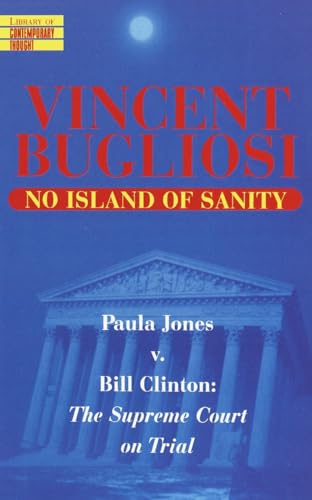
Imagen de portada de Amazon
Imagen de Amazon.com
Imagen de cubierta Syndetics
Portada de Syndetics
Imagen de OpenLibrary

No island of sanity Paula Jones v. Bill Clinton : the Supreme Court on trial Vincent Bugliosi.

Por: Series The library of contemporary thoughtDetalles de publicación: New York Ballantine Pub. Group 1998.Edición: 1st edDescripción: 146 p. ill. 21 cmISBN:
  • 0345424875 (alk. paper)
  • 9780345424877 (alk. paper)
Tema(s): Clasificación CDD:
  • 342.73/0878/0269 21
Clasificación LoC:
  • KF 228 .J66 B84 1998
Valoración
    Valoración media: 0.0 (0 votos)
Existencias
Imagen de cubierta Tipo de ítem Biblioteca actual Biblioteca de origen Colección Ubicación en estantería Signatura topográfica Materiales especificados Info Vol URL Copia número Estado Notas Fecha de vencimiento Código de barras Reserva de ítems Prioridad de la cola de reserva de ejemplar Reservas para cursos
Libro Biblioteca de Derecho Mons. Fremiot Torres Oliver Colección General biblioteca derecho KF 228 .J66 B84 1998 (Navegar estantería(Abre debajo)) Disponible 70000000845847
Total de reservas: 0

Descripciones mejoradas de Syndetics:

" One would like to think that the U.S. Supreme Court, the highest Court in the land, is the one island of sanity still remaining. But if what you folks are about to read is any indication, we've all got a lot to worry about. The question that presents itself is whether the near pathological dizziness and irrationality in our society has so invaded this nation's marrow that, like a wild-infectious virus, even the Supreme Court is not immune."
--from NO ISLAND OF SANITY

Now, in the powerful premiere of the Library of Contemporary Thought, Vincent Bugliosi takes a timely swipe at the Supreme Court's decision in Paula Jones v. Bill Clinton. Famed as the prosecutor of Charles Manson and author of the classic bestseller HELTER SKELTER, Bugliosi argues that the high court has rarely been proved so wrong, so fast.

NO ISLAND OF SANITY is only the beginning of an ongoing dialogue with some of the most original writers working today. Each month, the Library of Contemporary Thought will bring you a different voice on a hot-button topic in American life, politics, and culture. From Mickey Mouse to Tiger Woods, from how we age to how we read, no subject is too controversial or too unlikely for these powerful and provocative books.

Extracto provisto por Syndetics

...I have yet to read one single article, anywhere, criticizing the Supreme Court for its ruling in the case. (In fact, as we will see later on, even many who were upset with the Court's ruling and regretted its potential adverse implications went on to conclude that the Court was nevertheless legally correct in its ruling.) But by the time readers finish this book I'm confident that most of them will be highly condemnatory of the Supreme Court, some even angry at the Court, for its ruling in the Paula Jones case. About no one else seeing the error: Let me qualify this. I would guess that some constitutional law professors, somewhere, saw it. But I can tell you who didn't--no one in the media that I'm aware of, including the major newspapers of the land and political pundits, saw it. The president's own lawyer, Robert S. Bennett, didn't see it. Much more important, the Supreme Court of the United States, which handed down the ruling, didn't see it. As a result, the highest court in our land made an incomprehensible and terribly flawed decision against the nation's most powerful and important citizen, one that has injurious ramifications for all of us. It should be noted off the top that the position taken in this book has nothing at all to do with being pro-Clinton or pro-Democrat. It has everything to do with the office of the presidency of the United States. In fact, during Watergate, with a Republican president, I became so upset with people treating the matter as though it was so much more serious than it really was (prosecutor Leon Jaworski, incredibly, analogized it to the Third Reich, which resulted, as we know, in fifty million deaths during World War II, including the six million Jews murdered during the Holocaust) and with politicians (who, if the truth be told, had covered up their own misconduct) reacting with phony horror over the president's malfeasances (e.g., Senator Ted Kennedy, who did everything within his power to suppress the facts of Chappaquiddick) that I wanted to write a book titled Watergate: America's Finest Hour of Hypocrisy, but prior commitments prevented me from doing so. I believe I can establish conclusively that the Supreme Court's decision in this case was terribly and demonstrably wrong. The reason is that the Court failed to balance, as it must always do, the public interest against the private interest; here, the public interest in the effective functioning of the office of the presidency against the private interest of Paula Jones to have her case heard, without further delay, during the president's term in office. One could perhaps say that because I am not a constitutional scholar or even an appellate lawyer, just a plain trial lawyer, I am out of my depth in taking on the highest court in the land in this case. But in this instance, the Jones v. Clinton case, the depth is so shallow that anyone using even an ounce of common sense could navigate its weak currents. This is not the type of situation where the Supreme Court has issued a ruling with which those who disagree question the Court's analysis and interpretation of the legal issues before it. This happens every day; people see things differently all the time. This is a situation where, for instance, the judge of a professional fight never even added up his scorecard correctly, giving only one point, instead of the two he should have, to a knockdown in the third round. In other words, this is a ruling that is fatally defective, one no rational person can fail to condemn once he or she becomes aware of what the Supreme Court actually did in this case. The error was so flagrant that virtually everyone should have seen it. But they didn't. And that leads me, before we get into a fairly detailed examination of the Court's decision, into a discussion of two prefatory matters, the first of which is to try to explain why no one whom I'm aware of has been talking about the Supreme Court's terrible blunder in the Paula Jones case (and by extension, why no one saw the incompetence of the prosecutors in the Simpson case). The second concerns a frightening reality about the direction of American life. Excerpted from No Island of Sanity: Paula Jones v. Bill Clinton: The Supreme Court on Trial by Vincent Bugliosi All rights reserved by the original copyright owners. Excerpts are provided for display purposes only and may not be reproduced, reprinted or distributed without the written permission of the publisher.

Notas de autor provistas por Syndetics

Vincent T. Bugliosi, Jr. (August 18, 1934 - June 6, 2015) was an American attorney and New York Times bestselling author. During his eight years in the Los Angeles County district attorney's office, he was best known for prosecuting Charles Manson and other defendants accused of the seven Tate-LaBianca murders of August 9-10, 1969. Although Manson did not physically participate in the murders at Sharon Tate's home, Bugliosi used circumstantial evidence to show that he had orchestrated the killings.

Bugliosi co-wrote Helter Skelter and later wrote and co-wrote more than a dozen books, including Outrage: The Five Reasons Why O.J. Simpson Got Away with Murder, Reclaiming History: The Assassination of President John F. Kennedy, The Prosecution of George W. Bush for Murder and Divinity of Doubt: The God Question.

(Bowker Author Biography)

Compartir
logopucpr-y-vive

Contáctanos

¡Queremos saber de ti!

Tel. 787.841.2000 Ext. 1801

bibliotecavaldes@pucpr.edu

⁣Búscanos en las redes

© 2026 Desarrollado por Ignite Online • All Rights Reserved • Powered by Koha.