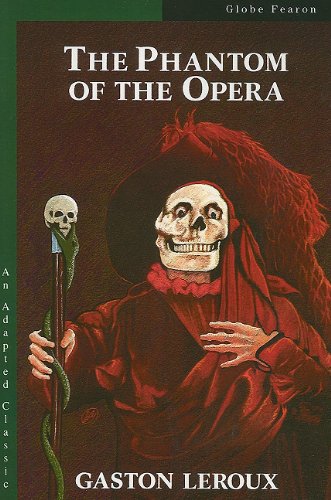

The phantom of the Opera Gaston Leroux.
Detalles de publicación: New Jersey Globe Fearon c1993.Descripción: xi, 193 p. 21 cmISBN:- 0835904768
| Imagen de cubierta | Tipo de ítem | Biblioteca actual | Biblioteca de origen | Colección | Ubicación en estantería | Signatura topográfica | Materiales especificados | Info Vol | URL | Copia número | Estado | Notas | Fecha de vencimiento | Código de barras | Reserva de ítems | Prioridad de la cola de reserva de ejemplar | Reservas para cursos | |
|---|---|---|---|---|---|---|---|---|---|---|---|---|---|---|---|---|---|---|
| Libro | Biblioteca de Mayagüez Colección General mb | PQ2623 .E6 F213 1993 (Navegar estantería(Abre debajo)) | Disponible | 50000003188678 |
Descripciones mejoradas de Syndetics:
This classic series of plays, novels, and stories has been adapted, in a friendly format, for students reading at a various levels.
Reading Level: 4-8
Interest Level: 6-12
gccsep2008
On cover: An adapted clasic.
Translation of: Le fantóme de l'Opéra.
Extracto provisto por Syndetics
Reseñas proporcionadas por Syndetics
School Library Journal Review
Gr 5-8-Fields has taken the original story and made it more approachable to younger and reluctant readers, losing none of the Dickensian drama. The characters are true to the original tale as are the plot and its development. McWilliam's whimsical cartoon artwork illustrates the key moments in the story and heightens its emotions and situations. Kelly does an adequate job of adapting the Dumas classic. The original is a rich, extravagant story about political intrigue, deception, history, and drama. All of the main players are here, but readers need to be familiar with The Three Musketeers in order to understand who the characters are and how they have grown. The language, sentence structure, and limited vocabulary make this appropriate for the middle grades and will introduce children to this literary classic. Unfortunately, while Lacey's illustrations provide a break for the eye at certain points in the narrative, they fail to capture the pageantry and drama of the period. In Phantom, Mullarkey uses simple vocabulary and sentence structure without losing Leroux's drama, horror, and suspense. The principal characters' roles, capacities, and importance are in no way diminished, but some parts of the story that have the most action and drama (e.g., the chandelier falling or the masquerade ball) aren't illustrated. Fisher's cartoonish art belies the dark, serious side of the story and oversimplifies some of its key points.-Robert A. Zupperoli, Warren Harding High School, Bridgeport, CT (c) Copyright 2011. Library Journals LLC, a wholly owned subsidiary of Media Source, Inc. No redistribution permitted.Notas de autor provistas por Syndetics
Gaston Leroux is best known as the creator of the 1911 novel, The Phantom of the Opera, about a masked figure who haunts the hidden parts of the Paris Opera House. The novel appeared first in serial installments a year before publication, ultimately grew into several movie versions, and later became an Tony Award-winning Andrew Lloyd Webber musical.Leroux was born in Paris in 1868. The only child of financially well-off parents, he moved easily into a clerk job in a law office. While working there, he wrote essays and short stories, many of which were accepted by publishers. This fired his enthusiasm, and he became a full-time reporter/writer in 1890.
Law experience covering famous cases and theater reviews fueled his writing career, but it was his news reporter job that took him around the world at the turn of the century, providing details for his novels.
Leroux wrote several mystery and fantasy novels, including the well-received The Mystery of the Yellow Room (1907) and The Man Who Came Back from the Dead (1912). Leroux also helped pioneer the character of the amateur detective who solves crime, so commonly seen today in movies and television.
Gaston Leroux continued to write until his death on April 16, 1927.
(Bowker Author Biography)