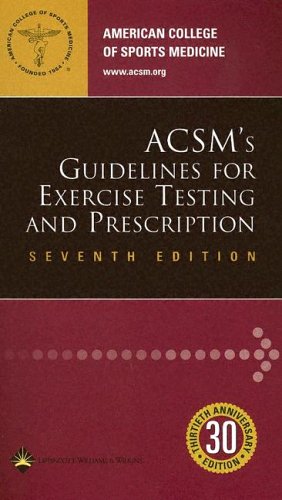

ACSM's guidelines for exercise testing and prescription American College of Sports Medicine ; senior editor, Mitchell H. Whaley ; associate editor--clinical, Peter H. Brubaker, associate editor--fitness, Robert M. Otto ; authors, Lawrence Armstrong ... [et al.].
Detalles de publicación: Philadelphia, Pa. Lippincott Williams & Wilkins c2006.Edición: 7th edDescripción: xxi, 366 p. ill. 22 cmISBN:- 0781745063 (pbk. spiral binding)
- Guidelines for exercise testing and prescription
- 615.82 A187 2006 22
- RM725 .A48 2006
- 2005 H-707
- WE 103
| Imagen de cubierta | Tipo de ítem | Biblioteca actual | Biblioteca de origen | Colección | Ubicación en estantería | Signatura topográfica | Materiales especificados | Info Vol | URL | Copia número | Estado | Notas | Fecha de vencimiento | Código de barras | Reserva de ítems | Prioridad de la cola de reserva de ejemplar | Reservas para cursos | |
|---|---|---|---|---|---|---|---|---|---|---|---|---|---|---|---|---|---|---|
| Referencia | Biblioteca Encarnación Valdés Sala de Referencia bev | 615.82 A187 2006 (Navegar estantería(Abre debajo)) | Disponible | 80000002358730 |
Descripciones mejoradas de Syndetics:
Recommended title for 2006 ACSM Certification Examinations!
The single most internationally read and referenced text in sports medicine, exercise science, and health and fitness, this manual succinctly summarizes recommended procedures for exercise testing and exercise prescription in healthy and diseased individuals. The Seventh Edition contains the most current public health and clinical information and state-of-the-art, research-based recommendations.
Coverage represents the fundamental knowledge, skills, and abilities (KSAs) that must be mastered by candidates for all ACSM certifications. Written by international experts in numerous fields, the Seventh Edition covers additional topics including arthritis, osteoporosis, dyslipidemia, immunology, and metabolic syndrome.
"30th Anniversary edition"--Cover.
Includes bibliographical references and index.
Tabla de contenidos provista por Syndetics
- Preface(p. VII)
- Note Bene(p. X)
- Contributors(p. XI)
- Abbreviations(p. XVIII)
- Section I. Health Appraisal, Risk Assessment, and Safety of Exercise(p. 1)
- Chapter 1. Benefits and Risks Associated With Exercise(p. 3)
- Public Health Perspective(p. 3)
- Benefits of Regular Physical Activity and/or Exercise(p. 5)
- Risks Associated With Exercise Testing(p. 6)
- Risks Associated With Vigorous Exercise(p. 10)
- Incidence of Cardiovascular Complications(p. 12)
- Issues Regarding Preliminary Screening(p. 13)
- Recommendations to Reduce the Incidence and Severity of Complications During Exercise(p. 15)
- Chapter 2. Health Screening and Risk Stratification(p. 22)
- Preparticipation Health Screening(p. 22)
- ACSM Risk Stratification(p. 25)
- Risk Stratification for Cardiac Patients(p. 27)
- Modifying Coronary Risk Status(p. 29)
- Section II. Exercise Testing(p. 33)
- Chapter 3. Pretest Clinical Evaluation(p. 35)
- Medical History, Physical Examination, and Laboratory Tests(p. 35)
- Alternative Stress Tests(p. 37)
- Blood Pressure(p. 39)
- Cholesterol and Lipoproteins(p. 39)
- Blood Profile Analyses(p. 41)
- Pulmonary Function(p. 43)
- Contraindications to Exercise Testing(p. 50)
- Informed Consent(p. 51)
- Patient Instructions(p. 52)
- Chapter 4. Physical Fitness Testing and Interpretation(p. 57)
- Purposes of Fitness Testing(p. 57)
- Basic Principles and Guidelines(p. 58)
- Test Order(p. 59)
- Test Environment(p. 59)
- Body Composition(p. 59)
- Densitometry(p. 60)
- Anthropometric Methods(p. 62)
- Other Techniques(p. 64)
- Cardiorespiratory Fitness(p. 68)
- The Concept of Maximal Oxygen Uptake(p. 68)
- Maximal versus Submaximal Exercise Testing(p. 69)
- Modes of Testing(p. 70)
- Cardiorespiratory Test Sequence and Measures(p. 77)
- Test Termination Criteria(p. 80)
- Muscular Fitness(p. 80)
- Flexibility(p. 85)
- Chapter 5. Clinical Exercise Testing(p. 91)
- Indications and Applications(p. 91)
- Diagnostic Exercise Testing(p. 91)
- Exercise Testing for Disease Severity and Prognosis(p. 93)
- Exercise Testing After Myocardial Infarction(p. 93)
- Functional Exercise Testing(p. 93)
- Exercise Test Modalities(p. 95)
- Exercise Protocols(p. 97)
- Upper Body Exercise Testing(p. 98)
- Testing for Return to Work(p. 99)
- Weight Carrying Test(p. 100)
- Repetitive Lifting Test(p. 101)
- Measurements(p. 101)
- Heart Rate and Blood Pressure(p. 102)
- Expired Gases(p. 103)
- Electrocardiographic Monitoring(p. 105)
- Subjective Ratings(p. 105)
- Postexercise Period(p. 106)
- Indications for Exercise Test Termination(p. 106)
- Exercise Testing With Imaging Modalities(p. 107)
- Exercise Echocardiography(p. 107)
- Exercise Nuclear Imaging(p. 107)
- Pharmacologic Stress Testing(p. 108)
- Considerations for Pulmonary Patients(p. 109)
- Lung Function(p. 109)
- Exercise Testing of Pulmonary Patients(p. 110)
- Supervision of Exercise Stress Testing(p. 111)
- Considerations Regarding Medical Supervision(p. 111)
- Current Guidelines and Practices(p. 111)
- Competency Considerations(p. 112)
- Implications for Cost-Effectiveness(p. 113)
- Chapter 6. Interpretation of Clinical Test Data(p. 115)
- Exercise Testing as a Screening Tool for Coronary Artery Disease(p. 115)
- Interpretation of Responses to Graded Exercise Testing(p. 116)
- Maximal Oxygen Uptake(p. 117)
- Heart Rate Response(p. 117)
- Blood Pressure Response(p. 117)
- ECG Waveforms(p. 120)
- Symptoms(p. 124)
- Diagnostic Value of Exercise Testing(p. 124)
- Sensitivity(p. 125)
- Specificity(p. 126)
- Predictive Value(p. 126)
- Comparison With Imaging Stress Tests(p. 127)
- Prognostic Applications of the Exercise Test(p. 129)
- Interpretation of Exercise Tests in Pulmonary Patients(p. 130)
- Specific Respiratory Diseases(p. 130)
- Section III. Exercise Prescription(p. 135)
- Chapter 7. General Principles of Exercise Prescription(p. 137)
- Principles of Training(p. 138)
- Overview of the Exercise Prescription(p. 139)
- The Art of Exercise Prescription(p. 139)
- Components of the Training Session(p. 140)
- Warm-up(p. 141)
- Endurance Phase(p. 142)
- Recreational Activities(p. 142)
- Cool-down(p. 143)
- Cardiorespiratory Fitness(p. 143)
- Mode of Exercise(p. 143)
- Exercise Intensity(p. 145)
- Exercise Duration(p. 150)
- Exercise Frequency(p. 151)
- Energy Expenditure Goals(p. 151)
- Rate of Progression(p. 154)
- Initial Conditioning Stage(p. 154)
- Improvement Stage(p. 155)
- Maintenance Stage(p. 155)
- Training Specificity(p. 156)
- Musculoskeletal Flexibility(p. 156)
- Muscular Fitness(p. 159)
- Maintenance of the Training Effect(p. 160)
- Program Supervision(p. 161)
- Chapter 8. Exercise Prescription for Cardiac Patients(p. 165)
- Inpatient Programs(p. 166)
- Outpatient Programs(p. 169)
- Intensity(p. 170)
- Frequency(p. 171)
- Duration(p. 172)
- Outpatient Rate of Progression(p. 172)
- Types of Outpatient Programs(p. 174)
- Exercise Prescription Without a Preliminary Exercise Test(p. 175)
- Resistance Training(p. 176)
- Eligibility and Exclusion Criteria(p. 177)
- Time Course to Resistance Training(p. 178)
- Prescriptive Guidelines(p. 178)
- Arm Exercise Prescription(p. 181)
- Arm Exercise Training Heart Rate(p. 181)
- Work Rates for Arm Training(p. 181)
- Arm Exercise Equipment and Training Modalities(p. 182)
- Exercise Training for Return to Work(p. 182)
- Optimal Exercise Dosage? Pathophysiologic Considerations(p. 183)
- Special Patient Populations(p. 185)
- Angina or Silent Ischemia(p. 185)
- Congestive Heart Failure(p. 186)
- Pacemaker and Implantable Cardioverter Defibrillators(p. 189)
- Cardiac Transplant(p. 191)
- Exercise: An Integral Component of a Comprehensive Treatment Approach(p. 193)
- Chapter 9. Exercise Prescription for Pulmonary Patients(p. 200)
- Exercise Prescription(p. 200)
- Mode of Exercise(p. 200)
- Frequency(p. 200)
- Intensity(p. 201)
- Duration(p. 201)
- Special Considerations(p. 202)
- Pursed-Lips Breathing(p. 202)
- Supplemental Oxygen(p. 202)
- Alternative Modes of Exercise Training(p. 202)
- Continuous Positive Airway Pressure(p. 203)
- Upper Body Resistance Training(p. 203)
- Ventilatory Muscle Training(p. 203)
- Program Design and Supervision(p. 204)
- Monitoring Exercise Training Intensity(p. 204)
- Chapter 10. Other Clinical Conditions Influencing Exercise Prescription(p. 206)
- Hypertension(p. 206)
- Lower-Extremity Peripheral Vascular Disease(p. 208)
- Diabetes Mellitus(p. 212)
- Obesity(p. 214)
- Programs for Reducing Body Fatness(p. 214)
- Chapter 11. Exercise Testing and Prescription for Children, the Elderly, and Pregnant Women(p. 217)
- Children(p. 217)
- Fitness Testing(p. 217)
- Clinical Exercise Testing(p. 218)
- Exercise Prescription(p. 219)
- The Elderly(p. 223)
- Exercise Testing(p. 223)
- Exercise Prescription(p. 225)
- Pregnant Women(p. 230)
- Section IV. Special Considerations(p. 235)
- Chapter 12. Methods for Changing Exercising Behaviors(p. 237)
- Exercise Compliance(p. 237)
- Adult Learning(p. 239)
- Psychological Components of Successful Behavior Change(p. 241)
- Strategies to Improve Behavioral Change Outcomes(p. 242)
- Practical Recommendations to Enhance Exercise Adherence(p. 245)
- Population-Specific Barriers to Physical Activity(p. 249)
- Program Models: Group versus Home-Based Exercise Therapy(p. 249)
- Other Targets for Health Behavior Change(p. 251)
- Smoking Cessation(p. 252)
- Weight Management(p. 252)
- Dietary Modification(p. 253)
- Stress Management(p. 254)
- Chapter 13. Legal Issues(p. 258)
- Contracts, Informed Consent, and Torts(p. 259)
- Contract Law(p. 259)
- Informed Consent(p. 260)
- Torts(p. 261)
- Negligence and/or Malpractice(p. 261)
- Defenses to Negligence and/or Malpractice Actions(p. 263)
- Liability Insurance(p. 264)
- Standards of Care(p. 264)
- Policies, Protocols, Forms, and Fulfillment(p. 266)
- Legal Concerns and the Roles of Licensed and Nonlicensed Exercise Professionals(p. 267)
- Summary(p. 269)
- Section V. Appendices(p. 271)
- Appendix A. Common Medications(p. 273)
- Appendix B. Emergency Management(p. 283)
- Appendix C. Electrocardiogram (ECG) Interpretation(p. 293)
- Appendix D. Metabolic Calculations(p. 300)
- Appendix E. Environmental Considerations(p. 313)
- Appendix F. American College of Sports Medicine Certifications(p. 322)
- Index(p. 353)