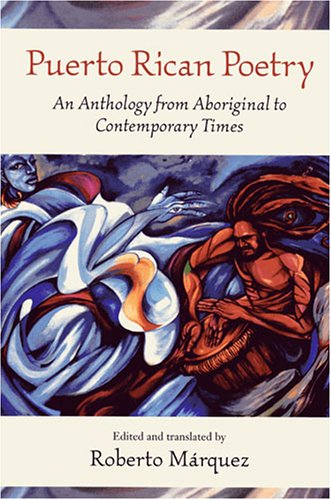
Offering a comprehensive collection of Puerto Rican poetry in English, this text includes the work of 64 poets, as well as selections from Puerto Rico's tradition of popular verse forms - coplas, decimas, bombas - produced by anonymous writers.
Includes bibliographical references (p. 485-490).
Translated from the Spanish.
Reseñas proporcionadas por Syndetics
Library Journal Review
M rquez (William R. Kenan Jr. Professor of Latin American & Caribbean Studies, Mount Holyoke Coll.) traces the development of Puerto Rican poetry from its indigenous beginnings and Creolist colonial legacies up through the peak years of the Great Migration and late 20th-century diaspora. Organized into four chronological and major thematic sections-"Before Columbus and After, 1400-1820," "The Creole Matrix: Notions of Nation, 1821-1950s," "Critique, Revolt and Renewal," and "Of Diasporas, Syncreticisms, Border Crossings and Transnationalizations: An AmerR!can Sancocho"-this rich literary resource offers English renditions of a wide representation of poetic forms ranging from oral, traditionally based decimas (ten-line poems written in octosyllabic meter) to romantic lyrics and conversational verse. M rquez discusses the work of more than 64 major Puerto Rican poets, situating them in a range of literary-cultural, political, and sociohistorical contexts. This potent anthology not only offers a multiplicity of perspectives on Puerto Rican literature and society but deepens our understanding of the commonwealth's history. Described as a "tiny isle/ bereft of foodstuffs and of any coin," Puerto Rico is also viewed as "poverty's port," a "promised land," a "nation [with] no flag," and a "mote in a cartographer's eye." Highly recommended for public and academic libraries with collections in Caribbean and Latin American studies.-Miriam Tuliao, NYPL (c) Copyright 2010. Library Journals LLC, a wholly owned subsidiary of Media Source, Inc. No redistribution permitted.
CHOICE Review
The intent of this book is to provide non-Spanish speaking Anglophones access to the multicultural originality and geographical scope of Puerto Rican poetic traditions. Marquez (Mount Holyoke College) skillfully achieves this goal. Texts are meticulously "transcreated" in a four-part format with introductions that contextualize island cultural production in national history. Book 1, "Before Columbus and After, 1400-1820," highlights early verse forms followed by those forged in the "colonial crucible"--where the archetypical folk hero, el jibaro, coexists with conquest elegies and Creole admiration of the island's beauty. Book 2, "The Creole Matrix: Notions of Nation, 1821-1950s," traces poetic rearticulations of national identities, including 19th-century speculations on citizenship overridden in 1898 by the US appropriation of the island and its resources. Despair is evident in poets' lyrical reclamations of land and identity, reflected in tropes of loss, disorientation, and poverty. The 1940s and 1950s texts witness increasingly self-conscious women's and populist voices calling for a redefinition of the island's social and political order. Focusing on the latter half of the 20th century, book 3 highlights contemporary islanders' verse. Book 4 explores the geographically fluid and syncretic "AmerRican" poetry of the diaspora. Summing Up: Highly recommended. Upper-division undergraduates and graduate students. J. C. Richards Park University
Puerto Rican poetry
APA
Márquez R., . (2007). Puerto Rican poetry: a selection from aboriginal to contemporary times. Amherst: University of Massachusetts Press.
Chicago
Márquez Roberto, . 2007. Puerto Rican poetry: a selection from aboriginal to contemporary times. Amherst: University of Massachusetts Press.
Harvard
Márquez R., . (2007). Puerto Rican poetry: a selection from aboriginal to contemporary times. Amherst: University of Massachusetts Press.
MLA
Márquez Roberto, . Puerto Rican poetry: a selection from aboriginal to contemporary times. Amherst: University of Massachusetts Press. 2007.