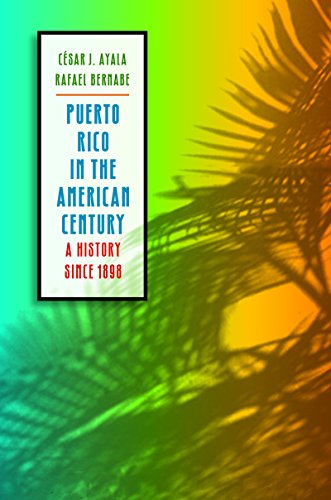

Puerto Rico in the American century a history since 1898 César J. Ayala and Rafael Bernabe.
Detalles de publicación: Chapel Hill University of North Carolina Press 2007.Descripción: 428 p. ill. 24 cmISBN:- 9780807831137 (cloth : alk. paper)
- 972.95052 A973p 22
- F1975 .A93 2007
| Imagen de cubierta | Tipo de ítem | Biblioteca actual | Biblioteca de origen | Colección | Ubicación en estantería | Signatura topográfica | Materiales especificados | Info Vol | URL | Copia número | Estado | Notas | Fecha de vencimiento | Código de barras | Reserva de ítems | Prioridad de la cola de reserva de ejemplar | Reservas para cursos | |
|---|---|---|---|---|---|---|---|---|---|---|---|---|---|---|---|---|---|---|
| Libro | Biblioteca Encarnación Valdés Colección General bev | 972.95052 A973p (Navegar estantería(Abre debajo)) | Disponible | 80000002376815 | ||||||||||||||
| Libro | Biblioteca Encarnación Valdés Colección de Puerto Rico | 972.95052 A973p (Navegar estantería(Abre debajo)) | Disponible | 80000002348459 |
Descripciones mejoradas de Syndetics:
Offering a comprehensive overview of Puerto Rico's history and evolution since the installation of U.S. rule, César Ayala and Rafael Bernabe connect the island's economic, political, cultural, and social past. Puerto Rico in the American Century explores Puerto Ricans in the diaspora as well as the island residents, who experience an unusual and daily conundrum: they consider themselves a distinct people but are part of the American political system; they have U.S. citizenship but are not represented in the U.S. Congress; and they live on land that is neither independent nor part of the United States.
Highlighting both well-known and forgotten figures from Puerto Rican history, Ayala and Bernabe discuss a wide range of topics, including literary and cultural debates and social and labor struggles that previous histories have neglected. Although the island's political economy remains dependent on the United States, the authors also discuss Puerto Rico's situation in light of world economies. Ayala and Bernabe argue that the inability of Puerto Rico to shake its colonial legacy reveals the limits of free-market capitalism, a break from which would require a renewal of the long tradition of labor and social activism in Puerto Rico in connection with similar currents in the United States.
Includes bibliographical references and index.
Tabla de contenidos provista por Syndetics
- Acknowledgments(p. xiii)
- Abbreviations(p. xv)
- Introduction(p. 1)
- 1 1898-Background and Immediate Consequences(p. 14)
- 2 Reshaping Puerto Rico's Economy, 1898-1934(p. 33)
- 3 Political and Social Struggles in a New Colonial Context, 1900-1930(p. 52)
- 4 Americanization and Its Discontents, 1898-1929(p. 74)
- 5 Economic Depression and Political Crisis: The Turbulent Thirties(p. 95)
- 6 Cultural Debates in an Epoch of Crisis: National Interpretations in the Thirties(p. 117)
- 7 Turning Point in the Forties: Rise of the Partido Popular Democratico(p. 136)
- 8 Birth of the Estado Libre Asociado(p. 162)
- 9 Transformation and Relocation: Puerto Rico's Operation Bootstrap(p. 179)
- 10 Politics and Culture in the Epoch of PPD Hegemony(p. 201)
- 11 PPD Hegemony Undermined: From Mobilization to Recession, 1960-1975(p. 223)
- 12 Rethinking the Past, Betting on the Future: Cultural Debates from the Sixties to the Eighties(p. 247)
- 13 Economic Stagnation and Political Deadlock, 1976-1992(p. 267)
- 14 Politics and Social Conflict in the Epoch of Neoliberalism, 1992-2004(p. 291)
- 15 Neonationalism, Postmodernism, and Other Debates(p. 316)
- Conclusion(p. 335)
- Notes(p. 343)
- Bibliographical Essay(p. 383)
- Index(p. 399)