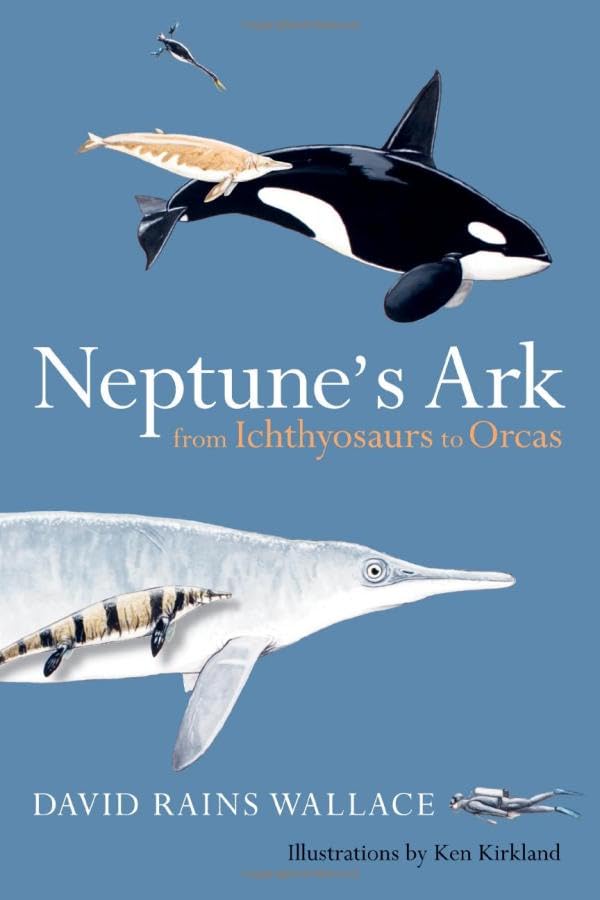
Neptune's Ark illuminates the dramatic saga of evolution spanning 500 million years of marine life along the magnificent Pacific coast of western North America. In an engaging narrative that artfully blends elements of science, history, folklore, and personal observation, renowned naturalist David Rains Wallace reveals a marvelous diversity of creatures, not only modern ones, but those from the far prehistoric past. Mysterious forms have abounded--from giant sea cows, oyster bears, and flightless toothed birds to the orcas, elephant seals, and sea otters of modern times. Wallace tells a story about evolution as well as a tale of the storms, scurvy, and shipwrecks that plagued the coast's explorers, naturalists, and scientists, many of whom led turbulent or tragic lives, with themes reflected in the wonder and danger of the coast itself. Neptune's Ark is full of vivid characters--from explorers like Sir Francis Drake and Captain James Cook, to pioneer naturalists including Georg Steller and Charles Scammon, to early paleontologists Othniel Marsh and Edward Cope, and to recent scientists and ecological visionaries.
Includes bibliographical references (p. 253-266) and index.
gccmay2008
Tabla de contenidos provista por Syndetics
List of Illustrations
Acknowledgments
Prologue. Steller's Sea Ape
1 Reefs in the Desert
2 Amphibious Ambiguities
3 Bird Teeth and Reptile Necks
4 Tail Tales
5 Cope's Elusive Ophidians
6 Hooves into Flippers
7 Marsh's Deceptive Desmostylians
8 Emlong's Whale
9 Paws into Flippers
10 Sea Cows and Oyster Bears
11 The Long, Warm Summer
12 Emptying Bays
13 Punctuated Pinnipeds and Darwinian Sirenians
14 Advent of Autumn
15 Ice Age Invasions
16 Hands into Paddles
17 Pileated Woodpecker's Boat
18 The End of the Earth
19 An Industrial Interlude
20 Intimations of Communication
Epilogue. The Old Man of the Sea
Notes
Bibliography
Index
Reseñas proporcionadas por Syndetics
Library Journal Review
Naturalist Wallace (Beasts of Eden: Walking Whales, Dawn Horses, and Other Enigmas of Mammal Evolution) here turns to evolution along the Pacific coast of North America. The diversity of the creatures he reveals is broader than the title implies--included are seals, whales, salmon, gulls, bears, otters, and "sea apes." Following the narrative can be difficult, partly because of the large number of species discussed (the index will be useful in tracking different species). Explorers James Cook and Francis Drake, naturalists Georg Steller and Charles Scammon, paleontologists Edward Cope and Othniel Marsh, and Douglas Emlong, an amateur with an amazing talent for finding fossils, thread through the book. Both Richard Ellis's Aquagenesis: The Origin and Evolution of Life in the Sea and Carl Zimmer's At the Water's Edge: Macroevolution and the Transformation of Life focus more on the evolution of strictly marine species. Wallace's research, as always, is strong, with good notes and a good bibliography. For academic and research libraries with an interest in paleontology. (Index not seen.)--Jean E. Crampon, Univ. of Southern California Science & Engineering Lib., Los Angeles (c) Copyright 2010. Library Journals LLC, a wholly owned subsidiary of Media Source, Inc. No redistribution permitted.
Publishers Weekly Review
Author and naturalist Wallace follows up Beasts of Eden, which tackled mammalian evolution, with this in-depth look at the evolution of marine tetrapods (four-limbed creatures), from the earliest proto-reptilians through present-day seals, whales and walruses. Using Georg Wilhelm Steller?s still-unidentified 1741 discovery of a "very unusual and new animal" as a symbol for all we don?t know about marine life, Wallace delves into a shrouded living environment that has likely hidden many more species than paleontologists will ever uncover. Unfortunately, the most interesting parts of the book-concerning the 18th, 19th and 20th century trailblazers in the field-are marred by Wallace?s inability to keep himself out of the narrative (at one point, he describes a dream he had). Later chapters explore the attempts of eccentric John Lilly to communicate with dolphins and whales, the first migration of humans to the Americas, animal myths of Northwest Coast Natives and the destructive influence of Europeans. Though Wallace?s voice can grate and the text gets bogged down in difficult-to-follow taxonomy discussions (a glossary would have been of immense help), those with a grounding in biology or science history will find Wallace?s fascinating vignettes worth the effort. (May) Copyright 2007 Reed Business Information.
CHOICE Review
This ambitious book is nothing less than a detailed and thoroughly documented consideration of the evolution of prototypical large marine mammals. When one considers the dozens of fossils' Latin names and their taxa, along with the identities and opinions of the paleontologists involved in centuries-long investigations, one might well anticipate a formula for readership coma. Wallace (independent scholar) refuses to avoid the complexities, and takes his readers with him in his uncompromising frontal assault. One finds oneself in the ancient seas as unicellular life emerges and evolves to multicellularity, and one struggles with the field workers to find meaning in fragmentary fossils of forms so bizarre as to demand not interpretation, but invention. Somehow one not only survives the confusion encountered when conceiving of the multiple transitions from water to land, and from land back to water, but one also cannot wait to pick up each new trail as the fossil hunters unearth yet another enigma. Much of the energy of this book is derived from the sometimes whimsical, yet always respectful descriptions of the paleontologists and their field efforts. This work is a must for aspiring paleontologists; laypeople will find the technical nomenclature challenging. Helpful notes and extensive index. Summing Up: Essential. Lower-level undergraduates and above; interested general readers. A. B. Schlesinger emeritus, Creighton University
Booklist Review
The western coastline of North America is as close to an ur-coast as can be found on our planet--that is, in geologic time it has never been part of the interior of any continent or supercontinent. It is along this coast that naturalist Wallace ( Beasts of Eden, 2004) bases his survey of marine evolution over the past 500 million years. Specifically targeting vertebrate evolution, Wallace examines the fantastical ancestors of today's species, as well as forms that left no direct descendants. Toothed birds flew above or dove below the seas, and fishlike ichthyosaurs patrolled open oceans. And sea cows, now reduced to a few tropical species, colonized the entire coastline. Wallace fills his narrative with stories of the often-quirky paleontologists who found these creatures and cautionary tales about the decimation and later conservation of their modern kin. The addition of coastal Indian creation tales and his own philosophical musings on the vast scope of diversity and time engages the reader in Wallace's voyage of discovery. --Nancy Bent Copyright 2007 Booklist
Notas de autor provistas por Syndetics
David Rains Wallace is the author of sixteen books, including Beasts of Eden: Walking Whales, Dawn Horses, and Other Enigmas of Mammal Evolution (UC Press), A New York Times Notable Book; The Klamath Knot: Explorations of Myth and Evolution (Twentieth Anniversary Edition, UC Press), winner of the John Burroughs Medal; The Bonehunter's Revenge: Dinosaurs, Greed, and the Greatest Scientific Feud of the Gilded Age; and The Monkey's Bridge: Mysteries of Evolution in Central America, A New York Times Notable Book.
Neptune's ark
APA
Wallace D. R., . (2007). Neptune's ark: from ichthyosaurs to orcas. Berkeley: University of California Press.
Chicago
Wallace David Rains, . 2007. Neptune's ark: from ichthyosaurs to orcas. Berkeley: University of California Press.
Harvard
Wallace D. R., . (2007). Neptune's ark: from ichthyosaurs to orcas. Berkeley: University of California Press.
MLA
Wallace David Rains, . Neptune's ark: from ichthyosaurs to orcas. Berkeley: University of California Press. 2007.