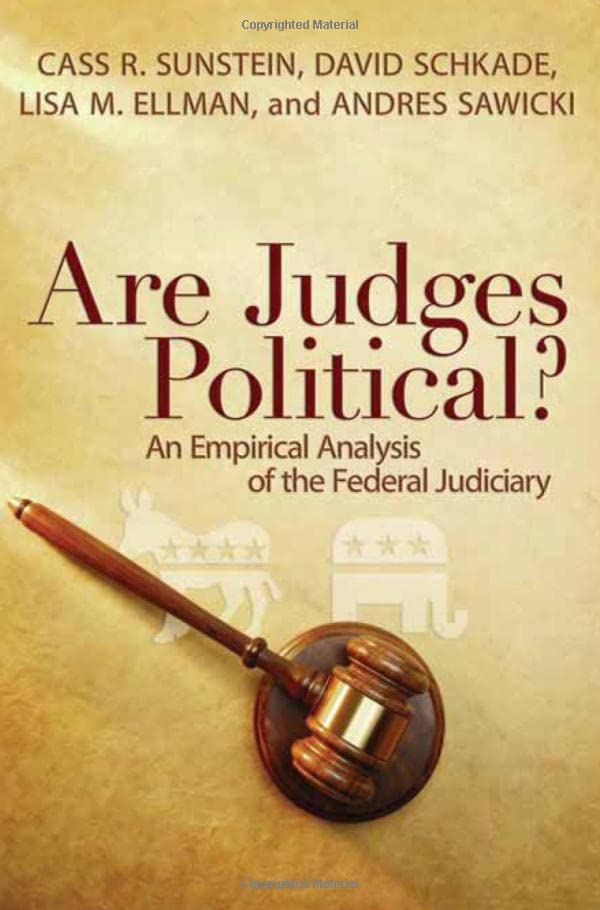

Are judges political? an empirical analysis of the federal judiciary Cass R. Sunstein ... [et al.].
Detalles de publicación: Washington, D.C. Brookings Institution Press c2006.Descripción: x, 177 p. 23 cmISBN:- 0815782349 (cloth : alk. paper)
- 9780815782346 (cloth : alk. paper)
- 347.73/14 22
- KF 8775 .A97 2006
| Imagen de cubierta | Tipo de ítem | Biblioteca actual | Biblioteca de origen | Colección | Ubicación en estantería | Signatura topográfica | Materiales especificados | Info Vol | URL | Copia número | Estado | Notas | Fecha de vencimiento | Código de barras | Reserva de ítems | Prioridad de la cola de reserva de ejemplar | Reservas para cursos | |
|---|---|---|---|---|---|---|---|---|---|---|---|---|---|---|---|---|---|---|
| Libro | Biblioteca de Derecho Mons. Fremiot Torres Oliver Colección General biblioteca derecho | KF 8775 .A97 2006 (Navegar estantería(Abre debajo)) | Disponible | 70000000841861 |
Descripciones mejoradas de Syndetics:
Over the past two decades, the United States has seen an intense debate about the composition of the federal judiciary. Are judges ""activists""? Should they stop ""legislating from the bench""? Are they abusing their authority? Or are they protecting fundamental rights, in a way that is indispensable in a free society? Are Judges Political? cuts through the noise by looking at what judges actually do. Drawing on a unique data set consisting of thousands of judicial votes, Cass Sunstein and his colleagues analyze the influence of ideology on judicial voting, principally in the courts of appeal. They focus on two questions: Do judges appointed by Republican Presidents vote differently from Democratic appointees in ideologically contested cases? And do judges vote differently depending on the ideological leanings of the other judges hearing the same case? After examining votes on a broad range of issues--including abortion, affirmative action, and capital punishment--the authors do more than just confirm that Democratic and Republican appointees often vote in different ways. They inject precision into an all-too-often impressionistic debate by quantifying this effect and analyzing the conditions under which it holds. This approach sometimes generates surprising results: under certain conditions, for example, Democrat-appointed judges turn out to have more conservative voting patterns than Republican appointees. As a general rule, ideology should not and does not affect legal judgments. Frequently, the law is clear and judges simply implement it, whatever their political commitments. But what happens when the law is unclear? Are Judges Political? addresses this vital question. that Democratic and Republican appointees often vote in different ways. They inject precision into an all-too-often impressionistic debate by quantifying this effect and analyzing the conditions under which it holds. This approach sometimes generates surprising results: under certain conditions, for example, Democrat-appointed judges turn out to have more conservative voting patterns than Republican appointees. As a general rule, ideology should not and does not affect legal judgments. Frequently, the law is clear and judges simply implement it, whatever their political commitments. But what happens when the law is unclear? Are Judges Political? addresses this vital question.ot and does not affect legal judgments. Frequently, the law is clear and judges simply implement it, whatever their political commitments. But what happens when the law is unclear? Are Judges Political? addresses this vital question. that Democratic and Republican appointees often vote in different ways. They inject precision into an all-too-often impressionistic debate by quantifying this effect and analyzing the conditions under which it holds. This approach sometimes generates surprising results: under certain conditions, for example, Democrat-appointed judges turn out to have more conservative voting patterns than Republican appointees. As a general rule, ideology should not and does not affect legal judgments. Frequently, the law is clear and judges simply implement it, whatever their political commitments. But what happens when the law is unclear? Are Judges Political? addresses this vital question.
Includes bibliographical references and index.
Studying judges with numbers -- Ideological votes and ideological panels -- Nonideological voting and entrenched views -- Explaining the data : conformity, group polarization, and the rule of law -- The case of big decisions : of segregation, abortion, and obscenity -- More conservative than thou? judicial voting across circuits, across presidents, and over time -- What should be done? of politics, judging, and diversity.
Reseñas proporcionadas por Syndetics
Library Journal Review
Sunstein (jurisprudence & political science, Univ. of Chicago; Why Societies Need Dissent), David Schkade (Rady Sch. of Management, Univ. of California, San Diego; contributing author, Punitive Damages: How Juries Decide), Lisa M. Ellman (associate, Mayer, Brown, Rowe & Maw), and Andres Sawicki (law clerk, U.S. Court of Appeals for the Second Circuit) have analyzed 6,408 published three-judge panel decisions and the 19,234 associated votes of individual judges, all dating from 1995 through 2004. The cases involve issues of public interest, including abortion, capital punishment, eminent domain, affirmative action, civil rights, sex discrimination, and environmental policy. Their sample set substantiates the prevalence of ideological voting, ideological dampening, and ideological amplification. The authors conclude that a judge's ideological tendency can be predicted by the party of the appointing president. They also note that a judge's ideological tendency is likely to be dampened if he or she is sitting with two judges of a different political party and amplified if he or she is sitting with two judges from the same political party. Clearly, variations in panel composition lead to dramatically different outcomes. Extrapolating from a broad base of social science evidence that like-minded people will, together, tend to go to extremes, the authors conclude that like-minded judges also go to extremes. Recommended for academic and law libraries, as well as court administrators and administrative judges who strive to maintain nonpartisanship on the bench.-Philip Y. Blue, New York State Supreme Court Criminal Branch Law Lib., First Judicial Dist., New York (c) Copyright 2010. Library Journals LLC, a wholly owned subsidiary of Media Source, Inc. No redistribution permitted.CHOICE Review
Readers informed on this topic know there are two schools of thought on how judges, especially appellate court judges, make their decisions. One side says that judges decide cases on the basis of law and precedent. The other side says that judges decide cases on the basis of their own political ideologies. This book is an empirical test of the latter, using as its database federal appeals court judges. A basic understanding of statistics is necessary to understand the complexity of the book's tables. There are some intriguing points. Judges may follow the ideological path of the appointing president. However, federal appeals court judges hear cases in panels typically composed of three judges. What happens when there is one former Democrat and two former Republicans, or any of the other combinations, is fascinating. Do panels of like-minded judges write more extreme decisions? The authors argue there is a positive value for these courts to have ideological diversity, especially given the broad range of social issues facing federal courts today and given that it is from those courts that the Supreme Court culls much of its own caseload. ^BSumming Up: Recommended. Upper-division undergraduates through practitioners. D. S. Mann College of CharlestonNotas de autor provistas por Syndetics
Cass R. Sunstein is a law professor at Harvard Law School and is the most cited law professor in the United States.(Bowker Author Biography)