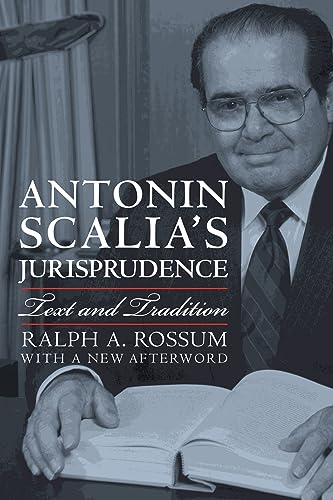

Antonin Scalia's jurisprudence text and tradition Ralph A. Rossum.
Detalles de publicación: Lawrence University Press of Kansas c2006.Descripción: x, 298 p. 24 cmISBN:- 0700614478 (cloth : alk. paper)
- 9780700614479 (cloth : alk. paper)
- 347.73/2634 B 22
- KF 8745 .S33 R67 2006
| Imagen de cubierta | Tipo de ítem | Biblioteca actual | Biblioteca de origen | Colección | Ubicación en estantería | Signatura topográfica | Materiales especificados | Info Vol | URL | Copia número | Estado | Notas | Fecha de vencimiento | Código de barras | Reserva de ítems | Prioridad de la cola de reserva de ejemplar | Reservas para cursos | |
|---|---|---|---|---|---|---|---|---|---|---|---|---|---|---|---|---|---|---|
| Libro | Biblioteca de Derecho Mons. Fremiot Torres Oliver Colección General biblioteca derecho | KF 8745 .S33 R67 2006 (Navegar estantería(Abre debajo)) | Disponible | 70000000841952 |
Descripciones mejoradas de Syndetics:
Lionized by the right and demonized by the left, Supreme Court Justice Antonin Scalia is the high court's quintessential conservative. Witty, outspoken, often abrasive, he is widely regarded as the most controversial member of the Court.
This book is the first comprehensive, reasoned, and sympathetic analysis of how Scalia has decided cases during his entire twenty-year Supreme Court tenure. Ralph Rossum focuses on Scalia's more than 600 Supreme Court opinions and dissents--carefully wrought, passionately argued, and filled with well-turned phrases--which portray him as an eloquent defender of an "original meaning" jurisprudence. He also includes analyses of Scalia's Court of Appeals opinions for the D.C. circuit, his major law review articles as a law professor and judge, and his provocative book, A Matter of Interpretation .
Rossum reveals Scalia's understanding of key issues confronting today's Court, such as the separation of powers, federalism, the free speech and press and religion clauses of the First Amendment, and the due process and equal protection clauses of the Fourteenth Amendment. He suggests that Scalia displays such a keen interest in defending federalism that he sometimes departs from text and tradition, and reveals that he has disagreed with other justices most often in decisions involving the meaning of the First Amendment's establishment clause. He also analyzes Scalia's positions on the commerce clause and habeas corpus clause of Article I, the take care clause of Article II, the criminal procedural provisions of Amendments Four through Eight, protection of state sovereign immunity in the Eleventh Amendment, and Congress's enforcement power under Section 5 of the Fourteenth Amendment.
The first book to fully articulate the contours of Scalia's constitutional philosophy and jurisprudence, Rossum's insightful study ultimately depicts Scalia as a principled, consistent, and intelligent textualist who is fearless and resolute, notwithstanding the controversy he often inspires.
Includes bibliographical references (p. 213-279) and index.
"Text and tradition" : Scalia's understanding of the interpretative enterprise -- Constitutional structure and separation of powers -- Constitutional structure and federalism -- Scalia's textualism applied to substantive rights -- Scalia's textualism applied to procedural rights -- The impact of Scalia's textualism on his colleagues -- Appendix. Cases in which Justice Scalia has cited dictionaries.
Tabla de contenidos provista por Syndetics
- Preface(p. ix)
- 1 Introduction(p. 1)
- 2 "Text and Tradition": Scalia's Understanding of the Interpretive Enterprise(p. 27)
- 3 Constitutional Structure and Separation of Powers(p. 52)
- 4 Constitutional Structure and Federalism(p. 90)
- 5 Scalia's Textualism Applied to Substantive Rights(p. 127)
- 6 Scalia's Textualism Applied to Procedural Rights(p. 166)
- 7 The Impact of Scalia's Textualism on His Colleagues(p. 198)
- Appendix Cases in Which Justice Scalia Has Cited Dictionaries(p. 209)
- Notes(p. 213)
- Index(p. 281)