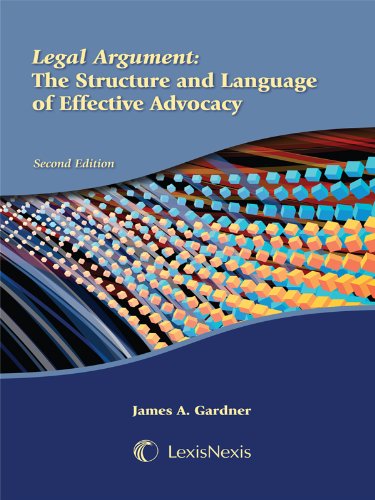

Legal argument the structure and language of effective advocacy James A. Gardner.
Detalles de publicación: Newark, NJ LexisNexis 2007.Edición: 2nd edDescripción: xvii, 169 p. 25 cmISBN:- 9781422418208
- Structure and language of effective advocacy
- KF 8915 .G28 2007
| Imagen de cubierta | Tipo de ítem | Biblioteca actual | Biblioteca de origen | Colección | Ubicación en estantería | Signatura topográfica | Materiales especificados | Info Vol | URL | Copia número | Estado | Notas | Fecha de vencimiento | Código de barras | Reserva de ítems | Prioridad de la cola de reserva de ejemplar | Reservas para cursos | |
|---|---|---|---|---|---|---|---|---|---|---|---|---|---|---|---|---|---|---|
| Libro | Biblioteca de Derecho Mons. Fremiot Torres Oliver Colección General biblioteca derecho | KF 8915 .G28 2007 (Navegar estantería(Abre debajo)) | c. 3 | Disponible | 70000000886817 | |||||||||||||
| Libro | Biblioteca de Derecho Mons. Fremiot Torres Oliver Colección General biblioteca derecho | KF 8915 .G28 2007 (Navegar estantería(Abre debajo)) | c. 1 | Disponible | 70000000841655 | |||||||||||||
| Libro | Biblioteca de Derecho Mons. Fremiot Torres Oliver Colección General biblioteca derecho | KF 8915 .G28 2007 (Navegar estantería(Abre debajo)) | c. 2 | Disponible | 70000000881651 |
Descripciones mejoradas de Syndetics:
Legal Argument: The Structure and Language of Effective Advocacy is a full-featured guide designed primarily for law students in research, writing, analysis and trial advocacy classes and moot court programs. Inside you'll find detailed explanations of how lawyers construct legal arguments and practical guidelines to the process of molding the raw materials of litigation--cases, statutes, testimony, documents, common sense--into instruments of persuasive advocacy. You'll also find writing guidelines that show you how to present a well-constructed legal argument in writing in a way that legal decision makers will find persuasive. The centerpiece of this indispensable work is its syllogism-based step-by-step method, designed to walk the advocate through the process of crafting a winning argument. Intuitive organization presents the material in five parts:
Part I sets out a general methodology for constructing legal arguments. Part II focuses more closely on the construction of persuasive, well-grounded legal premises, and covers the effective integration of legal doctrine and evidence into the argument's structure. Part III shows how to put the method to work by giving two detailed examples of the construction of complete legal arguments from scratch. Part IV provides a detailed protocol for reducing well-constructed legal arguments to written form, along with a concrete illustration of that process. It also provides concrete advice on how to recognize and avoid a host of common mistakes in the written presentation of legal arguments. Part V moves from the basics into more advanced techniques of persuasive legal argument, including rhetorical tactics like framing and emphasis, how to respond to arguments, maintaining professionalism in advocacy, and the ethical limits of argument.Includes bibliographical references.
The syllogism model -- Determining your conclusion from your position -- Building the premises -- Grounding the premises -- The major premise -- The minor premise -- Summary of the method -- Building a complete argument -- Introduction to writing arguments -- Writing a legal argument -- Common problems of written legal advocacy and how to avoid them -- Special problems of legal advocacy -- Responding to arguments -- Common tactics and rhetorical techniques of effective written advocacy -- Professionalism in advocacy -- The ethical limits of argument.