Imagen de portada de Amazon
Imagen de Amazon.com
Imagen de cubierta Syndetics
Portada de Syndetics
Imagen de OpenLibrary

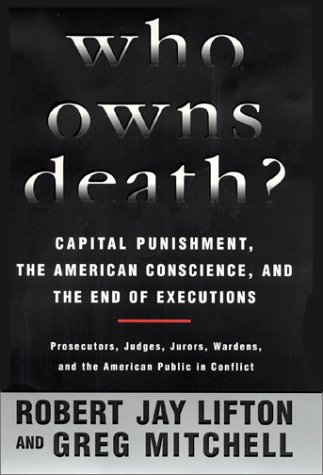
Who owns death? capital punishment, the American conscience, and the end of executions Robert Jay Lifton and Greg Mitchell.

Por: Colaborador(es): Detalles de publicación: New York, N.Y. Morrow c2000.Edición: 1st edDescripción: xvii, 270 p. 25 cmISBN:
  • 0380974983
  • 9780380974986
Tema(s): Clasificación CDD:
  • 364.66/0973 21
Clasificación LoC:
  • HV 8699 .U5 L54 2000
Contenidos:
The pope's travel plans: three states, three views of the death penalty -- Executions in America: trends and beginnings -- Methods of execution: seeking a "humane" end, from noose to needle -- Wardens and guards, chaplains and doctors -- Prosecutors and governors -- Jurors and judges -- Witnessing -- Murder victim's families -- Public opinion, private doubts -- The end of executions.
Valoración
    Valoración media: 0.0 (0 votos)
Existencias
Imagen de cubierta Tipo de ítem Biblioteca actual Biblioteca de origen Colección Ubicación en estantería Signatura topográfica Materiales especificados Info Vol URL Copia número Estado Notas Fecha de vencimiento Código de barras Reserva de ítems Prioridad de la cola de reserva de ejemplar Reservas para cursos
Libro Biblioteca de Derecho Mons. Fremiot Torres Oliver Colección General biblioteca derecho HV 8699 .U5 L54 2000 (Navegar estantería(Abre debajo)) Disponible 70000000841523
Total de reservas: 0

Descripciones mejoradas de Syndetics:

Conflict and ambivalence have surrounded capital punishment in the United States for centuries, but only now have we reached a state of profound confusion. The execution rate has soared by 800 percent in the post decade and, of the same time, opposition to state killing--on moral, practical, and legal grounds--has intensified. After a decade of dormancy, the capital punishment debate has asserted itself as a major political and social issue, and support for the death penalty, while still high, has dropped to its lowest level in nineteen years. America is clearly ready to ask the question "Who owns death?"

In this timely book, Robert Jay Lifton and Greg Mitchell, award-winning authors and collaborators on Hiroshima in America, take an unusual approach to the issue. By exploring the mind-sets of those directly involved in the death penalty, including prison wardens, prosecutors, jurors, religious figures, governors, judges, and relatives of murder victims, they offer a textured look at a system that perpetuates the longstanding American habit of violence.

Richly rewarding and meticulously researched, Who Owns Death? explores the history of the death penalty in the United States to explain how it has entered the American psyche. The authors probe changes in methods of execution, from hanging to lethal injection, considering what this search for more "humane" executions reveals about us as individuals and as a society. Through their interviews with participants, they uncover the psychological conflicts that complicate capital punishment, finding that those most deeply involved in the process reveal surprising doubts about, and even opposition to, state killing. In a controversial conclusion, the authors predict that executions in the United States will come to an end in the near future.

Powerful, passionate, and informed, Who Owns Death? is the right book at the right time. As citizens of the only Western democracy that sanctions state killing, Americans have to find a way to acknowledge simultaneously both the horror of the original murder and the wrongness of legal killing. This remarkable book shows the way.

Includes bibliographical references (p. [255]-263) and index.

The pope's travel plans: three states, three views of the death penalty -- Executions in America: trends and beginnings -- Methods of execution: seeking a "humane" end, from noose to needle -- Wardens and guards, chaplains and doctors -- Prosecutors and governors -- Jurors and judges -- Witnessing -- Murder victim's families -- Public opinion, private doubts -- The end of executions.

Reseñas proporcionadas por Syndetics

Library Journal Review

Eschewing the legal jargon often associated with the topic, Lifton (The Nazi Doctors) and Mitchell (Tricky Dick and the Pink Lady) offer a social and ethical perspective of the death penalty, highlighting the faulty logic behind it as well as its inherent conflict with the nation's moral conscience. In much the same manner that Hollywood assigns credits at the end of a movie to those who have participated in its creation, the authors assign possessory credit to each and every person involved in the bureaucratic process culminating in an execution. They allocate responsibility for the final act to specific individuals, such as prosecutors, judges, juries, defense attorneys, and state legislators, and citizens who vote for death-penalty proponents, among others. By shifting the blame from a nameless entity ("the state") toward individuals, the authors pinpoint and elucidate the weaknesses of the system. A new era of introspection and self-analysis is beginning to influence all participants in the grisly process, which, the authors contend, will result in the eventual abolition of capital punishment in America. Essential for anyone involved in the death penalty debate and highly recommended for academic and law libraries.DPhilip Y. Blue, New York State Supreme Court Criminal Branch Law Lib., New York (c) Copyright 2010. Library Journals LLC, a wholly owned subsidiary of Media Source, Inc. No redistribution permitted.

Publishers Weekly Review

In their preface, the authors write that they want to "understand the reasons for America's unyielding support for executions." But don't be fooled: this is a subtle, provocative argument against the death penalty. Lifton and Mitchell, longtime opponents of capital punishment, trace the history of the issue back to the GreeksÄinexplicably ignoring the penalty's biblical roots. The bulk of the book, however, delves into capital punishment today. Lifton and Mitchell argue that, in the U.S., one of the few Western industrialized countries to still practice the death penalty, this willingness for the state to execute its citizens derives from a deep-seated violent core of American history beginning with the American Revolution. Today, they say, the death penalty both feeds into a "pornography of violence" and fulfills our desire to eradicate evil. Relying heavily on case studies, the authors probe what they see as the corrosive effect of the death penalty on prison wardens and chaplains, as well as on the governors who often make the final decisions on whether a convicted criminal will die. Given what they report, the authors' optimism that the death penalty may be on the way out appears forced. But both opponents and supporters of the death penalty will find themselves enriched by this book. (Nov.) (c) Copyright PWxyz, LLC. All rights reserved

Booklist Review

In 1999, there were more than 550 prisoners on California's death row. More than 100 of them had been awaiting their executions for more than 15 years. That is merely one disturbing statistic in a book filled with disturbing statistics. Lifton and Mitchell offer a calm, rational discussion of a subject that too often provokes irrational behavior. They discuss capital punishment from a much-neglected angle, exploring the psychological and social ramifications of the death-penalty debate. Although capital punishment in the U.S. seems to be more accepted than ever before, the authors discovered in their research that Americans (even those who claim to support the death penalty) are deeply confused about the issue. But this is nothing new: one of the first debates over capital punishment, the authors point out, took place almost 2,500 years ago. By putting the current death-penalty debate in its historical context, the authors remind us that this is an issue that may never be resolved. An intelligent, rigorous, thought-provoking book. --David Pitt
Compartir
logopucpr-y-vive

Contáctanos

¡Queremos saber de ti!

Tel. 787.841.2000 Ext. 1801

bibliotecavaldes@pucpr.edu

⁣Búscanos en las redes

© 2026 Desarrollado por Ignite Online • All Rights Reserved • Powered by Koha.