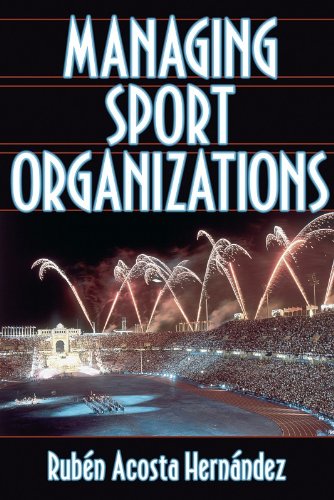

Managing sport organizations Rubén Acosta Hernández.
Idioma: Inglés Lenguaje original: Español Detalles de publicación: Champaign, IL Human Kinetics c2002.Descripción: xii, 299 p. ill. 24 cmISBN:- 0736038264
- 796/.06/9 21
- GV713 .A3613 2002
| Imagen de cubierta | Tipo de ítem | Biblioteca actual | Biblioteca de origen | Colección | Ubicación en estantería | Signatura topográfica | Materiales especificados | Info Vol | URL | Copia número | Estado | Notas | Fecha de vencimiento | Código de barras | Reserva de ítems | Prioridad de la cola de reserva de ejemplar | Reservas para cursos | |
|---|---|---|---|---|---|---|---|---|---|---|---|---|---|---|---|---|---|---|
| Libro | Biblioteca de Mayagüez Colección General mb | GV713 .A3613 2002 (Navegar estantería(Abre debajo)) | Disponible | 50000003181400 |
Descripciones mejoradas de Syndetics:
Dr. Rubén Acosta has built the International Volleyball Federation from a $100,000 operation to a $200,000,000 organization through his great understanding of sport marketing and management. In his book, Managing Sport Organizations, Dr. Acosta conveys his marketing and management insights and expertise. As a result, you will be able to build a successful sport program on the local, national, or international level.
Dr. Acosta offers straightforward advice to improve communication objectives, public relations goals, and promotion efforts--areas that many organizations fail to execute properly. The author goes into detail to show you how to market and promote a sport or event to the media and to train personnel and recruit members to aid in promotion. He also gives specific promotional strategies, such as having athletes promote the sport in their own community or country.
In addition, Dr. Acosta provides you with the skills needed to set and meet short-and long-term goals for your sport organization. The book is designed so that you will be able to build a sport organization from the ground up or improve on an existing organization.
Chapter 1 gives a historical overview and uses specific examples to explain current trends in sport organizations.
Chapter 2 describes the best strategies for establishing a new sport organization.
Chapter 3 offers tips on communicating with important people within the organization as well as the media.
Chapter 4 details how to project the right image to the press and the public.
Chapter 5 teaches how to establish a leadership style and manage and motivate staff.
Chapter 6 offers tips on setting goals and putting plans in place to achieve them.
Chapter 7 explains the budgeting process and the best strategies for planning an organization's future.
By utilizing the author's 30-plus years in sport leadership, Managing Sport Organizations provides you with the tools needed to develop contemporary sport management skills and sell your organization to sponsors, the press, and the public. With this unparalleled reference, you can successfully shape your sport program.
Translation of: Dirección, gestión y administracioón de las organizaciones deportivas.
Includes bibliographical references (p. 285-286) and index.
Machine generated contents note: Part I The World of Sport Organizations -- Chapter 1 Social Context for Modem Sport -- Need for New Structures in Sport Today -- International Sport Environment -- National Sport Enironment -- Sport Conflicts -- Sport Identity and Image -- Conclusion -- Chapter 2 A Successful Sport Organization -- Origins and Operations of a Sport Organization -- Choosing a Type of Organization -- Conclusion --Part II The Road to Success -- Chapter 3 The Power of Performance -- The Keys to Success -- Communicating Effectively -- Conclusion -- Chapter 4 Selling Sport to the Community -- Relating With the Media -- Relating With the Public -- Promotion and Fund-Raising -- Marketing Sport Events -- Conclusion -- Part III People Leading the Way -- Chapter 5 Being the Sport Manager -- Basics of Sport Management -- Management Function in Sport -- Enhancing Your Management Abilities -- Conclusion -- Chapter 6 Planning Your Organization's Work -- Planning Process -- Long-Term Planning -- Creating a Medium-Term National Plan -- Conclusion -- Chapter 7 Controlling Your Organization -- Fundamentals of Budgeting -- Controlling Deviations -- Conclusion.
gccabr2008
Tabla de contenidos provista por Syndetics
- Part I The World of Sport Organizations
- Chapter 1 The Social Sport Setting
- Chapter 2 Establishing a New Sport Organization
- Part II The Road to Success
- Chapter 3 The Power of Performance
- Chapter 4 Selling Sport to the Community
- Part III People Leading the Way
- Chapter 5 Being the Sport Manager
- Chapter 6 Planning Your Organization's Work
- Chapter 7 Controlling Your Organization
Notas de autor provistas por Syndetics
Rubén Acosta, PhD is president of the International Volleyball Federation (FIVB). During his tenure, the volleyball association grew from a $100,000 operation into a powerful $200,000,000 organization, making it one of the most successful marketing efforts in modern sport. Beach volleyball has also been recognized as an official Olympic medal event, while the FIVB has been under his guidance.
Dr. Acosta is currently serving on the International Olympic Committee. In the past, he served as the CEO of three major world championships in Mexico, the secretary general of the Mexican All Sports Confederation, and an executive member of the Mexican National Olympic Committee.
Dr. Acosta has received the Cross of the Chevalier of the Legion of Honour, the highest distinction of the French government. He has also been inducted into the International Scholar-Athlete Hall of Fame. Dr Acosta resides in Mexico but spends a great deal of his time in Switzerland. In his spare time, he enjoys swimming, playing golf, and listening to opera and classical music.