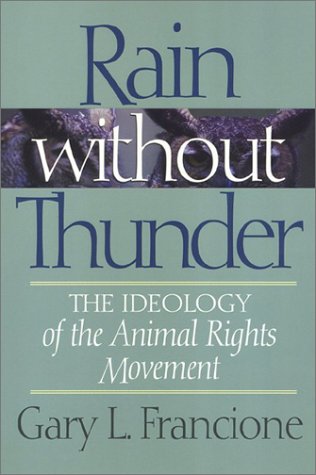

Rain without thunder the ideology of the animal rights movement Gary L. Francione.
Detalles de publicación: Philadelphia, Pa. Temple University Press 1996.Descripción: xii, 269 p. 24 cmTipo de contenido:- 1566394600 (cloth : alk. paper)
- 9781566394604 (cloth : alk. paper)
- 1566394619 (paper : alk. paper)
- 9781566394611 (paper : alk. paper)
- 179/.3 20
- HV 4764 .F73 1996
| Imagen de cubierta | Tipo de ítem | Biblioteca actual | Biblioteca de origen | Colección | Ubicación en estantería | Signatura topográfica | Materiales especificados | Info Vol | URL | Copia número | Estado | Notas | Fecha de vencimiento | Código de barras | Reserva de ítems | Prioridad de la cola de reserva de ejemplar | Reservas para cursos | |
|---|---|---|---|---|---|---|---|---|---|---|---|---|---|---|---|---|---|---|
| Libro | Biblioteca de Derecho Mons. Fremiot Torres Oliver Colección General biblioteca derecho | HV 4764 .F73 1996 (Navegar estantería(Abre debajo)) | Disponible | 70000000841309 |
Descripciones mejoradas de Syndetics:
Are animal welfare supporters indistinguishable from the animal exploiters they oppose? Do reformist measures "reaffirm "the underlying principles that make animal exploitation possible in the first place? In this provocative book, Gary L. Francione argues that the modern animal rights movement has become indistinguishable from a century-old concern with the "welfare "of animals that in no way prevents them from being exploited.
Francione maintains that advocating humane treatment of animals retains a sense of them as instrumental to human ends. When they are considered dispensable property, he says, they are left fundamentally without rights. Until the seventies, Francione claims, this was the paradigm within which the Animal Rights Movement operated, as demonstrated by laws such as the Federal Humane Slaughter Act of 1958.
In this wide-ranging book, Francione takes the reader through the philosophical and intellectual debates surrounding animal welfare to make clear the difference between animal rights and animal welfare. Through case studies such as campaigns against animal shelters, animal laboratories, and the wearing of fur, Francione demonstrates the selectiveness and confusion inherent in reformist programs that target fur, for example, but leave wool and leather alone.
The solution to this dilemma, Francione argues, is not in a liberal position that espouses the humane treatment of animals, but in a more radical acceptance of the fundamental inalienability of animal rights.
Includes bibliographical references and index.
Introduction : Animal rights and animal welfare -- 1. Animal rights: the rejection of instrumentalism -- 2. The new welfarists -- 3. The philosophical and historical origins of new welfarism -- 4. The results of new welfarism: the "animal confusion" movement -- 5. The empirical and structural defects of animal welfare theory -- 6. Is animal rights a "utopian" theory? -- Rights theory: an incremental approach -- Conclusion.