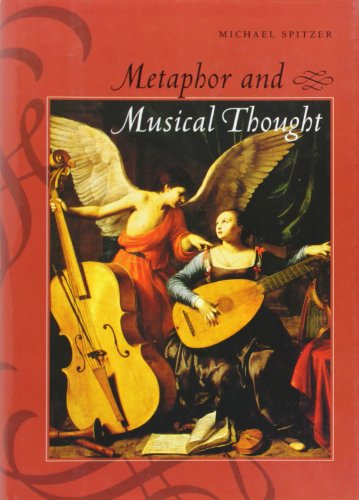

Metaphor and musical thought Michael Spitzer.
Detalles de publicación: Chicago University of Chicago Press 2004.Descripción: x, 380 p. ill. 25 cmISBN:- 0226769720 (alk. paper)
- 9780226769721 (alk. paper)
- 781.17 S7614m 21
- ML3845 .S684 2004
| Imagen de cubierta | Tipo de ítem | Biblioteca actual | Biblioteca de origen | Colección | Ubicación en estantería | Signatura topográfica | Materiales especificados | Info Vol | URL | Copia número | Estado | Notas | Fecha de vencimiento | Código de barras | Reserva de ítems | Prioridad de la cola de reserva de ejemplar | Reservas para cursos | |
|---|---|---|---|---|---|---|---|---|---|---|---|---|---|---|---|---|---|---|
| Libro | Biblioteca Encarnación Valdés Colección General bev | 781.17 S7614m (Navegar estantería(Abre debajo)) | Disponible | 80000002337585 |
Descripciones mejoradas de Syndetics:
"The scholarship of Michael Spitzer's new book is impressive and thorough. The writing is impeccable and the coverage extensive. The book treats the history of the use of metaphor in the field of classical music. It also covers a substantial part of the philosophical literature. The book treats the topic of metaphor in a new and extremely convincing manner."-Lydia Goehr, Columbia University
The experience of music is an abstract and elusive one, enough so that we're often forced to describe it using analogies to other forms and sensations: we say that music moves or rises like a physical form; that it contains the imagery of paintings or the grammar of language. In these and countless other ways, our discussions of music take the form of metaphor, attempting to describe music's abstractions by referencing more concrete and familiar experiences.
Michael Spitzer's Metaphor and Musical Thought uses this process to create a unique and insightful history of our relationship with music--the first ever book-length study of musical metaphor in any language. Treating issues of language, aesthetics, semiotics, and cognition, Spitzer offers an evaluation, a comprehensive history, and an original theory of the ways our cultural values have informed the metaphors we use to address music. And as he brings these discussions to bear on specific works of music and follows them through current debates on how music's meaning might be considered, what emerges is a clear and engaging guide to both the philosophy of musical thought and the history of musical analysis, from the seventeenth century to the present day. Spitzer writes engagingly for students of philosophy and aesthetics, as well as for music theorists and historians.
Includes bibliographical references (p. 351-366) and index.
The metaphorical present. The Aristotelian telescope -- New orientations in metaphor -- Conceptualization -- Poetics -- The metaphorical tradition. Sunflowers: toward a metaphorics of music history -- Harmony and painting -- Rhythm and language -- Melody and life.
Tabla de contenidos provista por Syndetics
- Acknowledgments
- Part I The Metaphorical Present The Aristotelian Telescope
- 1 What Is Metaphor?
- 2 Metaphor and Musical Thought
- 1 New Orientations in Metaphor
- 1 "Hearing as" and Dual-Aspect Perception
- 2 Basic-Level Mapping
- 3 Analytical Metaphors
- 4 Historical Metaphors
- 2 Conceptualization
- 1 Music and Metaphorical Thought
- 2 Schematism, Metaphors, and Prototypes
- 3 Excursus on Metaphor and Aesthetics
- 3 Poetics
- 1 Figures of Discourse: The Body in the Text
- 2 Musical Figures
- 3 Musical Discourse
- 4 Bach, Mozart, and Beethoven
- Part II The Metaphorical Tradition Sunflowers: Toward a Metaphorics of Music History
- 1 The Heliotrope
- 2 Metaphorization and Literalization
- 3 Map to Part II: Three Sunflowers
- 4 The Secret History: Structure without Structuralism
- 4 Harmony and Painting
- 1 Cultural Metaphors: The Dialogue of Harmony and Painting
- 2 Baroque Pedagogy
- 3 Painterly Discourse
- 5 Rhythm and Language
- 1 Cultural Metaphors: The Dialogue of Rhythm and Language
- 2 Classical Pedagogy
- 3 Linguistic Discourse
- 6 Melody and Life
- 1 Cultural Metaphors: The Dialogue of Melody and Life
- 2 Romantic Pedagogy
- 3 Organic Discourse
- Notes
- Bibliography
- Index