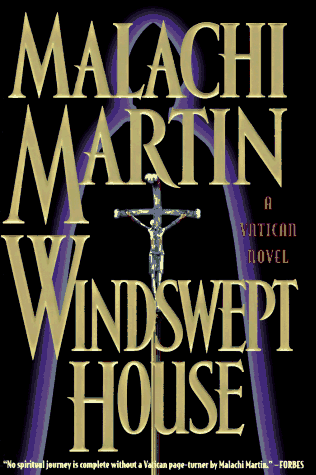
Imagen de portada de Amazon
Imagen de Amazon.com
Imagen de cubierta Syndetics
Portada de Syndetics
Imagen de OpenLibrary

Windswept house a Vatican novel Malachi Martin.

Por: Detalles de publicación: New York Doubleday c1996.Edición: 1st edDescripción: 646 p. 25 cmISBN:
  • 0385484089
  • 9780385484084
Tema(s): Clasificación CDD:
  • 813/.54 20
Clasificación LoC:
  • PS3563.A725 W56 1996
Resumen: In Rome, an attempt to overthrow the pope by a conspiracy of political and financial interests. The protagonists are two American brothers, one a lawyer who is leading the attack, the other a priest who is defending the pope. By the author of Vatican.
Valoración
    Valoración media: 0.0 (0 votos)
Existencias
Imagen de cubierta Tipo de ítem Biblioteca actual Biblioteca de origen Colección Ubicación en estantería Signatura topográfica Materiales especificados Info Vol URL Copia número Estado Notas Fecha de vencimiento Código de barras Reserva de ítems Prioridad de la cola de reserva de ejemplar Reservas para cursos
Libro Biblioteca Encarnación Valdés Colección General bev 813 M3791w 1996 (Navegar estantería(Abre debajo)) Disponible 80000002340027
Total de reservas: 0

Descripciones mejoradas de Syndetics:

"In Biblical times they would have called him a prophet," saidThe Dallas Morning Newsof Malachi Martin.The Houston Chronicledubbed him "one of the people most knowledgeable about the inner workings of the Vatican currently writing about the church." InWindswept House, this brilliant theologian and writer offers a gripping, provocative novel of faith and betrayal, power and conspiracy, within and without the walls of the Vatican. As the Cold War ends and the Soviet government collapses, a secret international association of political, religious, and financial leaders at last sees a clear path to a new world order--the establishment of a single global government and economy. Theirmodus operandi:taking control of the Roman Catholic Church by forcing the Pope's resignation and seizing power through a network of co-opted cardinals. Their perfect pawns: a pair of American brothers, one a lawyer and one a priest, scions of an old Texas family based at Windswept House, who will be placed as unknowing operatives within the Vatican. What the conspirators cannot know is that, while one brother will play along willingly, the other will become one of the Pope's closest allies--and that within their own ranks lies another, more secret group, with aims even more ambitious and deadly than their own. Complex and thrilling, set against a backdrop as broad as the world and as intimate as the most rarefied chambers of Vatican power and privilege,Windswept Houseis as vivid and immediate as today's headlines--and tomorrow's.

In Rome, an attempt to overthrow the pope by a conspiracy of political and financial interests. The protagonists are two American brothers, one a lawyer who is leading the attack, the other a priest who is defending the pope. By the author of Vatican.

Extracto provisto por Syndetics

History as Prologue: End Signs 1957 Diplomats schooled in harsh times and in the toughest ways of finance, trade and international rivalry are not much given to omens.  Still, today's enterprise brimmed with such promise that the six Foreign Ministers who gathered in Rome on March 25, 1957, felt that everything surrounding them--the rock-solid centrality of Europe's premier city, the cleansing winds, the open skies, the benign smile of the day's climate--was fortune's very cloak of blessing drawn about them as they laid the foundation stone for a new edifice of nations. As partners in the creation of a new Europe that would sweep away the squabbling nationalism that had so often split this ancient delta, these six men and their governments were one in their faith that they were about to open their lands to a wider economic horizon and a taller political sky than had ever been contemplated.  They were about to sign the treaties of Rome.  They were about to create the European Economic Community. In recent memory, nothing but death and destruction had been spawned in their capitals.  Only the year before, the Soviets had underscored their expansionist determination in the blood of Hungary's attempted uprising; any day Soviet armor could roll across Europe.  No one expected the U.S.A.  and its Marshall Plan to carry forever the burdens of building the new Europe.  Nor did any European government wish to be clamped between the U.S.A. and the U.S.S.R. in a rivalry that could only deepen in the decades ahead. As if already accustomed to acting as one in the face of such reality, all six ministers signed on as founders of the EEC.  The three representatives of the Benelux nations, because Belgium, the Netherlands and Luxembourg were the very crucible in which the idea of a new Europe had been tried and found true.  Or at least true enough.  The minister representing France, because his country would be the beating heart of the new Europe, as it had always been of the old Europe.  Italy, because his country was the living soul of Europe.  West Germany, because the world would never shunt his country aside again. So the European Community was born.  There were toasts to the geopolitical visionaries who had made this day possible.  To Robert Schuman and Jean Monnet of France; to Konrad Adenauer of West Germany; to Paul-Henri Spaak of Belgium. And there were congratulations all around.  It wouldn't be long before Denmark, Ireland and England would see the wisdom of the new venture.  And, while they might require some patient help, Greece, Portugal and Spain would join as well. Of course, there was the matter of holding the Soviets at bay.  And there was the matter of finding a new center of gravity.  But no doubt about it: the nascent EEC was the cutting edge of the new Europe that had to come if Europe was to survive. When all the signing and sealing and toasting were done, the moment came for the distinctively Roman ritual and privilege of diplomats: an audience with the octogenarian Pope in the Apostolic Palace on Vatican Hill. Seated on his traditional papal throne amid the panoply of Vatican ceremonial in an ornate sala, His Holiness Pius XII received the six ministers and their entourages with smiling countenance.  His welcome was sincere.  His remarks were brief.  His attitude was of a longtime owner and resident of a vast property giving some pointers to newly arrived and intending residents. Europe, the Holy Father recalled, had had its eras of greatness when a common faith had animated the hearts of its peoples.  Europe, he urged, would have its geopolitical greatness again, refurbished and burnished anew, if it could create a new heart.  Europe, he intimated, could again forge a supernal, common and binding faith. Inwardly, the ministers winced.  Pius had pointed to the greatest difficulty facing the EEC on the day of its birth.  Beneath his words lay the warning that neither democratic socialism nor capitalist democracy nor the prospect of the good life nor a mystic "Europa" of the humanists could provide the engine to drive their dream.  Practically speaking, their new Europe lacked a glowing center, a superior force or principle to bind it together and drive it forward. Practically speaking, their Europe lacked what this Pope had.  Lacked what he was. His points made, the Holy Father traced three crosses in the air as the traditional papal blessing.  Some few knelt to receive it.  Some who remained standing bowed their heads.  But it had become impossible for them to associate the Pope with the healing balm of the God he claimed to represent as Vicar, or to recognize that balm as the only cohesive factor that could mend the world's soul; neither could they acknowledge that economic and political treaties were not the glue that binds the hearts and minds of mankind. And yet, frail as he was, they could only envy this solitary, enthroned dignitary.  For, as Belgium's Paul-Henri Spaak later remarked, he presided over a universal organization.  And he was more than the elected represenive of that organization.  He was the possessor of its power.  He was its center of gravity. * * * From the window of his study on the third floor of the Apostolic Palace, the Holy Father watched the architects of the new Europe climb into their limousines in the square below. "What do you think, Holiness? Can their new Europe develop strongly enough to stop Moscow?" Pius turned to his companion--a German Jesuit, a longtime friend and favorite confessor.  "Marxism is still the enemy, Father.  But the Anglo-Saxons have the initiative." On this Pope's lips, Anglo-Saxon meant the Anglo-American establishment.  "Their Europe will go far.  And it will go fast.  But the greatest day for Europe has not yet dawned." The Jesuit failed to follow the papal vision.  "Which Europe, Holiness? The greatest day for whose Europe?" "For the Europe born today." The Pope's answer was unhesitating.  "On the day this Holy See is harnessed to the new Europe of the diplomats and politicians--to the Europe centered in Brussels and Paris--on that day the Church's misfortunes will start in earnest." Then, turning again to watch the limousines departing across St.  Peter's Square, "The new Europe will have its little day, Father.  But only a day." Excerpted from Windswept House: A Vatican Novel by Malachi Martin All rights reserved by the original copyright owners. Excerpts are provided for display purposes only and may not be reproduced, reprinted or distributed without the written permission of the publisher.

Reseñas proporcionadas por Syndetics

Publishers Weekly Review

A Black Mass in the Vatican in 1963 gets Malachi's first novel since Vatican (1985) off to a wicked start. A potentially gripping conflict between two American brothers‘one a priest, one a lawyer, both heirs to a fortune and to the family manse of Windswept House‘follows. But as Martin, a former Jesuit and veteran Church commentator, develops his complex plot, he begins to dwell to a fault upon the themes he's explored in numerous books, most recently The Keys of This Blood, 1991. Martin's concern is what he sees as the erosion of the Church's moral authority, both from within and without. Here, a Slavic pope who's obviously John Paul II is being maneuvered into approving the Resignation Protocol, which, if enacted, will force him to resign in the name of Church unity. Martin attributes this erosion to a global conspiracy among world powers both East and West, fueled by Satanic influence and by the failure of John XXIII to act upon the Third Prophecy of the Fatima Letter in 1960. The narrative is richly detailed with Church lore, but the sermonizing is incessant, with dialogue often sounding more like editorial commentary than speech. Many think of the current pope as theologically conservative, but Martin, through one of the brothers who have been caught up in the struggle, takes him roundly to task: "You have abandoned your seminarians to heretical teachers... your nuns to a destroying wave of secularizing feminists," and so on. What could have been a smart and shocking thriller winds up instead as an onslaught of ecclesiastical facts and religious opinions occasionally interrupted by plot. The wind that blows through this rambling shack of a novel is, ultimately, angry and hot. Major ad/promo; author tour. (June) (c) Copyright PWxyz, LLC. All rights reserved
Compartir
logopucpr-y-vive

Contáctanos

¡Queremos saber de ti!

Tel. 787.841.2000 Ext. 1801

bibliotecavaldes@pucpr.edu

⁣Búscanos en las redes

© 2026 Desarrollado por Ignite Online • All Rights Reserved • Powered by Koha.