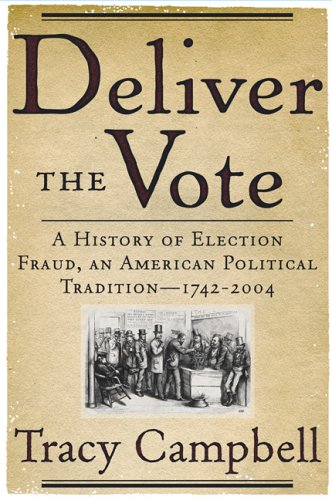

Deliver the vote a history of election fraud, an American political tradition, 1742-2004 Tracy Campbell.
Detalles de publicación: New York Carroll & Graf 2006.Edición: 1st Carroll & Graf trade pbk edDescripción: xix, 452 p. ill. 23 cmISBN:- 0786718439
- 9780786718436
- JK1994 .C36 2006
| Imagen de cubierta | Tipo de ítem | Biblioteca actual | Biblioteca de origen | Colección | Ubicación en estantería | Signatura topográfica | Materiales especificados | Info Vol | URL | Copia número | Estado | Notas | Fecha de vencimiento | Código de barras | Reserva de ítems | Prioridad de la cola de reserva de ejemplar | Reservas para cursos | |
|---|---|---|---|---|---|---|---|---|---|---|---|---|---|---|---|---|---|---|
| Libro | Biblioteca de Derecho Mons. Fremiot Torres Oliver Colección General biblioteca derecho | JK1994 .C36 2006 (Navegar estantería(Abre debajo)) | Disponible | 70000000839956 |
Descripciones mejoradas de Syndetics:
If elections are the lifeblood of democracy, then the United States is a sorely ailing body politic. From ballot stuffing and intimidating voters to suppressing turnout, buying votes, and manipulating returns, Deliver the Vote is an intensive examination of the corrupt underbelly of American politics. Drawing on records of hundreds of elections from the pre-colonial era through the 2004 election, historian Tracy Campbell reveals how a persistent culture of corruption has long thrived in local, state, and national elections. Among the public figures whose stories are central to his chronicle are Boss Tweed, William Randolph Hearst, Huey Long, Harry Truman, Lyndon Johnson, Jimmy Carter, and George W. Bush, as well as countless local and state politicians of all parties. Our elections are often held up as the model for the world's budding democracies to emulate. But after two of the most bitterly contested presidential elections in American history, this book shows how our democratic house has never been in proper order. Using a candid appraisal of our history as a guide, Deliver the Vote offers some surprising suggestions for a demoralized electorate to reclaim its democratic birthright.
Originally published by Carroll & Graf, 2005.
Includes bibliographical references (p. [399]-431) and index.
Tabla de contenidos provista por Syndetics
- Introduction: "The Inclination to Injustice"(p. xv)
- Part 1 The Failure of a Democratic Experiment
- Chapter 1 "I Never Saw Such Havock"(p. 3)
- A "Corrupting Influence"
- The Rise of Parties
- "The Pivot on Which Turns the First Wheel"
- "Let Dogs Be Registered!"
- "We Ought to Be the Last People Afraid to Vote"
- Tammany Hall
- "The Embodiment of All That Is Fraudulent"
- Defining the Problem
- Freedom or Slavery
- Chapter 2 The Limits of Popular Sovereignty(p. 31)
- Kansas Dirt
- Federal Complicity
- "What Is Popular Government Worth?"
- Regulating the Election
- 1860
- Chapter 3 "Can You Hold Your State?"(p. 51)
- "Without Restraint or Regulation"
- "You Can Fill Them Up as Well as We Can Here"
- Black Suffrage
- "We Intend to Succeed by Intimidation"
- The Thefts of 1876
- Who Decides?
- The Greatest Danger to Free Government
- Chapter 4 "The Holiest Institution of the American People"(p. 83)
- Self-Preservation
- Shaving Moustaches
- Social Darwinism and Elections
- Challenges
- "Men of the Strictest Integrity"
- Approaching the Gates of the Penitentiary
- Voting in Secret
- "The People Are Demoralized"
- "We Have Taken a City. To God Be the Praise"
- The Agents of Democracy
- Part 2 The Struggle to Reclaim Democracy
- Chapter 5 How to Steal an Election(p. 113)
- "The Political Filth of Louisville"
- "We Were Cheated on Every Side"
- Nothing Short of Revolutionary Tactics
- "All Elections Require Money"
- "The Wagon That Stole Our Rights"
- "Frauds Open and Brazen"
- The Triumph of Democracy
- A City of White People
- "Louisville Is Not a Hardened Sinner"
- Chapter 6 "The Lowest Layer of Corruption"(p. 136)
- Hearst
- "It's Just a Condition Down There"
- "Worse Than Dynamite"
- "Next Time, Be More Careful"
- The Suffrage Issue
- Congressional Remedies
- Less Than a One-in-Eight Chance
- "Accept Defeat Like a Man"
- Chapter 7 The Real Foundations of the Gateway Arch(p. 160)
- The St. Louis Tradition
- Developing the Riverfront
- The Dictator
- Delivering the Vote
- "Voted 'Em Like Soldiers"
- "A Miscarriage of Justice"
- "It Stinks"
- "The Greatest Memorial Since the Eiffel Tower"
- Chapter 8 "Consistency, Thou Art a Jewel"(p. 192)
- Pendergast
- Stealing Second Base
- Outdummied
- The Proper Protection
- Women and the Honest Election League
- EPIC
- Bloody Harlan
- "Sober, Square, and Honest"
- Part 3 The Path to Popular Resignation
- Chapter 9 Uncomfortable Majorities(p. 215)
- "God Almighty, Sears Roebuck, and Gene Talmadge"
- "These are the Same Old Cracker Tactics"
- "We Didn't Steal as Many Counties as You Think"
- The Duke of Duval
- "As Clean an Election As Ever Has Been Held"
- Ballot Box 13
- "Yes, It's True"
- "The Good, the True, and the Beautiful"
- "One Person, One Vote"
- "You Haven't Learned Anything About Voting My Way"
- Chapter 10 "Elections Are Like Cement"(p. 242)
- Legalized Bribery
- "It Was Going to Be All Right"
- "Be Held for Naught"
- "A Sad Day in American Politics"
- Hawaii
- Set in Concrete
- "Substantial Non-Complementary Miscounts"
- The Cold Light of the Next Dawn
- Uncovering the Daley Machine
- Chapter 11 Thieves Who Steal Democracy(p. 268)
- The Freedom Ballot
- Protective Zones
- Plaquemines-"This Is the First Time We've Had an Open Election"
- "To Get 50 Percent of the Vote, You've Got to Buy It"
- Absentee Ballots and Bullets
- "A Successful Flea Market"
- Phantom Voters
- The Paradox of Modern Civic Life
- "Democracy Is Dispensable in Miami"
- Chapter 12 A Hidden Time Bomb(p. 292)
- Suspicious Activity
- Dead Man Running
- "From the Comfort of Your Home"
- Count Till You Win
- Hyper-Technical Reliances
- "Until Voters Get to Speak Again"
- "Widespread Voter Disfranchisement"
- "Count Every Vote"
- Semi-Spontaneous Combustion
- 537 Votes
- Bush v. Gore
- "Our Votes Are Not Sacrosanct"
- Conclusion: "Something Very Personal"(p. 325)
- 2004
- "Have a Nice Day"
- New Machines
- "The Long and Ugly Tradition"
- Reclaiming Democracy
- "Something Very Personal"
- Endnotes(p. 341)
- Selected Bibliography(p. 399)
- Acknowledgments(p. 433)
- Index(p. 439)
- About the Author(p. 453)