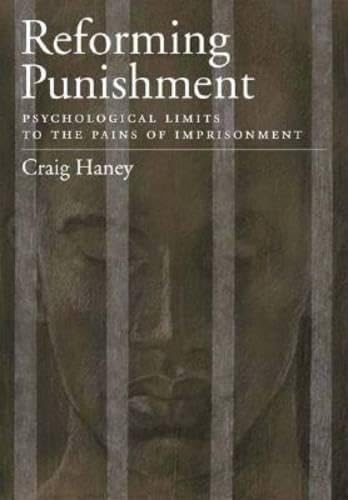

Reforming punishment psychological limits to the pains of imprisonment Craig Haney.
Series The law and public policyDetalles de publicación: Washington, DC American Psychological Association c2006.Edición: 1st edDescripción: xxii, 386 p. ill. 26 cmISBN:- 1591473179
- 365/.973 22
- HV9471 .H33 2006
| Imagen de cubierta | Tipo de ítem | Biblioteca actual | Biblioteca de origen | Colección | Ubicación en estantería | Signatura topográfica | Materiales especificados | Info Vol | URL | Copia número | Estado | Notas | Fecha de vencimiento | Código de barras | Reserva de ítems | Prioridad de la cola de reserva de ejemplar | Reservas para cursos | |
|---|---|---|---|---|---|---|---|---|---|---|---|---|---|---|---|---|---|---|
| Libro | Biblioteca de Mayagüez Colección General mb | HV9471 .H33 2006 (Navegar estantería(Abre debajo)) | Disponible | 50000003179198 |
Descripciones mejoradas de Syndetics:
In Reforming Punishment: Psychological Limits to the Pains of Imprisonment, author Craig Haney argues that the United States justice and prison system suffers from fatal structural and legal flaws that cause pain to the imprisoned and ultimately increase crime. Today the U.S. imprisons more people than any other nation. Prisons cause prisoners to make adaptations so they can take the long-term exposure to pain and these adaptations cause personal and social problems, both while offenders are imprisoned and after the offenders are released. Haney presents evidence that problems in prisons - which include overcrowding, violence, and sexual assault - are the result of poor design, lack of funding, and an outdated understanding of individual punishment that does not acknowledge the context in which crimes are perpetrated.
Includes bibliographical references and indexes.
Introduction: Humane values, psychology, and the pains of imprisonment -- Human nature and the history of imprisonment -- Spreading pain : the punitive state and the state of the prisons -- Attribution error as crime control and prison polict -- Context matters : social history -- Surviving the social context of prison -- overcrowding and the situational pathologies of prison -- Special needs prisoners in extremis -- Prison law and the disregard of context -- Limiting prison pain : a psychologically informed corrections agenda -- Toward a rational prison policy.
gccoct2007
Tabla de contenidos provista por Syndetics
- Preface(p. xiii)
- Acknowledgments(p. xxi)
- Chapter 1 Humane Values, Psychology, and the Pains of Imprisonment(p. 3)
- Modern Psychological Theory and the Revamped Role of Prison(p. 6)
- The Problematics of Pain: Limiting Prison Excess(p. 9)
- Adapting to Long-Term Incarceration: The Deferred Pains of Imprisonment(p. 13)
- Victims' Rights and Prison Pain(p. 15)
- Conclusion(p. 17)
- I Psychology and the Prison Form(p. 25)
- Chapter 2 Human Nature and the History of Imprisonment(p. 27)
- The Emergence of the Prison Form(p. 28)
- Psychological Individualism, Perfectibility, and Prison Policy(p. 30)
- The Rise of Psychological and Prison "Science"(p. 34)
- Psychological Science and the Pragmatics of Confinement(p. 37)
- Formalizing the Rehabilitative Ideal(p. 38)
- Psychology in the "Progressive Era" Criminal Justice System(p. 40)
- The Practice of Prison Psychology(p. 44)
- Prison Trends at Midcentury: Science Begins to Pay Modest Dividends(p. 47)
- Conclusion(p. 48)
- Chapter 3 Spreading Pain: The Punitive State and the State of the Prisons(p. 57)
- The Corrections Crisis by the Numbers(p. 61)
- The Racialization of Prison Pain(p. 64)
- The Crisis Expands: Accommodating the Press of Numbers(p. 65)
- The Climate of Harsh Punishment(p. 68)
- Prison Failure Begets Prison Growth(p. 70)
- The Benefits and Burdens of Mass Imprisonment(p. 74)
- Conclusion(p. 80)
- Chapter 4 Attribution Error as Crime Control and Prison Policy(p. 91)
- The Punitive Legacy of Slavery(p. 92)
- Context and Criminal Law: "Fundamental Attribution Error" as Crime Policy(p. 95)
- Mandated Ignorance: Dispositionalizing Race-Based Disparity(p. 98)
- Drug Laws: Waging War With Prison Pain(p. 103)
- Race, Drugs, and Prison Policy: A Nexus of Causes and Consequences(p. 107)
- Conclusion(p. 113)
- II Prison as Criminogenic Context(p. 125)
- Chapter 5 Context Matters: Social History, Circumstance, and Crime Causation(p. 127)
- The Contextual Revolution in Psychology(p. 129)
- Criminogenic Lives: The Role of Social Historical Factors(p. 133)
- Juvenile Institutionalization: State-Sanctioned Risk Factors(p. 139)
- Criminogenic Contexts: The Role of Immediate Situations(p. 141)
- The Criminogenics of Race and Ethnicity in a Divided Society(p. 146)
- Conclusion(p. 148)
- Chapter 6 Surviving the Social Context of Prison(p. 161)
- Measuring Prison Pain(p. 163)
- The Psychological Toll of Incarceration(p. 167)
- Coping With the Stress of Imprisonment(p. 169)
- On Prisonization as Coping(p. 174)
- Prison Conditions and Prison Violence(p. 181)
- Extreme Reactions to Painful Conditions of Confinement(p. 184)
- Conclusion(p. 186)
- Chapter 7 Overcrowding and the Situational Pathologies of Prison(p. 199)
- Overcrowding: The Emergence of a Destructive Correctional Norm(p. 201)
- Crowding and Deprivation: Creating a Dysfunctional Prison Context(p. 203)
- The Dynamics of Desperation: Cycles of Dysfunctional Behavior(p. 205)
- Measuring Harm in Unstable Prison Systems(p. 207)
- Prisons Behaving Badly: The Broader Context of Overcrowding(p. 209)
- Ignoring the Critical Needs of Prisoners in Times of Crisis(p. 211)
- Maintaining Control Through Force and Intimidation(p. 213)
- The Contextual Origins of the Prison Gang(p. 218)
- The Legacy of Adverse Conditions: Riots and Recidivism(p. 220)
- Conclusion(p. 225)
- Chapter 8 "Special Needs" Prisoners in Extremis(p. 241)
- The Legal Status of "Special Needs" Prisoners(p. 243)
- Recent Trends in Incarcerating Vulnerable Persons(p. 244)
- Prevalence Estimates of Especially Vulnerable Prisoners(p. 248)
- Context-Based Special Challenges: Rules, Conflict, and Discipline(p. 254)
- Patterns of "Maladaptation" Among Vulnerable Prisoners and the Implications of "Prison Madness"(p. 256)
- Conclusion(p. 260)
- III Using Psychology to Limit Prison Pain(p. 269)
- Chapter 9 Prison Law and the Disregard of Context(p. 271)
- The Evolution of the Eighth Amendment(p. 273)
- Developing Minimal Standards for Regulating Harsh Conditions(p. 275)
- The Individualizing of the Constitutional Law of Prisons(p. 278)
- Narrowing the Legal Scope of Prison "Harm"(p. 280)
- The Wages of Deference: Race and the Context of Imprisonment(p. 283)
- Beginning to Evaluate and Limit Painful Conditions of Confinement(p. 285)
- Conclusion(p. 290)
- Chapter 10 Limiting Prison Pain: A Psychologically Informed Corrections Agenda(p. 303)
- Limiting Prison Pain by Ending the Overuse of Imprisonment(p. 305)
- Do No Harm: Normalizing Prison Contexts(p. 308)
- Minimizing and Responding to Adverse Prison Effects(p. 311)
- Resurrecting the Rehabilitative Ideal(p. 313)
- Psychological Treatment in a Context-Oriented Prison Setting(p. 319)
- Race-Related Prison Reforms(p. 323)
- Gangs and Context: Reducing Prison Pathologies(p. 326)
- The Context of Reentry: Preserving Positive Change(p. 328)
- Conclusion(p. 331)
- Chapter 11 Toward a Rational Prison Policy(p. 351)
- Author Index(p. 355)
- Subject Index(p. 371)
- About the Author(p. 385)