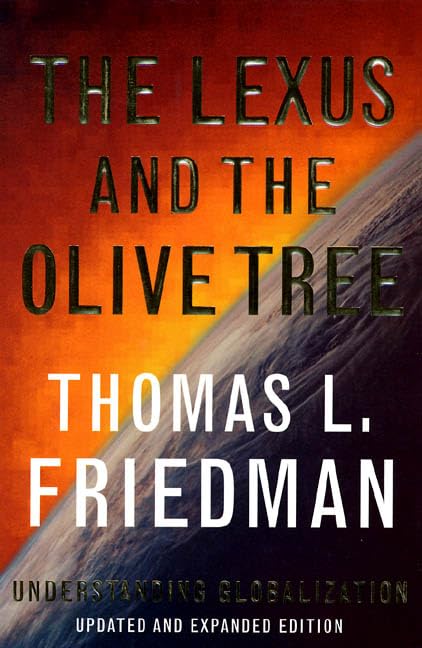

The Lexus and the olive tree Thomas L. Friedman.
Detalles de publicación: New York Farrar, Straus, Giroux 2000.Edición: Rev. edDescripción: xxi, 469 p. 24 cmISBN:- 0374185522 (alk. paper)
- 337 F9112L 21
- HF1359 .F74 2000b
| Imagen de cubierta | Tipo de ítem | Biblioteca actual | Biblioteca de origen | Colección | Ubicación en estantería | Signatura topográfica | Materiales especificados | Info Vol | URL | Copia número | Estado | Notas | Fecha de vencimiento | Código de barras | Reserva de ítems | Prioridad de la cola de reserva de ejemplar | Reservas para cursos | |
|---|---|---|---|---|---|---|---|---|---|---|---|---|---|---|---|---|---|---|
| Libro | Biblioteca Encarnación Valdés Colección General bev | 337 F9112L (Navegar estantería(Abre debajo)) | Disponible | 80000002331224 |
Descripciones mejoradas de Syndetics:
A brilliant investigation of globalization, the most significant socioeconomic trend in the world today, and how it is affecting everything we do-economically, politically, and culturally-abroad and at home.
As foreign affairs columnist for" The New York Times," Thomas L. Friedman crisscrosses the globe talking with the world's economic and political leaders, and reporting, as only he can, on what he sees. Now he has used his years of experience as a reporter and columnist to produce a pithy, trenchant, riveting look at the worldwide market forces that are driving today's economies and how they are playing out both internationally and locally.
Globalization is the technologically driven expression of free-market capitalism, and as such is essentially an American creation. It has irrevocably changed the way business is done and has raised living standards throughout the world. But powerful local forces-of religion, race, ethnicity, and cultural identity-are in competition with technology for the hearts and minds of their societies. Finding the proper balance between the Lexus and the olive tree is the great game of globalization-and the ultimate theme of Friedman's challenging, provocative book, essential reading for all who care about how the world really works.
Includes index.
Opening scene : the world is ten years old -- Seeing the system: The new system -- Information arbitrage -- Lexus and the olive tree -- And the walls came tumbling down -- Microchip immune deficiency -- The golden straitjacket -- The electronic herd -- Plugging into the system: DOScapital 6.0 -- Globalution -- Shapers, adapters, and other new ways of thinking about power -- Buy Taiwan, hold Italy, sell France -- The golden arches theory of conflict prevention -- Demolition man -- Winners take all -- Backlash against the system: Backlash -- Groundswell -- America and the system: Rational exuberance -- Revolution is U.S. -- If you want to speak to a human being, press 1 -- There is a way forward.
A brilliant investigation of globalization, the most significant socioeconomic trend in the world today, and how it is affecting everything we do-economically, politically, and culturally-abroad and at home. As foreign affairs columnist for The New York Times, Thomas L. Friedman crisscrosses the globe talking with the world's economic and political leaders, and reporting, as only he can, on what he sees. Now he has used his years of experience as a reporter and columnist to produce a pithy, trenchant, riveting look at the worldwide market forces that are driving today's economies and how they are playing out both internationally and locally. Globalization is the technologically driven expression of free-market capitalism, and as such is essentially an American creation. It has irrevocably changed the way business is done and has raised living standards throughout the world. But powerful local forces-of religion, race, ethnicity, and cultural identity-are in competition with technology for the hearts and minds of their societies. Finding the proper balance between the Lexus and the olive tree is the great game of globalization-and the ultimate theme of Friedman's challenging, provocative book, essential reading for all who care about how the world really works.
Tabla de contenidos provista por Syndetics
- Foreword to the Anchor Edition(p. ix)
- Opening Scene: The World Is Ten Years Old(p. xi)
- Part 1 Seeing the System
- 1. The New System(p. 3)
- 2. Information Arbitrage(p. 17)
- 3. The Lexus and the Olive Tree(p. 29)
- 4. ... And the Walls Came Tumbling Down(p. 44)
- 5. Microchip Immune Deficiency(p. 73)
- 6. The Golden Straitjacket(p. 101)
- 7. The Electronic Herd(p. 112)
- Part 2 Plugging into the System
- 8. DOScapital 6.0(p. 145)
- 9. Globalution(p. 167)
- 10. Shapers, Adapters and Other New Ways of Thinking About Power(p. 194)
- 11. Buy Taiwan, Hold Italy, Sell France(p. 212)
- 12. The Golden Arches Theory of Conflict Prevention(p. 248)
- 13. Demolition Man(p. 276)
- 14. Winners Take All(p. 306)
- Part 3 The Backlash Against the System
- 15. The Backlash(p. 327)
- 16. The Groundswell(p. 348)
- Part 4 America and the System
- 17. Rational Exuberance(p. 367)
- 18. Revolution Is U.S.(p. 379)
- 19. If You Want to Speak to a Human Being, Press 1(p. 406)
- 20. There Is a Way Forward(p. 434)
- Acknowledgments(p. 477)
- Index(p. 480)
Extracto provisto por Syndetics
Reseñas proporcionadas por Syndetics
Booklist Review
Friedman, a foreign correspondent for the New York Times, has written an accessible and informative primer on globalization and its currency in the world today. He uses his extensive reporting experience to better frame the observations and comments of economists, politicians, and ordinary people around the world. Friedman cites two extremes of global trends: growing consumerism and the desire for material well-being (as represented by the Lexus automobile) and conflicts over territorial tradition and security (as represented by the olive tree). The collapse of communism has left capitalism as the economic system with potential for universal application, not just as an internal economic system but as a mode of interchange between nations and people. Friedman conceptualizes globalization as the overriding international trend of the post-cold war era, with the U.S. maintaining a major role as both a power and a model. The driving ideal behind globalization is free market capitalism, which is homogenizing markets that are dispersed but reachable through major financial centers. The globalization trend is driven by the electronic herd of worldwide investors who seek good returns and will withdraw their money at the drop of a dime. Globalization is also technology-driven, resulting from the democratization of information through personal computers. In turn, technology has helped foster the democratization of finance via junk bonds, mutual funds, and hedge funds. Friedman notes that the one constant in the trend toward globalization is change, and the prerequisites for survival are flexibility and adjustment. Though Friedman sees great potential in the trend, he also sees threats for nations that fail to accept the reality of globalization and adopt a strategy for survival within it. Friedman's fascinating book provides insightful perspective on this important trend. (Reviewed March 1, 1999)0374192030Vernon FordNotas de autor provistas por Syndetics
Journalist Thomas L. Friedman was born in 1953 in Minneapolis, Minnesota. Friedman graduated from Brandeis University with a degree in Mediterranean Studies and earned a graduate degree from Oxford in Modern Middle East Studies. His reporting on the war in Lebanon won the George Polk Award, the Pulitzer Prize, and the Livingston Award for Young Journalists. He won a second Pulitzer for his work in Israel. Friedman began his career as a correspondent for United Press International and later served as bureau chief for the New York Times in Beirut and Jerusalem. He moved to the op-ed page of The New York Times as a foreign affairs columnist. In 2002, Friedman won his third Pulitzer Prize, this time for Commentary.Friedman wrote about his experiences as a Jewish-American reporter in the Middle East in From Beirut to Jerusalem, which won the National Book Award in 1989. The bestselling Lexus and the Olive Tree won the 2000 Overseas Press Club Award for best nonfiction book on foreign policy. He wrote Longitudes and Attitudes: Exploring the World After September 11 and The World Is Flat, which received the first Financial Times and Goldman Sachs Business Book of the Year Award. His other works include Hot, Flat, and Crowded, Hot, Flat, and Crowded 2.0, and That Used to Be Us which made The New York Times Best Seller List for 2012. His title, Thank You for Being Late, made the New York Times Best Seller List in 2016.
(Bowker Author Biography)