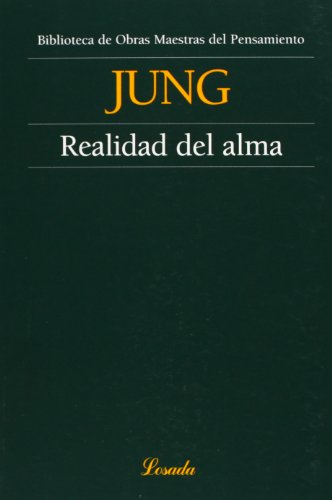

Realidad del alma : aplicación y progreso de la nueva psicología / Carl Gustav Jung ; traducción: Fernando Vela y Felipe Jiménez de Asúa.
Series Biblioteca de obras maestras del pensamiento ; 11Detalles de publicación: Buenos Aires : Losada, c2003.Edición: 1a edDescripción: 229 p. : 22 cmTipo de contenido:- 9500378183
| Imagen de cubierta | Tipo de ítem | Biblioteca actual | Biblioteca de origen | Colección | Ubicación en estantería | Signatura topográfica | Materiales especificados | Info Vol | URL | Copia número | Estado | Notas | Fecha de vencimiento | Código de barras | Reserva de ítems | Prioridad de la cola de reserva de ejemplar | Reservas para cursos | |
|---|---|---|---|---|---|---|---|---|---|---|---|---|---|---|---|---|---|---|
| Libro | Biblioteca de Mayagüez Colección General mb | BF173 .J818 2003 (Navegar estantería(Abre debajo)) | Disponible | 50000003178380 | ||||||||||||||
| Libro | Biblioteca Encarnación Valdés Colección General bev | 150.195 J951w 2003E (Navegar estantería(Abre debajo)) | Disponible | 80000002333840 |
Descripciones mejoradas de Syndetics:
Formado en la escuela freudiana, Carl gustav Jung no tardo en encaminarse por terreno propio. Su mayor aportacion al psicoanalisis fue el concepto de inconsciente colectivo, y no menor merito le compete por haber sido el iniciador de la caracterologia de los tipos psicologicos que distingue a los introvertidos de los extravertidos. Pero el interes principal de Jung se centra en el problema de la realidad, "puesto que el alma intenta adaptarse a la realidad mediante la expansion de sus propias energias y la expresion simbolica de sus propios impulsos. El inconsciente colectivo seria el deposito de energia del cual se forma la cociencia individual y el conjunto de relaciones entre esta y la conciencia social que designamos con el nombre de persona."
Translation of: Wirklichkeit der seele ; anwendungen und fortschritte der neueren psychologie.
gccsep2007
Notas de autor provistas por Syndetics
Carl Gustav Jung was born in Switzerland on July 26, 1875. He originally set out to study archaeology, but switched to medicine and began practicing psychiatry in Basel after receiving his degree from the University of Basel in 1902. He became one of the most famous of modern psychologists and psychiatrists. Jung first met Sigmund Freud in 1907 when he became his foremost associate and disciple. The break came with the publication of Jung's Psychology of the Unconscious (1912), which did not follow Freud's theories of the libido and the unconscious. Jung eventually rejected Freud's system of psychoanalysis for his own "analytic psychology." This emphasizes present conflicts rather than those from childhood; it also takes into account the conflict arising from what Jung called the "collective unconscious"---evolutionary and cultural factors determining individual development.Jung invented the association word test and contributed the word complex to psychology, and first described the "introvert" and "extrovert" types. His interest in the human psyche, past and present, led him to study mythology, alchemy, oriental religions and philosophies, and traditional peoples. Later he became interested in parapsychology and the occult. He thought that unidentified flying objects (UFOs) might be a psychological projection of modern people's anxieties.
He wrote several books including Studies in Word Association, Flying Saucers: A Modern Myth of Things Seen in the Skies, and Psychology and Alchemy. He died on June 6, 1961 after a short illness.
(Bowker Author Biography)