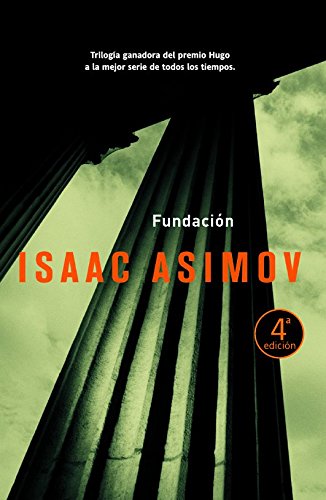

Fundación Isaac Asimov; traducción: Manuel Mata Álvarez-Santullano.
Detalles de publicación: Madrid La Factoría de Ideas 2007.Edición: 2a. edDescripción: 314[5] p. 23 cmISBN:- 9788498003116
- 8498003113
| Imagen de cubierta | Tipo de ítem | Biblioteca actual | Biblioteca de origen | Colección | Ubicación en estantería | Signatura topográfica | Materiales especificados | Info Vol | URL | Copia número | Estado | Notas | Fecha de vencimiento | Código de barras | Reserva de ítems | Prioridad de la cola de reserva de ejemplar | Reservas para cursos | |
|---|---|---|---|---|---|---|---|---|---|---|---|---|---|---|---|---|---|---|
| Libro | Biblioteca Encarnación Valdés Colección General bev | 813 A832f2 E (Navegar estantería(Abre debajo)) | Disponible | 80000002333824 |
Includes bibliographical references.
Reseñas proporcionadas por Syndetics
Publishers Weekly Review
Set in a fictional South American nation where guerrillas have long clashed with the government, Alarcón's (Guerra en la penumbra, Rayo, 2005; War by Candlelight, HarperCollins, 2005) ambitious first novel follows a trio of characters upended by civil strife. Norma, whose husband Rey disappeared ten years ago after the end of a civil war, hosts popular radio show Lost City Radio, which reconnects callers with their missing loved ones. ... When an 11-year-old orphan, Victor, shows up at the radio station with a list of his distant village's "lost people," the station plans a special show dedicated to his case.... Norma, meanwhile, notices a name on the list that's an alias her husband used to use, prompting her to resume her quest to find him. She and Victor travel to Victor's home village, where local teacher Manau reveals to Norma what she's long feared-and more. ... [A] successful and nimbly handled portrayal of war's lingering consequences. [PW 10/23/06] (Foundation)Asimov, Isaac.Often cited as one of the most important science fiction texts ever written, Asimov's Foundation is the first book in a series of seven novels. Earth, at the opening of this saga, has long since disappeared, and the galaxy is unified under the Galactic Empire based in Trántor. Hari Seldon, founder of "psychohistory," a predictive branch of science, has foreseen the long age of barbarism that will follow the imminent collapse of the Empire. Seldon and his staff work to minimize the span of the coming Dark Age by compiling all human knowledge into an Encyclopedia in a faraway sanctuary Seldon calls the "Foundation." It will take many years to complete, and meanwhile, they are faced with the impending threat of the warlords who rise to fill the vacuum created by the crumbling of the Empire's power. (c) Copyright PWxyz, LLC. All rights reserved All rights reserved.Notas de autor provistas por Syndetics
Isaac Asimov was born in Petrovichi, Russia, on January 2, 1920. His family emigrated to the United States in 1923 and settled in Brooklyn, New York, where they owned and operated a candy store. Asimov became a naturalized U.S. citizen at the age of eight. As a youngster he discovered his talent for writing, producing his first original fiction at the age of eleven. He went on to become one of the world's most prolific writers, publishing nearly 500 books in his lifetime.Asimov was not only a writer; he also was a biochemist and an educator. He studied chemistry at Columbia University, earning a B.S., M.A. and Ph.D. In 1951, Asimov accepted a position as an instructor of biochemistry at Boston University's School of Medicine even though he had no practical experience in the field. His exceptional intelligence enabled him to master new systems rapidly, and he soon became a successful and distinguished professor at Columbia and even co-authored a biochemistry textbook within a few years.
Asimov won numerous awards and honors for his books and stories, and he is considered to be a leading writer of the Golden Age of science fiction. While he did not invent science fiction, he helped to legitimize it by adding the narrative structure that had been missing from the traditional science fiction books of the period. He also introduced several innovative concepts, including the thematic concern for technological progress and its impact on humanity.
Asimov is probably best known for his Foundation series, which includes Foundation, Foundation and Empire, and Second Foundation. In 1966, this trilogy won the Hugo award for best all-time science fiction series. In 1983, Asimov wrote an additional Foundation novel, Foundation's Edge, which won the Hugo for best novel of that year. Asimov also wrote a series of robot books that included I, Robot, and eventually he tied the two series together. He won three additional Hugos, including one awarded posthumously for the best non-fiction book of 1995, I. Asimov. "Nightfall" was chosen the best science fiction story of all time by the Science Fiction Writers of America.
In 1979, Asimov wrote his autobiography, In Memory Yet Green. He continued writing until just a few years before his death from heart and kidney failure on April 6, 1992.
(Bowker Author Biography)