Imagen de Amazon.com

Portada de Syndetics
Imagen de OpenLibrary
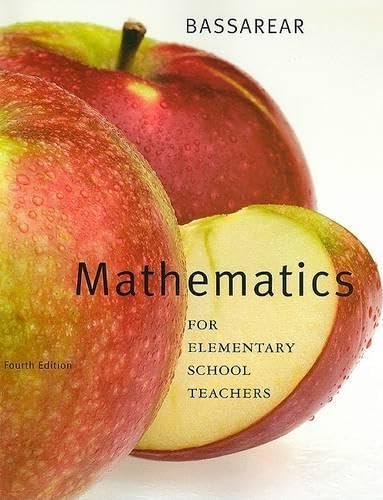
Mathematics for elementary school teachers Tom Bassarear.
Detalles de publicación: Boston, Mass. Houghton Mifflin Co. 2008.Edición: 4th edDescripción: xxix, 701 p. ill. (some col.) 28 cmISBN:- 061876836X
| Imagen de cubierta | Tipo de ítem | Biblioteca actual | Biblioteca de origen | Colección | Ubicación en estantería | Signatura topográfica | Materiales especificados | Info Vol | URL | Copia número | Estado | Notas | Fecha de vencimiento | Código de barras | Reserva de ítems | Prioridad de la cola de reserva de ejemplar | Reservas para cursos | |
|---|---|---|---|---|---|---|---|---|---|---|---|---|---|---|---|---|---|---|
| Libro | Biblioteca Encarnación Valdés Colección General bev | 372.7 B317m4 (Navegar estantería(Abre debajo)) | Disponible | 80000002326505 |
Total de reservas: 0
Descripciones mejoradas de Syndetics:
Intended for the one- or two-semester course required of Education majors, Mathematics for Elementary School Teachers, 4/e, offers pre-service teachers a comprehensive mathematics course designed to foster concept development through examples, investigations, and explorations. Visual icons throughout the main text allow instructors to easily connect content to the hands-on activities in the corresponding Explorations Manual. In addition to presenting real-world problems that require active learning, Bassarear demonstrates that there may be many paths to finding a solution--and even more than one answer. With this exposure, future teachers are better prepared to assess student needs using diverse approaches.
Include index.
Tabla de contenidos provista por Syndetics
- 1 Foundations for Learning Mathematics
- 1.1 Getting Comfortable with Mathematics
- 1.2 Problem-Solving
- 1.3 Patterns
- 1.4 Representation
- 1.5 Reasoning and Proof
- 1.6 Communication
- 1.7 Connections
- 2 Fundamental Concepts
- 2.1 Sets
- 2.2 Algebraic Thinking
- 2.3 Numeration
- 3 The Four Fundamental Operations of Arithmetic
- 3.1 Understanding Addition
- 3.2 Understanding Subtraction
- 3.3 Understanding Multiplication
- 3.4 Understanding Division
- 4 Number Theory
- 4.1 Divisibility and Related Concepts
- 4.2 Prime and Composite Numbers
- 4.3 Greatest Common Factor and Least Common Multiple
- 5 Extending the Number System
- 5.1 Integers
- 5.2 Fractions and Rational Numbers
- 5.3 Understanding Operations with Fractions
- 5.4 Beyond Integers and Fractions: Decimals, Exponents, and Real Numbers
- 6 Proportional Reasoning
- 6.1 Ratio and Proportion
- 6.2 Percents
- 7 Uncertainty: Data and Chance
- 7.1 The Process of Collecting and Analyzing Data
- 7.2 Going Beyond the Basics
- 7.3 Concepts Related to Chance
- 7.4 Counting and Chance
- 8 Geometry as Shape
- 8.1 Basic Ideas and Building Blocks
- 8.2 Two-Dimensional Figures
- 8.3 Three-Dimensional Figures
- 9 Geometry as Transforming Shapes
- 9.1 Congruence Transformations
- 9.2 Symmetry and Tessellations
- 9.3 Similarity
- 10 Geometry as Measurement
- 10.1 Systems of Measurement
- 10.2 Perimeter and Area
- 10.3 Surface Area and Volume