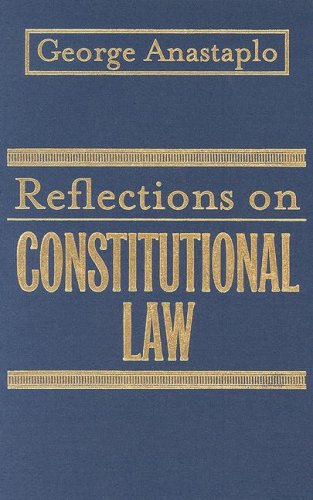

Reflections on constitutional law George Anastaplo.
Detalles de publicación: Lexington, Ky. University Press of Kentucky c2006.Descripción: xiii, 269 p. 23 cmISBN:- 0813123968 (hardcover : alk. paper)
- 9780813123967 (hardcover : alk. paper)
- 0813191564 (pbk. : alk. paper)
- 9780813191560 (pbk. : alk. paper)
- 342.73 22
- KF 4550 .A7297 2006
| Imagen de cubierta | Tipo de ítem | Biblioteca actual | Biblioteca de origen | Colección | Ubicación en estantería | Signatura topográfica | Materiales especificados | Info Vol | URL | Copia número | Estado | Notas | Fecha de vencimiento | Código de barras | Reserva de ítems | Prioridad de la cola de reserva de ejemplar | Reservas para cursos | |
|---|---|---|---|---|---|---|---|---|---|---|---|---|---|---|---|---|---|---|
| Libro | Biblioteca de Derecho Mons. Fremiot Torres Oliver Colección General biblioteca derecho | KF 4550 .A7297 2006 (Navegar estantería(Abre debajo)) | Disponible | 70000000834338 |
Descripciones mejoradas de Syndetics:
In a trend that disturbs nationally known constitutional scholar George Anastaplo, law schools now place very little emphasis on the study of the United States Constitution as a document. Today, many constitutional law professors spend less than a week teaching the history, philosophical tenets, and legal origins of the Constitution itself and more time on Supreme Court cases. In Reflections on Constitutional Law, Anastaplo emphasizes the continuing significance and importance of the Constitution, by examining the most important influences on the American constitutional system, including the Magna Carta and the Declaration of independence. According to Anastaplo, a rigorous understanding of the Constitution is crucial to comprehending the true meaning of Supreme Court decisions.
Includes bibliographical references and index.
An introduction to constitutionalism -- Magna Carta (1215) -- The Declaration of Independence (1776) -- The Articles of Confederation (1776-1789); the Northwest Ordinance (1787) -- Emergence of the constitution (1786-1791) -- Marbury v. Madison (1803) -- Swift v. Tyson (1842); Erie Railroad Company v. Tompkins (1938) -- Martin v. Hunter's Lessee (1816); M'culloch v. Maryland (1819) -- Gibbons v. Ogden (1824) -- Burdens on interstate commerce (1905-1981) -- Missouri v. Holland (1920); Wickard v. Filburn (1942) -- The presidency and the constitution -- A government of enumerated powers? -- Realism and the study of constitutional law -- The challenges of skepticism for the constitutionalist -- Constitutionalism and the common law: the Erie problem reconsidered -- The Confederate Constitution (1861-1865) -- The Japanese relocation cases (1943,1944) -- Calder v. Bull (1798); Barron v. Baltimore (1833) -- Corfield v. Coryell (1823) and the privileges and immunities puzzles -- The slaughter-house cases (1872): a false start? -- The civil rights cases (1883); Plessey v. Ferguson (1896): more false starts? -- Shelley v. Kraemer (1948); Brown v. Board of Education (1954, 1955) -- Affirmative action and the Fourteenth Amendment -- San Antonio Independent School District v. Rodriguez (1973) -- Whose votes count for what--and when?
Tabla de contenidos provista por Syndetics
- Preface(p. ix)
- Part 1
- 1 An Introduction to Constitutionalism(p. 3)
- 2 Magna Carta (1215)(p. 9)
- 3 The Declaration of Independence (1776)(p. 15)
- 4 The Articles of Confederation (1776-1789); The Northwest Ordinance (1787)(p. 21)
- 5 Emergence of the Constitution (1786-1791)(p. 27)
- 6 Marbury v. Madison (1803)(p. 33)
- 7 Swift v. Tyson (1842); Erie Railroad Company v. Tompkins (1938)(p. 40)
- 8 Martin v. Hunter's Lessee (1816); M'Culloch v. Maryland (1819)(p. 47)
- 9 Gibbons v. Ogden (1824)(p. 53)
- 10 Burdens on Interstate Commerce (1905-1981)(p. 60)
- 11 Missouri v. Holland (1920); Wickard v. Filburn (1942)(p. 67)
- 12 The Presidency and the Constitution(p. 74)
- 13 A Government of Enumerated Powers?(p. 81)
- Part 2
- 1 Realism and the Study of Constitutional Law(p. 91)
- 2 The Challenges of Skepticism for the Constitutionalist(p. 97)
- 3 Constitutionalism and the Common Law: The Erie Problem Reconsidered(p. 102)
- 4 The Confederate Constitution (1861-1865)(p. 108)
- 5 The Japanese Relocation Cases (1943, 1944)(p. 114)
- 6 Calder v. Bull (1798); Barron v. Baltimore (1833)(p. 120)
- 7 Corfield v. Coryell (1823) and the Privileges and Immunities Puzzles(p. 126)
- 8 The Slaughter-House Cases (1872): A False Start?(p. 132)
- 9 The Civil Rights Cases (1883); Plessy v. Ferguson (1896): More False Starts?(p. 139)
- 10 Shelley v. Kraemer (1948); Brown v. Board of Education (1954, 1955)(p. 146)
- 11 Affirmative Action and the Fourteenth Amendment(p. 153)
- 12 San Antonio Independent School District v. Rodriguez (1973)(p. 160)
- 13 Whose Votes Count for What-and When?(p. 167)
- Appendixes
- A Magna Carta (1215)(p. 175)
- B The Declaration of Independence (1776)(p. 187)
- C The Articles of Confederation and Perpetual Union (1776-1789)(p. 193)
- D The Northwest Ordinance (1787)(p. 203)
- E The United States Constitution (1787)(p. 211)
- F A Chart for Article I, Section 8, of the United States Constitution(p. 225)
- G The Amendments to the United States Constitution (1791-1992)(p. 227)
- H Proposed Amendments to the United States Constitution Not Ratified by the States (1789-1978)(p. 237)
- I The Confederate Constitution (1861)(p. 239)
- J Roster of Cases and Other Materials Drawn On(p. 257)
- Index(p. 261)
- About the Author(p. 269)