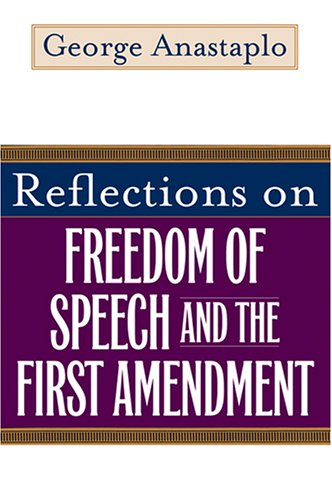

Reflections on freedom of speech and the First Amendment George Anastaplo.
Detalles de publicación: Lexington, Ky. University Press of Kentucky c2007.Descripción: xviii, 320 p. 24 cmISBN:- 9780813191737 (pbk. : alk. paper)
- 0813191734 (pbk. : alk. paper)
- 9780813124247 (hardcover : alk. paper)
- 0813124247 (hardcover : alk. paper)
- 342.7308/53 22
- KF 4772 .A96 2007
| Imagen de cubierta | Tipo de ítem | Biblioteca actual | Biblioteca de origen | Colección | Ubicación en estantería | Signatura topográfica | Materiales especificados | Info Vol | URL | Copia número | Estado | Notas | Fecha de vencimiento | Código de barras | Reserva de ítems | Prioridad de la cola de reserva de ejemplar | Reservas para cursos | |
|---|---|---|---|---|---|---|---|---|---|---|---|---|---|---|---|---|---|---|
| Libro | Biblioteca de Derecho Mons. Fremiot Torres Oliver Colección General biblioteca derecho | KF 4772 .A96 2007 (Navegar estantería(Abre debajo)) | Disponible | 70000000834346 |
Descripciones mejoradas de Syndetics:
The guarantee of free speech enshrined in the U.S. Bill of Rights draws upon two millennia of Western thought about the value and necessity of free inquiry. Acclaimed legal scholar George Anastaplo traces the philosophical development of the idea of free inquiry from Plato's Apology to Socrates to John Milton's Areopagitica. He describes how these seminal texts and others by such diverse thinkers as St. Paul, Thomas More, and John Stuart Mill influenced the formation and the earliest applications of the First Amendment. Anastaplo also focuses on the critical free speech implications of a dozen Supreme Court cases and shows how First Amendment interpretations have evolved in response to modern events. Reflections on Freedom of Speech and the First Amendment grounds its vision of America's most basic freedoms in the intellectual traditions of Western political philosophy, providing crucial insight into the legal challenges of the future through the lens of the past.
Includes bibliographical references (p. 300-304) and index.
Plato's Apology of Socrates -- The ministry of St. Paul -- Thomas More and parliamentary immunity (1521) -- John Milton's Areopagitica (1644) -- William Blackstone, Patrick Henry, and Edmund Burke on liberty (1765-1790) -- The Declaration of Independence (1776), the Northwest Ordinance (1787) -- Constitutionalism and the workings of freedom of speech -- The Virginia Statute of Religious Freedom (1785) -- The emergence of a national bill of rights (1789-1791) -- The organization of the First Amendment -- The Sedition Act of 1798 -- John Stuart Mill's On Liberty (1859) -- Freedom of speech and the coming of the Civil War -- The naive folly of realists : a defense of Justice Black (1937-1971) -- Schenck v. United States (1919), Abrams v. United States (1919) -- Debs v. United States (1919), Gitlow v. New York (1925) -- Winston S. Churchill and the cause of freedom -- Dennis v. United States (1951), the Rosenberg Case (1950-1953) -- Cohen v. California (1971), Texas v. Johnson (1989) -- The Pentagon Papers Case (1971) -- Obscenity and the law -- Private property and public freedom -- Buckley v. Valeo (1976) -- The regulation of commercial speech -- The Universal Declaration of Human Rights (1948) -- The future of the First Amendment?.
Tabla de contenidos provista por Syndetics
- Preface(p. xi)
- Part 1
- 1 Plato's Apology of Socrates(p. 3)
- 2 The Ministry of St. Paul(p. 9)
- 3 Thomas More and Parliamentary Immunity (1521)(p. 14)
- 4 John Milton's Areopagitica (1644)(p. 20)
- 5 William Blackstone, Patrick Henry, and Edmund Burke on Liberty (1765-1790)(p. 26)
- 6 The Declaration of Independence (1776); the Northwest Ordinance (1787)(p. 36)
- 7 Constitutionalism and the Workings of Freedom of Speech(p. 43)
- 8 The Virginia Statute of Religious Freedom (1786)(p. 49)
- 9 The Emergence of a National Bill of Rights (1789-1791)(p. 57)
- 10 The Organization of the First Amendment(p. 64)
- 11 The Sedition Act of 1798(p. 71)
- 12 John Stuart Mill's On Liberty (1859)(p. 78)
- 13 Freedom of Speech and the Coming of the Civil War(p. 85)
- Part 2
- 1 The Naive Folly of Realists: A Defense of Justice Black (1937-1971)(p. 95)
- 2 Schenck v. United States (1919); Abrams v. United States (1919)(p. 101)
- 3 Debs v. United States (1919); Gitlow v. New York (1925)(p. 108)
- 4 Winston S. Churchill and the Cause of Freedom(p. 116)
- 5 Dennis v. United States (1951); the Rosenberg Case (1950-1953)(p. 123)
- 6 Cohen Y. California (1971); Texas v. Johnson (1989)(p. 133)
- 7 The Pentagon Papers Case (1971)(p. 140)
- 8 Obscenity and the Law(p. 148)
- 9 Private Property and Public Freedom(p. 155)
- 10 Buckley v. Valeo (1976)(p. 162)
- 11 The Regulation of Commercial Speech(p. 170)
- 12 The Universal Declaration of Human Rights (1948)(p. 177)
- 13 The Future of the First Amendment?(p. 183)
- Appendixes
- A The Declaration of Independence (1776)(p. 189)
- B The United States Constitution (1787)(p. 193)
- C The Amendments to the United States Constitution (1791-1992)(p. 205)
- D Thomas More, Petition to Henry VIII on Parliamentary Freedom of Speech (1521)(p. 215)
- E The Virginia Statute of Religious Liberty (1786)(p. 218)
- F Some Stages of the Religion/Speech/Press/Assembly/Petition Provisions in the First Congress (1789)(p. 221)
- G The Sedition Act (1798)(p. 224)
- H The Virginia Resolutions (1798)(p. 226)
- I Report of a House of Delegates Minority on the Virginia Resolutions (1799)(p. 229)
- J Thomas Jefferson, the First Inaugural Address (1801)(p. 236)
- K Schenck v. United States Leaflet (1917)(p. 241)
- L The Universal Declaration of Human Rights (1948)(p. 246)
- M George Anastaplo, On the Alcatraz Imprisonment of a Convicted Soviet Spy (1954)(p. 253)
- N George Anastaplo, An Obscenity-Related Case from Dallas (1989-1990)(p. 269)
- O Cases and Other Materials Drawn On(p. 300)
- Index(p. 305)
- About the Author(p. 321)