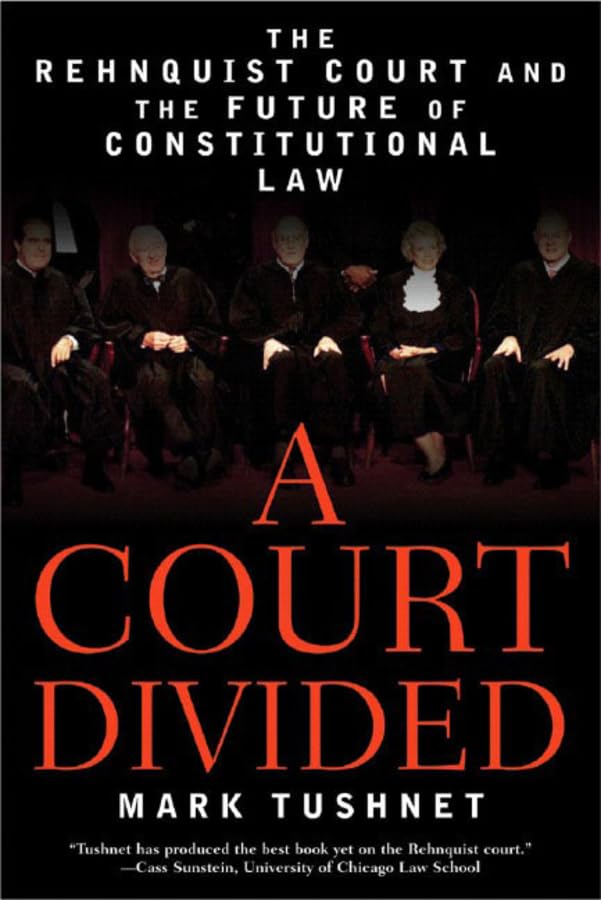

A Court divided the Rehnquist court and the future of constitutional law Mark Tushnet.
Detalles de publicación: New York W.W. Norton and Co. c2006.Edición: 1st edDescripción: 398 p. 21 cmISBN:- 0393327574 (pbk.)
- 9780393327571 (pbk.)
| Imagen de cubierta | Tipo de ítem | Biblioteca actual | Biblioteca de origen | Colección | Ubicación en estantería | Signatura topográfica | Materiales especificados | Info Vol | URL | Copia número | Estado | Notas | Fecha de vencimiento | Código de barras | Reserva de ítems | Prioridad de la cola de reserva de ejemplar | Reservas para cursos | |
|---|---|---|---|---|---|---|---|---|---|---|---|---|---|---|---|---|---|---|
| Libro | Biblioteca de Derecho Mons. Fremiot Torres Oliver Colección General biblioteca derecho | KF 8742 .T87 2006 (Navegar estantería(Abre debajo)) | Disponible | 70000000832720 |
Descripciones mejoradas de Syndetics:
"An incisive consideration of the Supremes, offering erudite yet accessible clues to legal thinking on the most important level."-- Kirkus Reviews
In this authoritative reckoning with the eighteen-year record of the Rehnquist Court, Georgetown law professor Mark Tushnet reveals how the decisions of nine deeply divided justices have left the future of the Court; and the nation; hanging in the balance. Many have assumed that the chasm on the Court has been between its liberals and its conservatives. In reality, the division was between those in tune with the modern post-Reagan Republican Party and those who, though considered to be in the Court's center, represent an older Republican tradition. As a result, the Court has modestly promoted the agenda of today's economic conservatives, but has regularly defeated the agenda of social issues conservatives; while paving the way for more radically conservative path in the future.
Includes bibliographical references and index.
William Rehnquist's court -- Two kinds of Republicans -- Clarence Thomas's constitution -- Ruth Bader Ginsburg's equal protection clause -- Antonin Scalia's First Amendment -- Anthony Kennedy and gay rights -- The religious right's agenda : symbols and money -- Holding the line on abortion -- Race, affirmative action, and crime -- The federalism revolution -- The takings project -- Big business's constitution -- A Supreme Court united?
Tabla de contenidos provista por Syndetics
- Introduction(p. 9)
- 1 William Rehnquist's Court(p. 13)
- 2 Two Kinds of Republican(p. 49)
- 3 Clarence Thomas's Constitution(p. 71)
- 4 Ruth Bader Ginsburg's Equal Protection Clause(p. 104)
- 5 Antonin Scalia's First Amendment(p. 130)
- 6 Anthony Kennedy and Gay Rights(p. 156)
- 7 The Religious Right's Agenda-Symbols and Money(p. 180)
- 8 Holding the Line on Abortion(p. 204)
- 9 Race, Affirmative Action, and Crime(p. 223)
- 10 The Federalism Revolution(p. 249)
- 11 The Takings Project(p. 279)
- 12 Big Business's Constitution(p. 302)
- 13 A Supreme Court United?(p. 319)
- Epilogue: The End of the Rehnquist Court(p. 347)
- Notes(p. 361)
- Index(p. 383)