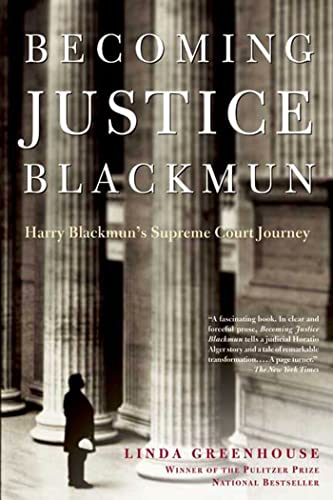

Becoming Justice Blackmun Harry Blackmun's Supreme Court journey Linda Greenhouse.
Detalles de publicación: New York Times Books H. Holt and Co. 2006.Edición: 1st pbk edDescripción: xiii, 268 p. ill. 21 cmISBN:- 0805080570 (pbk.)
- 9780805080575 (pbk.)
| Imagen de cubierta | Tipo de ítem | Biblioteca actual | Biblioteca de origen | Colección | Ubicación en estantería | Signatura topográfica | Materiales especificados | Info Vol | URL | Copia número | Estado | Notas | Fecha de vencimiento | Código de barras | Reserva de ítems | Prioridad de la cola de reserva de ejemplar | Reservas para cursos | |
|---|---|---|---|---|---|---|---|---|---|---|---|---|---|---|---|---|---|---|
| Libro | Biblioteca de Derecho Mons. Fremiot Torres Oliver Colección General biblioteca derecho | KF 8745 .B555 G74 2006 (Navegar estantería(Abre debajo)) | Disponible | 70000000832738 |
Descripciones mejoradas de Syndetics:
"A fascinating book. In clear and forceful prose, Becoming Justice Blackmun tells a judicial Horatio Alger story and a tale of a remarkable transformation . . . A page-turner."
-- The New York Times Book Review
In this acclaimed biography, Linda Greenhouse of The New York Times draws back the curtain on America's most private branch of government, the Supreme Court. Greenhouse was the first print reporter to have access to the extensive archives of Justice Harry A. Blackmun (1908-1999), the man behind numerous landmark Supreme Court decisions, including Roe v. Wade .
Through the lens of Blackmun's private and public papers, Greenhouse crafts a compelling portrait of a man who, from 1970 to 1994, ruled on such controversial issues as abortion, the death penalty, and sex discrimination yet never lost sight of the human beings behind the legal cases. Greenhouse also paints the arc of Blackmun's lifelong friendship with Chief Justice Warren E. Burger, revealing how political differences became personal, even for two of the country's most respected jurists.
From America's preeminent Supreme Court reporter, this is a must-read for everyone who cares about the Court and its impact on our lives.
Originally published: 2005
Includes bibliographical references (p. 253-254) and index.
Minnesota beginnings -- Appeals -- Old number three -- The road to Roe -- Finding his voice -- Big storms -- Dissents -- Saving Roe -- Improbable icon -- In the center.
Extracto provisto por Syndetics
Reseñas proporcionadas por Syndetics
Library Journal Review
A Pulitzer Prize-winning Supreme Court journalist and commentator for the New York Times, Greenhouse offers an exceptionally readable biography of Justice Harry Blackmun, from his childhood to his service on the Supreme Court. Drawing upon primary-source materials in the Harry A. Blackmun Collection at the Library of Congress, Greenhouse portrays the evolution of Blackmun's judicial philosophy. In using Blackmun's files, correspondence, and papers, the author creates a revealing portrait of both the man himself and the inner workings of the Supreme Court, including his fractious relationship with Chief Justice Warren Burger. Central to the narrative is Blackmun's involvement in Roe v. Wade, subsequent abortion litigation, and capital punishment litigation. This small book is a valuable addition to the existing body of judicial biographies. Highly recommended.-Theodore Pollack, New York Cty. Public Access Law Lib., New York (c) Copyright 2010. Library Journals LLC, a wholly owned subsidiary of Media Source, Inc. No redistribution permitted.Publishers Weekly Review
Supreme Court justice Harry Blackmun's lifelong connection with Chief Justice Warren Burger-beginning in kindergarten in St. Paul, Minn., and culminating in 16 years together on the Supreme Court-supplies Greenhouse with one of her main organizing themes in this illuminating study of Blackmun's life and intellectual history. Once the closest of friends, Blackmun (1908-1999) and Burger diverged personally and ideologically, beginning in 1973, when Burger assigned Blackmun to write the Court's opinion in Roe v. Wade. Greenhouse, the New York Times's veteran Supreme Court watcher, draws primarily on Blackmun's massive personal archive to show how his authorship of the majority opinion in Roe (7-2) propelled him down several unexpected paths. Blackmun embraced equal protection for women and came to reject capital punishment. A Nixon appointee, Blackmun became the Supreme Court's most liberal justice after the retirement of William Brennan and Thurgood Marshall. The personality that emerges in Greenhouse's portrayal is that of a self-effacing and scholarly judge, devoid of partisanship, willing to follow his ideas wherever they led him. Making no pretense at being definitive or comprehensive, Greenhouse sets a high standard in offering an intimate look both at the man and at the development of his judicial thought. B&w photos. (May) (c) Copyright PWxyz, LLC. All rights reservedBooklist Review
Greenhouse, a Pulitzer Prize-winning reporter with the New York Times, was the first print reporter to have access to the personal and official papers of Justice Blackmun, who died in 1999, five years after retiring from the Supreme Court. Those papers are Greenhouse's primary source as she looks back on the 24 years of Blackmun's service on the court. He wrote the majority opinion in the Roe v. Wade decision that established a constitutional right to abortion, but his papers reflect his personal struggle with the decision, as well as others on issues of the death penalty and sex discrimination. The immense collection includes correspondence with other jurists, including Chief Justice Warren E. Burger. Greenhouse draws on personal papers to show Blackmun's personal journey, from entries in a childhood diary to the musings of a young lawyer hungering for partnership. This is an absorbing look at the personal and official concerns of a man who helped to shape American law and society. --Vernon Ford Copyright 2005 BooklistNotas de autor provistas por Syndetics
Linda Greenhouse has covered the Supreme Court for The New York Times since 1978 and won a Pulitzer Prize in 1998 for her reporting on the Court. She appears regularly on the PBS program Washington Week and lectures frequently on the Supreme Court at colleges and law schools. She graduated from Radcliffe College at Harvard University and holds a master of studies in law from Yale Law School. She lives outside Washington, D.C.