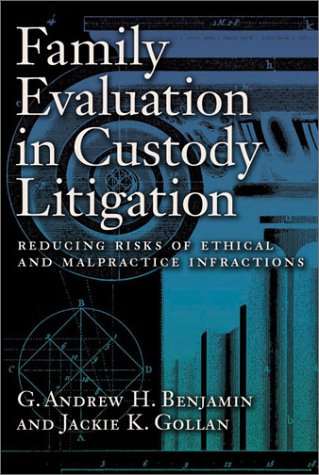

Family evaluation in custody litigation reducing risks of ethical infractions and malpractice G. Andrew H. Benjamin and Jackie K. Gollan.
Series Forensic practice guidebooks seriesDetalles de publicación: Washington, DC American Psychological Association c2003.Edición: 1 st edDescripción: xiv, 240 p. forms 27 cmISBN:- 1557989532 (hardcover : alk. paper)
- 346.730173 B4681f 21
- KF 505.5 .B46 2003
| Imagen de cubierta | Tipo de ítem | Biblioteca actual | Biblioteca de origen | Colección | Ubicación en estantería | Signatura topográfica | Materiales especificados | Info Vol | URL | Copia número | Estado | Notas | Fecha de vencimiento | Código de barras | Reserva de ítems | Prioridad de la cola de reserva de ejemplar | Reservas para cursos | |
|---|---|---|---|---|---|---|---|---|---|---|---|---|---|---|---|---|---|---|
| Libro | Biblioteca Encarnación Valdés Colección General bev | 346.730173 B4681f (Navegar estantería(Abre debajo)) | Disponible | 80000002321852 |
Descripciones mejoradas de Syndetics:
This text provides a step-by-step child custody assessment protocol that protects families, while at the same time helps new evaluators minimize the likelihood of committing ethical infractions or malpractice. For mental health professionals interested in a career in forensic child custody assessment, balancing both the legal and clinical issues that surround family evaluations and custody disputes can be complicated. Without this knowledge, the risk of causing undue emotional injury increases. The book puts family litigation into context and reviews the legal evidentiary standards that pertain to psychological testing, scientific evidence and expert witness testimony used in the court system. Although written for the novice evaluator, it can help enhance the clinical skills of even the most seasoned evaluators, as it offers a complete overview of the judicial process and the evolving changes in the standards of practice. The authors share valuable materials, including a sample written evaluation report and other forms that readers can adapt for use in their own practices. The book draws from a practical and straightforward assessment methodology that is founded on empirical research, clinical expertise and professional practice. Those also interested in cultivating a practice outside the parameters of the managed health care system should find the authors' instruction useful. The book is recommended reading for any mental health professional who wants to conduct custody evaluations while adhering to the highest ethical standards and guidelines.
Includes bibliographical references (p. 219-226) and index.
Tabla de contenidos provista por Syndetics
- Foreword to the Series(p. vii)
- Preface(p. ix)
- Acknowledgments(p. xiii)
- Introduction(p. 3)
- I. Understanding the Context(p. 9)
- Chapter 1. Context of Custody Litigation(p. 11)
- Chapter 2. Evidentiary Standards and Rules of Evidence(p. 17)
- Chapter 3. Ethics, Competence, and Training(p. 29)
- II. Conducting Evaluations: Introduction(p. 37)
- Chapter 4. Phase 1: Pre-Evaluation Procedures(p. 41)
- Chapter 5. Phase 2: First Clinical Interview(p. 49)
- Chapter 6. Phase 3: Observations of Parents and Children(p. 65)
- Chapter 7. Phase 4: Contacting Collaterals(p. 73)
- Chapter 8. Phase 5: Closing Interviews and Data Integration(p. 83)
- Chapter 9. Phase 6: Presentation to Court(p. 93)