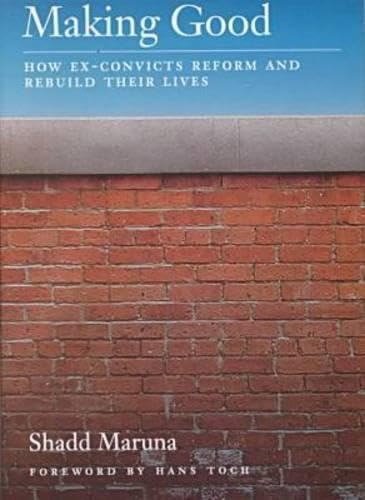

Making good how ex-convicts reform and rebuild their lives Shadd Maruna.
Detalles de publicación: Washington, D.C. American Psychological Association c2001.Edición: 1st edDescripción: xix, 211 p. 26 cmISBN:- 1557987319 (alk. paper)
- How ex-convicts reform and rebuild their lives
- 364.80973 M389m 21
- HV9276 .M37 2001
| Imagen de cubierta | Tipo de ítem | Biblioteca actual | Biblioteca de origen | Colección | Ubicación en estantería | Signatura topográfica | Materiales especificados | Info Vol | URL | Copia número | Estado | Notas | Fecha de vencimiento | Código de barras | Reserva de ítems | Prioridad de la cola de reserva de ejemplar | Reservas para cursos | |
|---|---|---|---|---|---|---|---|---|---|---|---|---|---|---|---|---|---|---|
| Libro | Biblioteca Encarnación Valdés Colección General bev | 364.8 M389m (Navegar estantería(Abre debajo)) | Disponible | 80000002308586 |
Descripciones mejoradas de Syndetics:
Can hardened criminals really reform? ""Making Good"" provides resounding proof that the answer is yes. This book provides a fascinating narrative analysis of the lives of repeat offenders who, by all statistical measures, should have continued on the criminal path but instead have created lives of productivity and purpose. This examination of the phenomenology of ""making good"" includes an encyclopedic review of the literature on personal reform as well as a practical guide to the use of narratives in offender counseling and rehabilitation.The author's research shows that criminals who desist from crime have constructed powerful narratives that aided them in making sense of their pasts, finding fulfillment in productive behaviors, and feeling in control of their future. Borrowing from the field of narrative psychology, Maruna argues that to truly understand offenders, we must understand the stories that they tell - and that in turn this story-making process has the capacity to transform lives. ""Making Good"" challenges some of the cherished assumptions of various therapy models for offenders and supports new paradigms for offender rehabilitation. This groundbreaking book is a must read for criminologists, forensic psychologists, lawyers, rehabilitation counselors, or anyone interested in the generative process of change.
Includes bibliographical references (p. 181-200) and indexes.
Tabla de contenidos provista por Syndetics
- Acknowledgments(p. xi)
- Foreword(p. xv)
- Introduction: The Common Criminal and Us(p. 3)
- I. Dissecting Desistance(p. 15)
- Chapter 1. Defining Desistance(p. 19)
- Chapter 2. The Liverpool Desistance Study(p. 37)
- II. Two Views of a Brick Wall(p. 53)
- Chapter 3. Sample Prognosis: Dire(p. 57)
- Chapter 4. Reading From a Condemnation Script(p. 73)
- Chapter 5. Making Good: The Rhetoric of Redemption(p. 85)
- III. Applied Mythology(p. 109)
- Chapter 6. Work, Generativity, and Reform(p. 117)
- Chapter 7. Mea Culpa: Shame, Blame, and the Core Self(p. 131)
- Chapter 8. The Rituals of Redemption(p. 147)
- Appendix(p. 169)
- References(p. 181)
- Author Index(p. 201)
- Subject Index(p. 207)
- About the Author(p. 211)