Imagen de Amazon.com

Portada de Syndetics
Imagen de OpenLibrary
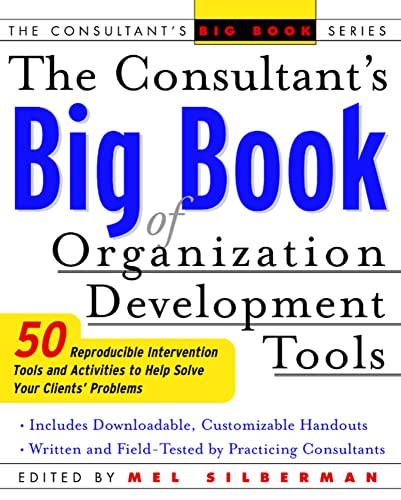
The consultant's big book of organization development tools 50 reproducible, customizable interventions to help solve your clients' problems edited by Mel Silberman.
Series The consultant's big book seriesDetalles de publicación: New York McGraw-Hill 2003.Descripción: xiii, 314 p. ill. 24 cmISBN:- 0071408835
- 658.406 C7585 21
- HD58.8 .C654 2003
Recursos en línea:
| Imagen de cubierta | Tipo de ítem | Biblioteca actual | Biblioteca de origen | Colección | Ubicación en estantería | Signatura topográfica | Materiales especificados | Info Vol | URL | Copia número | Estado | Notas | Fecha de vencimiento | Código de barras | Reserva de ítems | Prioridad de la cola de reserva de ejemplar | Reservas para cursos | |
|---|---|---|---|---|---|---|---|---|---|---|---|---|---|---|---|---|---|---|
| Referencia | Biblioteca Encarnación Valdés Sala de Referencia bev | 658.406 C7585 (Navegar estantería(Abre debajo)) | Disponible | 80000002308362 |
Total de reservas: 0
Descripciones mejoradas de Syndetics:
The Consultant's Big Book of Organization Development Tools provides consultants with tools, interventions, and activities they can use to solve individual, team, and organizational performance problems.
This book offers incredible value for the consultant looking to use structured interventions as a vital part of the consultation approach. Many of the tools consist of a simulation or other structured activity consultants can use with leaders in the client organization to address the soft issues in a nonthreatening way. And most include downloadable, customizable handouts that they can freely reproduce and use with clients.
Tabla de contenidos provista por Syndetics
- Preface(p. ix)
- Part I Leadership Development(p. 1)
- 1. Communicating Clearly and Effectively(p. 3)
- 2. Managing Time Effectively(p. 10)
- 3. Developing Coaching Skills(p. 18)
- 4. Delegating with Style(p. 35)
- 5. Assimilating the New Team Leader(p. 41)
- 6. Training Leaders for Success(p. 52)
- 7. Giving Feedback to Leaders(p. 56)
- 8. Developing New Team Managers(p. 59)
- 9. Tapping the Collective Power of a Group(p. 64)
- 10. Practicing How to Coach(p. 69)
- Part II Employee Development(p. 83)
- 11. Getting a Quick Read on Your Training Group(p. 85)
- 12. Giving and Receiving Feedback(p. 88)
- 13. Improving Listening Skills(p. 96)
- 14. Collaborating at On-Line Sessions and Web Conferences(p. 99)
- 15. Seeing through Another's Eyes(p. 101)
- 16. Introducing Human Performance Technology(p. 104)
- 17. Linking Effort and Performance to Valued Outcomes(p. 110)
- 18. Learning How to Learn(p. 118)
- 19. Assessing and Reinforcing Learning(p. 123)
- Part III Team Development(p. 127)
- 20. Forming, Storming, Norming, and Performing(p. 129)
- 21. Building Bridges between Two Teams(p. 135)
- 22. Clarifying New Team Projects and Initiatives(p. 139)
- 23. Encouraging Feedback(p. 147)
- 24. Forming Learning Teams(p. 152)
- 25. Sinking or Swimming Together(p. 156)
- 26. Using Diversity in Team Decision Making(p. 162)
- 27. Problem Solving by Distant Teams(p. 167)
- 28. Building Strengths in Virtual Teams(p. 175)
- 29. Sharing Information in Teams(p. 178)
- 30. Demonstrating Team Brainpower(p. 191)
- 31. Building Ground Rules for Successful Teamwork(p. 196)
- Part IV Organization Development(p. 201)
- 32. Building Organizational Commitment(p. 203)
- 33. Fostering Creative Problem-Solving Skills within the Organization(p. 212)
- 34. Managing Roadblocks to Getting Things Done(p. 219)
- 35. Improving Work Design(p. 225)
- 36. Balancing Advocacy and Inquiry(p. 229)
- 37. Improving Meetings(p. 234)
- 38. Resolving Conflict Effectively(p. 245)
- 39. Communicating What You Mean(p. 248)
- 40. Understanding Cultural Differences in the Organization(p. 251)
- 41. Developing Organizational Resiliency(p. 259)
- Part V Strategic Planning and Change Management(p. 263)
- 42. Exploring Issues about Mergers(p. 265)
- 43. Understanding Change through Other People's Eyes(p. 273)
- 44. Minimizing Resistance to Change and Innovation(p. 278)
- 45. Thinking Positively(p. 283)
- 46. Improving the Quality of Strategic Planning(p. 290)
- 47. Learning Patience(p. 293)
- 48. Introducing Planning(p. 296)
- 49. Creating a Mission Statement(p. 307)
- 50. Determining What Changes Are Needed(p. 310)