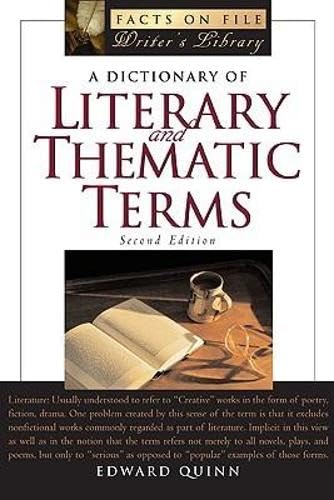

A dictionary of literary and thematic terms Edward Quinn.
Series Writer's library (Facts on File, Inc.)Detalles de publicación: New York, NY Checkmark Books c2006.Edición: 2nd edDescripción: vi, 474 p. 23 cmISBN:- 0816062447 (pbk.)
- Literary and thematic terms
- 803 Q73d2 22
| Imagen de cubierta | Tipo de ítem | Biblioteca actual | Biblioteca de origen | Colección | Ubicación en estantería | Signatura topográfica | Materiales especificados | Info Vol | URL | Copia número | Estado | Notas | Fecha de vencimiento | Código de barras | Reserva de ítems | Prioridad de la cola de reserva de ejemplar | Reservas para cursos | |
|---|---|---|---|---|---|---|---|---|---|---|---|---|---|---|---|---|---|---|
| Referencia | Biblioteca Encarnación Valdés Sala de Referencia bev | 803 Q73d2 (Navegar estantería(Abre debajo)) | Disponible | 80000002302977 |
Descripciones mejoradas de Syndetics:
This is an insightful guide to literary terms in context. In clear, non-technical language, this dictionary explores more than 1,000 literary terms and themes - with 200 new to this edition. Taking an expanded view of the term ""literary,"" this book gives readers not only a traditional literary vocabulary, but also the knowledge of related theoretical, historical, and cultural terms they need in the interdisciplinary world of contemporary literary studies. New entries include: traditional literary terms and themes, such as individualism, skepticism, and the Odysseus/Ulysses theme; literary topics that have become increasingly popular in recent years, such as terrorism and prison literature; and, subjects perennially popular among writers, such as alcoholism, baseball, and vampirism. Its features include: fresh definitions and examples of standard literary and related terms such as meter, antagonist, and New Criticism; essays on major themes in literature such as evil, power, love, death, time, and more; terms related to multicultural and feminist literature; major contemporary theoretical terms, with clear definitions and examples; and culture terms from film, television, psychology, history, and other fields related to literature. It serves as a reference.
Includes bibliographical references and index.
Extracto provisto por Syndetics
Reseñas proporcionadas por Syndetics
School Library Journal Review
Gr 8 Up-Employing an expanded use of the word "literary," this volume includes social, theoretical, and historical terms as they relate to literature, film, television, and others forms of popular culture. In addition to the many expected terms (iamb, onomatopoeia), entries on places (Abbey Theatre), philosophical principles (the Absolute), movements (futurism), and discussions on major themes such as love and jealousy are also covered. Most of the clear, concise entries offer excellent examples of written and cinematic works that further clarify the definitions and/or titles of resources that provide additional commentary on the topics. While there is no pronunciation key for the foreign words and expressions, this valuable resource is more accessible and broader in approach than other literary dictionaries.-J. B. MacDonald, Milner Library, Illinois State University, Normal (c) Copyright 2010. Library Journals LLC, a wholly owned subsidiary of Media Source, Inc. No redistribution permitted.CHOICE Review
Quinn's 850-entry, Aristotle-to-postmodernism dictionary adds vocabulary from the performing/visual arts and popular media to the familiar roster of entries for literary critical, rhetorical, and theoretical terms, periods, movements, genres, institutions, and publications. Terms are English-language except for a few naturalized from other languages. Entries range from a couple of lines to more than a page; one-to-three item bibliographies, briefly and often not helpfully annotated, accompany many entries. Articles on the literatures of US minorities are serviceable as historical outlines but are short on discussion of those literatures' distinctive themes and relationships to the dominant Anglo tradition. Quinn (English emeritus, CUNY) is unique among competitors in treating 38 literary themes (e.g., love, war, AIDS, Holocaust, silence), articles just long enough to be substantively and bibliographically unsatisfying in some cases; granting that the "how-much-is-enough?" problem intensifies with "long" brief entries, Quinn's shorter definitions are better than his longer treatments. Despite its clear writing, catholicity, and thematic entries, this dictionary unconvincingly braves strong predecessors M. H. Abrams's Glossary of Literary Terms (6th ed., CH, Sep'93), J.A. Cuddon's A Dictionary of Literary Terms and Literary Theory (4th ed., CH, Mar'99), Jeremy Hawthorn's Glossary of Contemporary Literary Theory (3rd ed., CH. Oct'98), C. Hugh Holman's A Handbook to Literature (7th ed., 1996), and Ross Murfin and Supryia Ray's The Bedford Glossary of Critical and Literary Terms (CH, Jun'98). R. H. Kieft; Haverford CollegeBooklist Review
Chicago renaissance, Chinese-American literature, Ecocriticism, Graphic novel,0 and Interdisciplinary0 are among the 200 terms added to this edition of a useful guide first published in 1999. We said in our review of the first edition that the entries on thematic concepts are what set this book apart from other dictionaries of literary terms, and now new entries address themes such as Alcoholism0 , Baseball0 , Madness0 , Odysseus/Ulysses theme0 , and Vampirism,0 to name a few. --Mary Ellen Quinn Copyright 2006 BooklistNotas de autor provistas por Syndetics
Edward Quinn is Professor Emeritus of English at the City College of New York. He Holds a Ph.D. from New York University and has co-edited several major reference works, including the classic The Reader's Encyclopedia of Shakespeare. Mr. Quinn lives in Brooklyn, NY.(Bowker Author Biography)