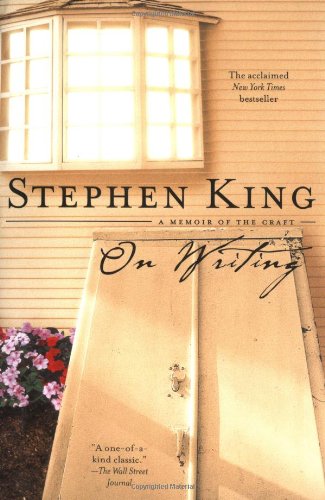

On writing a memoir of the craft Stephen King.
Detalles de publicación: New York Pocket Books 2001.Descripción: 288 p. 21 cmISBN:- 0671024256 (pbk.)
- 813.54 K521o
| Imagen de cubierta | Tipo de ítem | Biblioteca actual | Biblioteca de origen | Colección | Ubicación en estantería | Signatura topográfica | Materiales especificados | Info Vol | URL | Copia número | Estado | Notas | Fecha de vencimiento | Código de barras | Reserva de ítems | Prioridad de la cola de reserva de ejemplar | Reservas para cursos | |
|---|---|---|---|---|---|---|---|---|---|---|---|---|---|---|---|---|---|---|
| Libro | Biblioteca Encarnación Valdés Colección General bev | 813.54 K521o (Navegar estantería(Abre debajo)) | Disponible | 80000002302985 |
Descripciones mejoradas de Syndetics:
The author shares his insights into the craft of writing and offers a humorous perspective on his own experience as a writer.
Originally published: New York: Scribner, 2000.
Extracto provisto por Syndetics
Reseñas proporcionadas por Syndetics
Library Journal Review
In 1981 King penned Danse Macabre, a thoughtful analysis of the horror genre. Now he is treating his vast readership to another glimpse into the intellect that spawns his astoundingly imaginative works. This volume, slim by King standards, manages to cover his life from early childhood through the aftermath of the 1999 accident that nearly killed him. Along the way, King touts the writing philosophies of William Strunk and Ernest Hemingway, advocates a healthy appetite for reading, expounds upon the subject of grammar, critiques a number of popular writers, and offers the reader a chance to try out his theories. But most important, we who climb aboard for this ride with the master spend a few pleasant hours under the impression that we know what it!s like to think like Stephen King. Recommended for anyone who wants to write and everyone who loves to read. [Previewed in Prepub Alert, LJ 6/1/00.]"Nancy McNicol, Hagaman Memorial Lib., East Haven, CT (c) Copyright 2010. Library Journals LLC, a wholly owned subsidiary of Media Source, Inc. No redistribution permitted.Publishers Weekly Review
As his diehard fans know, King is a member of a writers-only rock 'n' roll band (Amy Tan is also a member), and this recording starts off with a sampling of their music. It may sound unsettling to some, but King quickly puts listeners at ease with his confident, candid and breezy tone. Here, King tells the story of his childhood and early influences, describes his development as a writer, offers extensive advice on technique (read: write tight and no bullshit) and finally recounts his well-known experience of being hit by a drunk driver while walking on a country road in 1999 and the role that his work has played in his rehabilitation. While some of his guidance is not exactly revolutionary (he recommends The Elements of Style as a must-have reference), other revelations that vindicate authors of popular fiction, like himself, as writers, such as his preference for stressing character and situation over plot, are engrossing. He also offers plenty of commonsense advice on how to organize a workspace and structure one's day. While King's comical childhood anecdotes and sober reflections on his accident may be appreciated while driving to work or burning calories on a treadmill, the book's main exercise does not work as well in the audio format. King's strongest recommendation, after all, is that writers must be readers, and despite his adept performance, aspiring authors might find that they would absorb more by picking up the book. Based on the Scribner hardcover (Forecasts, July 31, 2000). (Jan.) (c) Copyright PWxyz, LLC. All rights reservedSchool Library Journal Review
Adult/High School-By the time King was 14, the scads of rejection slips he'd accumu-lated grew too heavy for the nail in the wall on which they were mounted. He replaced the nail with a spike and went on writing. This straight-up book inspires without being corny, and teens suspicious of adult rhap-sodies to perseverance will let down their guard and be put at ease by the book's gritty conversational tone. The first 100 pages are pure memoir-paeans to the horror movies and fanzines that captivated King as a child, the expected doses of misadventure (weeks of detention for distributing his own satirical zine at school; building an electromagnet that took out the electricity of half a street), and hard times. King writes just as passion-ately in the second half of the book, where the talk turns to his craft. He provides plenty of samples of awkward or awful writing and contrasts them with polished versions. Hand this title to reluctant readers and reluctant writers, sit back, and watch what happens.-Emily Lloyd, Fairfax County Public Library, VA (c) Copyright 2010. Library Journals LLC, a wholly owned subsidiary of Media Source, Inc. No redistribution permitted.Booklist Review
King could write a phone book and make it not only a best-seller but also gripping reading. So expect his fiction-writing how-to to be a megahit that reaches plenty of readers besides wanna-be novelists. It is riveting, thanks to King's customary flair for the vernacular and conversational tone, and to the fact that he flanks his advice with two memoirs, the latter recalling his near-fatal 1999 stint as the victim of a bad driver. The first memoir, "C.V.," concentrates on his life as a writer, which began in childhood. It took some time to publish for money, but ever since Carrie garnered $400,000 for paperback rights, he has been the Stephen King. He loves to write, though he emphasizes it is far more work than play. Loving it is essential, though, and having a good "toolbox," full of vocabulary, grammar, and the usage and mechanics prescribed by Strunk and White's perdurable Elements of Style, is next most important. It is invaluable to read a lot, and the key to novel writing is following the story--not a plot that can be charted or outlined, but the developments natural for the characters, given the situation they are in. For himself, King says, good health and a good marriage have been crucial, never more so than during his recovery from the accident. Good advice and a good, ordinary life, relayed in spunky, vivid prose, are the prime ingredients of what must be considered not at all the usual writer's guide. --Ray OlsonNotas de autor provistas por Syndetics
Stephen King was born in Portland, Maine, on September 21, 1947. After graduating with a Bachelor's degree in English from the University of Maine at Orono in 1970, he became a teacher. His spare time was spent writing short stories and novels.King's first novel would never have been published if not for his wife. She removed the first few chapters from the garbage after King had thrown them away in frustration. Three months later, he received a $2,500 advance from Doubleday Publishing for the book that went on to sell a modest 13,000 hardcover copies. That book, Carrie, was about a girl with telekinetic powers who is tormented by bullies at school. She uses her power, in turn, to torment and eventually destroy her mean-spirited classmates. When United Artists released the film version in 1976, it was a critical and commercial success. The paperback version of the book, released after the movie, went on to sell more than two-and-a-half million copies.
Many of King's other horror novels have been adapted into movies, including The Shining, Firestarter, Pet Semetary, Cujo, Misery, The Stand, and The Tommyknockers. Under the pseudonym Richard Bachman, King has written the books The Running Man, The Regulators, Thinner, The Long Walk, Roadwork, Rage, and It. He is number 2 on the Hollywood Reporter's '25 Most Powerful Authors' 2016 list.
King is one of the world's most successful writers, with more than 100 million copies of his works in print. Many of his books have been translated into foreign languages, and he writes new books at a rate of about one per year. In 2003, he received the National Book Foundation Medal for Distinguished Contribution to American Letters. In 2012 his title, The Wind Through the Keyhole made The New York Times Best Seller List. King's title's Mr. Mercedes and Revival made The New York Times Best Seller List in 2014. He won the Edgar Allan Poe Award in 2015 for Best Novel with Mr. Mercedes. King's title Finders Keepers made the New York Times bestseller list in 2015. Sleeping Beauties is his latest 2017 New York Times bestseller.
(Bowker Author Biography)