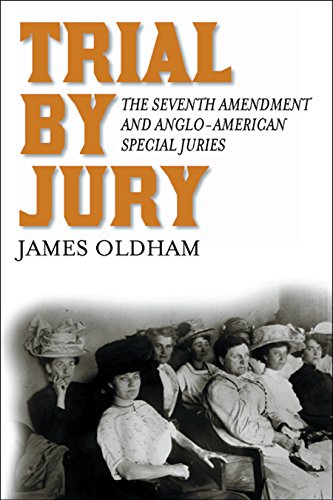

Trial by jury the Seventh Amendment and Anglo-American special juries James Oldham.
Detalles de publicación: New York New York University Press c2006.Descripción: ix, 355 p. ill. 24 cmISBN:- 0814762042 (cloth : alk. paper)
- 9780814762042 (cloth : alk. paper)
- 9780814762042
- 347.73/752 22
- KF 8972 .O415 2006
| Imagen de cubierta | Tipo de ítem | Biblioteca actual | Biblioteca de origen | Colección | Ubicación en estantería | Signatura topográfica | Materiales especificados | Info Vol | URL | Copia número | Estado | Notas | Fecha de vencimiento | Código de barras | Reserva de ítems | Prioridad de la cola de reserva de ejemplar | Reservas para cursos | |
|---|---|---|---|---|---|---|---|---|---|---|---|---|---|---|---|---|---|---|
| Libro | Biblioteca de Derecho Mons. Fremiot Torres Oliver Colección General biblioteca derecho | KF 8972 .O415 2006 (Navegar estantería(Abre debajo)) | Disponible | 70000000775762 |
Descripciones mejoradas de Syndetics:
While the right to be judged by one's peers in a court of law appears to be a hallmark of American law, protected in civil cases by the Seventh Amendment to the Constitution, the civil jury is actually an import from England. Legal historian James Oldham assembles a mix of his signature essays and new work on the history of jury trial, tracing how trial by jury was transplanted to America and preserved in the Constitution.
Trial by Jury begins with a rigorous examination of English civil jury practices in the late eighteenth century, including how judges determined one's right to trial by jury and who composed the jury. Oldham then considers the extensive historical use of a variety of "special juries," such as juries of merchants for commercial cases and juries of women for claims of pregnancy. Special juries were used for centuries in both English and American law, although they are now considered antithetical to the idea that American juries should be drawn from jury pools that reflect reasonable cross-sections of their communities. An introductory overview addresses the relevance of Anglo-American legal tradition and history in understanding America's modern jury system.
Includes bibliographical references (p. 229-312) and index.
Tabla de contenidos provista por Syndetics
- Preface(p. vii)
- Introduction(p. 1)
- 1 The Scope of the Seventh Amendment Guarantee(p. 5)
- 2 The "Complexity Exception"(p. 17)
- 3 Law versus Fact(p. 25)
- 4 Determining Damages: The Seventh Amendment, the Writ of Inquiry, and Punitive Awards(p. 45)
- 5 The Jury of Matrons(p. 80)
- 6 The Self-Informing Jury(p. 115)
- 7 The English Origins of the Special Jury(p. 127)
- 8 Special Juries in England: Nineteenth-Century Usage and Reform(p. 153)
- 9 Special Juries in the United States and Modern Jury Formation Procedures(p. 174)
- Appendix 1(p. 213)
- Appendix 2(p. 217)
- Appendix 3(p. 219)
- Appendix 4(p. 220)
- Notes(p. 229)
- Table of Statutes(p. 313)
- Table of Cases(p. 321)
- Index(p. 333)
- About the Author(p. 355)