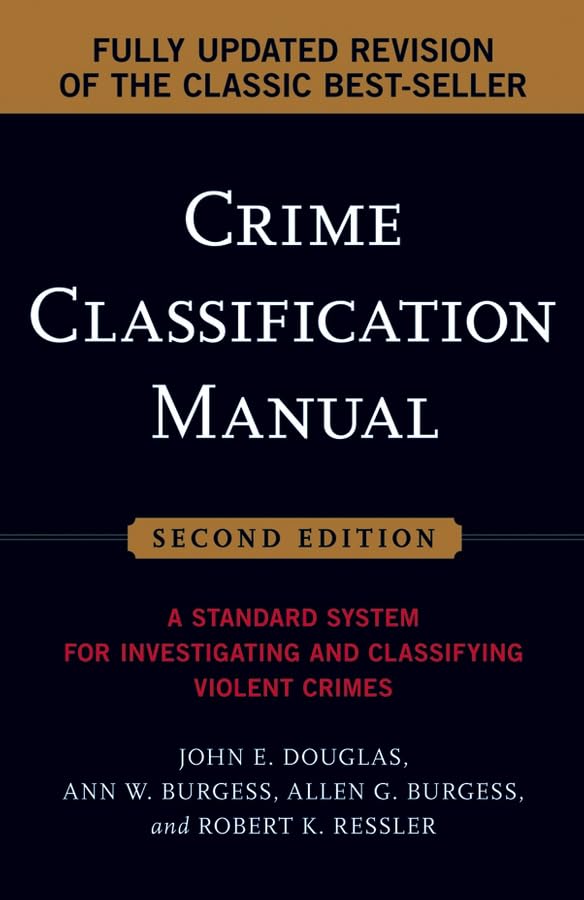

Crime classification manual a standard system for investigating and classifying violent crimes John E. Douglas ... [et al.], editors.
Detalles de publicación: San Francisco, CA Jossey-Bass c2006.Edición: 2nd edDescripción: xii, 555 p. 23 cmISBN:- 0787985015 (alk. paper)
- 9780787985011 (alk. paper)
- HV 6253 .C75 2006
| Imagen de cubierta | Tipo de ítem | Biblioteca actual | Biblioteca de origen | Colección | Ubicación en estantería | Signatura topográfica | Materiales especificados | Info Vol | URL | Copia número | Estado | Notas | Fecha de vencimiento | Código de barras | Reserva de ítems | Prioridad de la cola de reserva de ejemplar | Reservas para cursos | |
|---|---|---|---|---|---|---|---|---|---|---|---|---|---|---|---|---|---|---|
| Libro | Biblioteca de Derecho Mons. Fremiot Torres Oliver Colección General biblioteca derecho | HV 6253 .C75 2006 (Navegar estantería(Abre debajo)) | Disponible | 70000000775007 |
Descripciones mejoradas de Syndetics:
This is the second edition of the landmark book that standardized the language and terminology used throughout the criminal justice system. It classifies the critical characteristics of the perpetrators and victims of major crimes-murder, arson, sexual assault, and nonlethal acts-based on the motivation of the offender. The second edition contains new classifications on computer crimes, religion-extremist murder, and elder female sexual homicide. This edition also contains new information on stalking and child abduction, the use of biological agents as weapons, cybercrimes, Internet child sex offenders, burglary and rape, and homicidal poisoning. In addition, many of the case studies and crime statistics have been updated.
Includes bibliographical references (p. 519-528) and indexes.
Tabla de contenidos provista por Syndetics
- Preface to the Second Edition
- Introduction
- Part I Crime Analysis and Investigation
- 1 Modus Operandi and the Signature Aspects of Violent Crime
- 2 The Detection of Staging, Undoing, and Personation at the Crime Scene
- 3 Prescriptive Interviewing: Interfacing the Interview and Interrogation with Crime Classification
- 4 Classifying Crimes by Severity: From Aggravators to Depravity
- 5 VICAP: The Violent Criminal Apprehension Program Unit
- Part II Classifications
- 6 Homicide
- 7 Arson/Bombing
- 8 Rape and Sexual Assault
- 9 Nonlethal Crimes
- 10 Computer Crimes
- 11 Cybercrimes
- 12 Classifying Internet Child Sex Offenders
- Part III Methods of Killing
- 13 Mass, Spree, and Serial Homicide
- 14 Homicidal Poisoning
- 15 The Use of Biological Agents as Weapons
- Part IV Issues in Crime
- 16 Wrongful Convictions: Causes, Solutions, and Case Studies
- 17 Criminal Confessions: Overcoming the Challenges
- Bibliography
- About the Editors
- About the Contributors
- Name Index
- Subject Index
Reseñas proporcionadas por Syndetics
CHOICE Review
With the passage of time, the nature and permutations of violent crime have become increasingly varied and complicated. This fully revised and updated criminal justice classic--written by and primarily for criminal justice professionals--is designed to standardize terminology in the field to facilitate analysis and communication, educate both practitioners and the general public on the types of crimes being committed and the individuals who commit them, and serve as a basis for continued investigative research. Standard categories (murder, arson, rape, and sexual assault) and basic chapters (covering modus operandi and signature aspects of violent crime, staging/personation at the crime scene, and prescriptive interviewing) are repeated from the first (1992) edition, but are updated with new case examples and observations. New categories/entries include nonlethal crimes, computer crime, cybercrimes, Internet child sex offenders, neonatocides, and elder female sexual homicide. New chapters include methods of killing (mass, spree, and serial homicide; homicidal poisoning; and the use of biological agents as weapons) and problematic issues in crime (wrongful convictions and criminal confessions). This manual will be useful in academic or special libraries that support law enforcement personnel, forensic scientists, mental health professionals and social workers, criminal justice faculty and students, lawyers and judges, public policy makers, and anyone else who deals with violent crime offenders or their victims. Extensive bibliography and name/subject indexes. ^BSumming Up: Recommended. Lower-level undergraduates through professionals. J. J. Harrison Michigan State UniversityNotas de autor provistas por Syndetics
Criminal profiler John E. Douglas worked for the FBI's Investigative Support Unit for 25 years. He is an Air Force veteran and doctor of education and has written or coauthored more than 100 criminology texts and research papers. In his study of the criminal mind, Douglas interviewed convicted murders, rapists, kidnappers and assassins that included Charles Manson, Sirhan Sirhan, Richard Speck, John Wayne Gacy, David Berkowitz, James Earl Ray and Ted Bundy, to name a few. Through this research, he learned how criminals think, and to see the world, the victims and the crime scenes through their eyes as well as perfected the art of psychological profiling to catch serial killers. Jack Crawford, a major character in the Thomas Harris novels Red Dragon and The Silence of the Lambs, was directly based on Douglas.."Mind Hunter: Inside the FBI's Elite Serial Crime Unit," which is co-written with Mark Olshaker, is a psychological study that tells the real life story of the Investigative Support Unit of the FBI and the country's most notorious serial killers. It's a memoir of Douglas' time with the FBI and shows how this special force assisted state and local police in solving some of the most celebrated serial murder and rape cases. Olshaker and Douglas' first fictional work together was "Broken Wings." It tells how former profiler Jake Donovan and a special team of former agents investigate the apparent suicide of the director of the FBI. Also written with Olshaker were the titles "The Anatomy of Motive," "Obsession," and "Journey into Darkness."
"Sexual Homicide: Patterns and Motives" was written with Robert K. Kessler and Ann W. Burgess, both former FBI agents. These three authors, along with Allen G. Burgess, also wrote "Crime Classification Manual," which classifies the three major felonies of murder, arson and sexual assault and standardizes the language and terminology used throughout the criminal justice system.
(Bowker Author Biography)