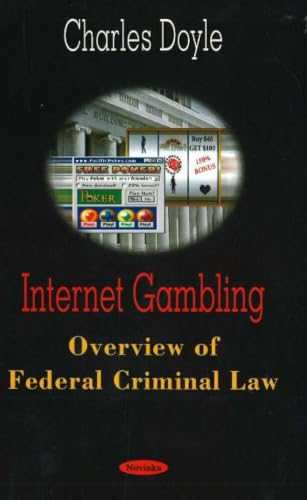

Internet gambling overvierw of federal criminal law Charles Doyle.
Detalles de publicación: New York Novinka Books c2006.Descripción: viii, 78 p. 22 cmISBN:- 159454784X (pbk.)
- KF 9440 .Z9 D69 2006
| Imagen de cubierta | Tipo de ítem | Biblioteca actual | Biblioteca de origen | Colección | Ubicación en estantería | Signatura topográfica | Materiales especificados | Info Vol | URL | Copia número | Estado | Notas | Fecha de vencimiento | Código de barras | Reserva de ítems | Prioridad de la cola de reserva de ejemplar | Reservas para cursos | |
|---|---|---|---|---|---|---|---|---|---|---|---|---|---|---|---|---|---|---|
| Libro | Biblioteca de Derecho Mons. Fremiot Torres Oliver Colección General biblioteca derecho | KF 9440 .Z9 D69 2006 (Navegar estantería(Abre debajo)) | Disponible | 70000000775127 |
Descripciones mejoradas de Syndetics:
This is a brief summary of the federal criminal status implicated by conducting illegal gambling using the Internet. It also discusses some of the constitutional issues associated with prosecuting illegal Internet gambling. Gambling is primarily a matter of state law, reinforced by federal law in instances where the presence of an interstate or foreign element might otherwise frustrate the enforcement policies of state law. State officials and others have expressed concern that the Internet may be used to bring illegal into their jurisdictions. Illicit Internet gambling implicates at least six federal criminal statutes. It is a federal crime to (1) conduct an illegal gambling business, 18 U.S.C. 1955; (2) use the telephone or telecommunications to conduct an illegal gambling business, 18 U.S.C. 1084; (3) use the facilities of interstate commerce to conduct an illegal gambling business, 18 U.S.C. 1952; (4) conduct the activities of an illegal gambling business involving either the collection of an unlawful debt or a pattern of gambling offences, 18 U.S.C. 1962; (5) launder the proceeds from an illegal gambling business or to plow them back into the business, 18 U.S.C. 1956; or (6) spend over $10,000 of the proceeds from an illegal gambling operation at any one time and place, 18 U.S.C. 1957. There have been suggestions that enforcement of these provisions against illegal Internet gambling raises constitutional issues under the Commerce Clause, the First Amendment's guarantee of free speech, and the Due Process Clause. The commercial nature of a gambling business and the reliance of the Internet on telephone communications seems to satisfy doubts under the Commerce Clause. The fact that illegal activities enjoy no First Amendment protection appears to quell free speech objections. The due process arguments raised in contemplation of federal prosecution of offshore Internet gambling operations suffer when financial transactions with individuals in the United States are involved. A bibliography, citations to state and federal gambling laws, and the text of the statutes cited above are appended.
Includes bibliographical references( p. [47]-52) and index.
Tabla de contenidos provista por Syndetics
- Introduction
- Federal Criminal Law
- The Wire Act
- Illegal Gambling Businesses
- Travel Act
- Racketeer Influenced and Corrupt Organizations (RICO)
- Money Laundering
- Laundering the Proceeds
- Promotion
- Concealment
- Tax evasion, smurfing and international laundering
- Spending the Proceeds
- Constitutional Considerations
- Commerce Clause
- First Amendment
- Due Process
- Personal jurisdiction
- Subject matter jurisdiction