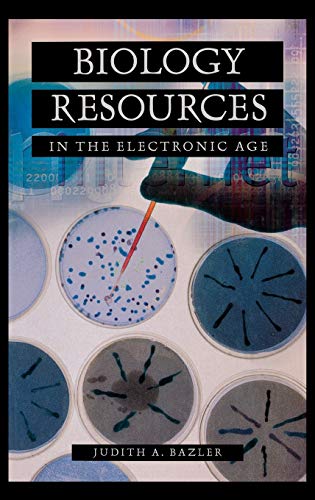
Imagen de portada de Amazon
Imagen de Amazon.com
Imagen de cubierta Syndetics
Portada de Syndetics
Imagen de OpenLibrary

Biology resources in the electronic age / Judith A. Bazler.

Por: Series Science resources in the electronic ageDetalles de publicación: Westport, Conn. Greenwood Press 2003.Descripción: xiii, 286 p. 25 cmISBN:
  • 1573563803 (hc : alk. paper)
Tema(s): Clasificación CDD:
  • 025.06/57 21
Clasificación LoC:
  • QH303.5 .B39 2003
Valoración
    Valoración media: 0.0 (0 votos)
Existencias
Imagen de cubierta Tipo de ítem Biblioteca actual Biblioteca de origen Colección Ubicación en estantería Signatura topográfica Materiales especificados Info Vol URL Copia número Estado Notas Fecha de vencimiento Código de barras Reserva de ítems Prioridad de la cola de reserva de ejemplar Reservas para cursos
Libro mb Biblioteca de Mayagüez Sala de Referencia mb QH303.5 .B39 2003 (Navegar estantería(Abre debajo)) c. 1 Disponible 50000003170676
Total de reservas: 0

Descripciones mejoradas de Syndetics:

How can students, teachers, parents, and librarians be certain that the information a Web site provides is accurate and age appropriate? In this unique book, experienced science educator Judith A. Bazler reviews hundreds of the most reliable biology-related Web sites. Each review discusses the most appropriate grade level of the site, analyzes its accuracy and usefulness, and provides helpful hints for getting the most out of the resource.

The Web is the first place many students look for information. Yet the Web is notoriously unreliable. How can students, teachers, parents, and librarians be certain that the information a Web site provides is accurate and age appropriate? In this unique book, experienced science educator Judith A. Bazler reviews hundreds of the most reliable biology-related Web sites. Each review discusses the most appropriate grade level of the site, analyzes its accuracy and usefulness, and provides helpful hints for getting the most out of the resource.

Sites are organized by topic, from Adaptation to Viruses, making it easy to locate the most useful sites. A handy summary presents the best places on the Web to find information on science museums, science centers, careers in biology, and biology supplies.

Includes index.

gccdic2006

Reseñas proporcionadas por Syndetics

CHOICE Review

Bazler attempts to gather the best Web resources in biology and its subdisciplines. The book consists of an opening chapter on the use of the Internet as a research tool; a second chapter that is a detailed compilation of Web sites by topic, giving URL, title, appropriate grade level, the best search engine to locate the site, keywords to search, and an evaluative abstract; and chapters on biology suppliers, museums, science centers and summer programs, and Web sites about careers. The book ends with a glossary and a subject index. All entries were reviewed by Bazler's graduate students and presumably by the author herself (she holds a faculty appointment specializing in science education, Monmouth Univ., NJ). Books like this go out of date the day they are published; URLs change, Web sites come and go. While it offers an impressive list of biology Web sites, it does not replace the Web itself in keeping up with Internet sites. ^BSumming Up: Not recommended. R. Dyson Lamar University

Booklist Review

Here is a useful resource intended to provide a gateway to authoritative Web sites suitable for use in teaching and learning. The first chapter, "The Basics," contains short descriptions of a variety of electronic resources and formats, terms, and some information on searching and on copyright. The bulk of the volume is a bibliography of Web resources grouped by topic. Each record includes title, URL, grade level (ranging from elementary to postgraduate), a suggested search engine for hunting similar information, suggested keyword(s), and a detailed annotation. Among the 37 topic categories are "Animal Behavior," "Diffusion," "Heredity," and "Viruses." This is a very useful reference for building discipline-, course-, or assignment-specific Web pages. Had the author left out the rather unnecessary suggested search-engine lines from entries, there would have been room for a number of additional sites. The chapter about biology suppliers' Web addresses and catalogs is a handy directory, as is the brief chapter with a collection of career-related links to associations, universities, and similar resources. The detailed index is the best entry point for finding sites for topics that may be in several categories. The book will be useful for the public, but librarians can also use it to build excellent reference Web pages. It should be especially helpful in libraries serving students from the junior-high-school through lower-division undergraduate levels. -- RBB Copyright 2004 Booklist

Notas de autor provistas por Syndetics

JUDITH A. BAZLER is Associate Professor of Science Education in the Department of Curriculum and Instruction at Monmouth University.
Compartir
logopucpr-y-vive

Contáctanos

¡Queremos saber de ti!

Tel. 787.841.2000 Ext. 1801

bibliotecavaldes@pucpr.edu

⁣Búscanos en las redes

© 2026 Desarrollado por Ignite Online • All Rights Reserved • Powered by Koha.