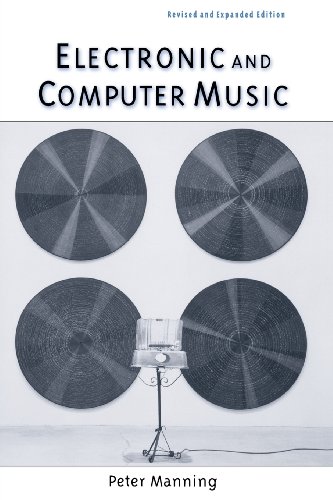

Electronic and computer music Peter Manning.
Detalles de publicación: Oxford New York Oxford University Press 2004.Edición: Rev. and expanded edDescripción: x, 474 p. ill. 24 cmISBN:- 0195170857 (pbk.)
- 786.709 M2832e 21
- ML1380 .M36 2004
| Imagen de cubierta | Tipo de ítem | Biblioteca actual | Biblioteca de origen | Colección | Ubicación en estantería | Signatura topográfica | Materiales especificados | Info Vol | URL | Copia número | Estado | Notas | Fecha de vencimiento | Código de barras | Reserva de ítems | Prioridad de la cola de reserva de ejemplar | Reservas para cursos | |
|---|---|---|---|---|---|---|---|---|---|---|---|---|---|---|---|---|---|---|
| Libro | Biblioteca Encarnación Valdés Sala de Música | 786.709 M2832e (Navegar estantería(Abre debajo)) | Disponible | 80000002302183 |
Descripciones mejoradas de Syndetics:
In this revised and expanded third edition of the classic text on the history and evolution of electronic and computer music, Peter Manning provides the definitive account of the medium from its birth to the present day. After explaining the antecedents of electronic music from the turn of the century to the Second World War, Manning discusses the emergence of early "classical" studios of the 1950s. He goes on to chronicle the upsurge of creative activity during the 1960s and 70s in the analog domain, as well as with live electronic music and the early use of electronics in rock and pop music. This edition contains new information about software innovations, digital media and the essential features of digital and audio control, the MIDI synthesizer and its many derivatives, and the evolution of computer workstations and multimedia personal computers. Manning offers a critical perspective of the medium both in terms of its musical output and the philosophical and technical features that have shaped its growth. Emphasizing the functional characteristics of emerging technologies and their influence on the creative development of the medium, Manning covers key developments in both commercial and the non-commercial sectors to provide readers with the most comprehensive resource available on this ever-evolving subject.
Includes bibliographical references (p. [423]-425), discography (p. [427]-450), and index.
Tabla de contenidos provista por Syndetics
- 1. The Background to 1945(p. 3)
- I. Developments from 1945 to 1960
- 2. Paris and Musique Concrete(p. 19)
- 3. Cologne and Elektronische Musik(p. 39)
- 4. Milan and Elsewhere in Europe(p. 68)
- 5. America(p. 74)
- II. New Horizons in Electronic Design
- 6. The Voltage-Controlled Synthesizer(p. 101)
- III. The Electronic Repertory from 1960
- 7. Works for Tape(p. 135)
- 8. Live Electronic Music(p. 157)
- 9. Rock and Pop Electronic Music(p. 168)
- IV. The Digital Revolution to 1980
- 10. The Foundations of Computer Music(p. 181)
- 11. From Computer Technology to Musical Creativity(p. 197)
- 12. The Microprocessor Revolution(p. 217)
- V. Digital Audio
- 13. The Characteristics of Digital Audio(p. 245)
- VI. MIDI
- 14. The Development of the MIDI Communications Protocol(p. 263)
- 15. From Analog to Digital: The Evolution of MIDI Hardware(p. 279)
- 16. From Microcomputer to Music Computer: The MIDI Dimension(p. 312)
- 17. New Horizons for MIDI-based Technologies(p. 329)
- VII. Desktop Synthesis and Signal Processing
- 18. Personal Computers and Sound Processing(p. 347)
- 19. Music Workstations and Related Computing Architectures(p. 361)
- VIII. The Expanding Perspective
- 20. Performance Controllers(p. 377)
- 21. New Horizons in Synthesis and Signal Processing Software(p. 386)
- 22. Conclusion(p. 401)
- Notes(p. 409)
- Bibliography(p. 423)
- Discography(p. 427)
- Index(p. 451)